Thursday, August 7, 2008

Was Jesus executed on a cross or a stake? #3C: Historical (5th-4th century BC)

[See also Introduction #1; Linguistic #2A, #2B, #2C; Historical #3A, #3B, #3D]

Continuing from #3B: Historical, in the series, Was Jesus executed on a cross or a stake? (updated 4th century BC). See previous #1, #2A, Justus Lipsius, #2B, #2C, #3A & #3B.

[Above: Jesus `impaled' on a single stake with both arms together over his head affixed by one nail: Watchtower Bible & Tract Society, "What Does the Bible Really Teach?," 2005, p.52. This is how the Watchtower Bible & Tract Society has consistently depicted Jesus' execution since at least 1950, i.e. over half a century.]

As previously explained, this Part #3 Historical series is an extended comment on Appendix 3C of "The Kingdom Interlinear Translation," 1985, p.1149:

In the writings of Livy, a Roman historian of the first century B.C.E., crux means a mere stake."Cross" is only a later meaning of crux. ... Evidence is, therefore, completely lacking that Jesus Christ was crucified on two pieces of timber placed at right angles.

References were originally from Leolaia's "The facts on crucifixion, stauros, and the `torture stake'" but I checked each one out in libraries and the quotes here were scanned by me from photocopies of library books or from books that I own. Each referenced quote is hyperlinked to a fuller version at the end of this post.

5th century BC (cont'd):
Livy. The Roman historian Titus Livius (Livy) (59 BC-AD 17), in his history of Rome described an example in 491 BC of the Roman yoke-bearing punishment:

"a certain householder had driven his slave, bearing a yoke ... through the midst of the circus, scourging the culprit as he went" (Livy, History, 2.36).

Plutarch. The Greek historian Plutarch (c. AD 46-120), comments on this same incident:

"A certain man had handed over one of his slaves to other slaves, with orders to scourge him through the forum, and then put him to death ... it was a severe punishment for a slave who had committed a fault, if he was obliged to take the piece of wood [xulon] ... and carry it around through the neighbourhood." (Plutarch, Coriolanus, 24.3-5).

Clearly:

"This patibulum-bearing punishment, during which a slave is whipped and lead [sic] through the city ... was the direct ancestor of the portion of the crucifixion ritual in which the victim carries his own cross ... It is this piece of wood that centuries later became the crossbeam in the Roman cross." (Leolaia, 2005, pt I. Cf. Torrance, 1982, p.253).

Esther. The Bible in Esther 2:23; 5:14; 6:4; 7:9; 7:10; 8:7; 9:13; 9:14; 9:25 refers to "hanging" [Heb. talah "suspend," "hang"] from a Persian "gallows" [Heb. 'ets "tree," "wood"] in the reign of Xerxes I or Ahasuerus I, who reigned 485-465 BC. There is no conclusive evidence that this was "hanging" on a "gallows" was live crucifixion on a cross. Here "gallows (Heb. `es) is literally `tree'; it could- have been a pole or indeed anything made of wood" (Baldwin, 1984, p.88).

Josephus. The Jewish historian Josephus (c. AD 37-100), refers to the same incident where Haman "a tree [xulon] sixty cubits high to be cut down, and in the morning ask the king for leave to crucify [anastaurosai] Mordecai" on "gallows [xulon]" or "cross [stauron]" made from it, but Haman himself is "hanged [ekeinou] on that very same cross [stauron] till he was dead" (Josephus, Jewish Antiquities, 11.246ff). But despite Josephus' English translator rendering Gk. stauron" as cross and anastaurosai as "crucify," there is nothing in the account that necessarily indicates live crucifixion by being affixed to a cross and Josephus' "hanged ... till he was dead" seems consistent with a long-drawn-out death hung high on a wooden pole or frame, which may well have been a form of crucifixion.

Thucydides. Greek historian Thucydides (c.460-395 BC) , in his "History of the Peloponnesian War," describes the 454 BC execution by the Persians of an Egyptian rebel leader Inaros as him being "impaled [anestaurothe]":

"Inaros, however, the king of the Libyans, who had been the originator of the whole movement in Egypt, was taken by treachery and impaled [anestaurothe]." (Thucydides, Peloponnesian War, 1.110).

The Encyclopædia Britannica interprets this as crucifixion:

"... in Egypt. ... a revolt broke out .... It was led by a dynast, Inaros, who acquired control over the delta and was supported by Athenian forces against the Persians. Inaros was crucified by the Persians in 454 BC, when they regained control of most of the delta." ("Egypt, ancient," Encyclopædia Britannica, 2008).

The Greek word, anestaurothe could mean impalement or crucifixion on a single stake, or crucifixion on a two-beamed cross, but there is not enough information in the account to decide.

Aeschylus. The Greek playwright Aeschylus (c.525-456 BC) in his Prometheus Bound, probably written in his last year, 456 BC, depicts the Greek god Prometheus being fastened to mountain crags:

"... clamp this miscreant upon the high-beetling crags in shackles of binding [desmon] adamant that cannot be broken." (Aeschylus, Prometheus Bound, 4-5).

"...The bracelets are ready ... Cast them about his wrists ... clamp him tight, leave nothing loose ... This arm, at least, is fixed ... Now rivet this one too ..." (Aeschylus, 55-57).

Amazingly, the Watchtower cites this is as evidence of being fastened to "an upright stake":

"In the classical Greek the word stau-ros' meant merely an upright stake, or pale ... It was to such a stake, or pale, that the person to be punished was fastened, just as the popular Greek hero Prometheus was represented as tied to rocks. Whereas the Greek word that the dramatist Aeschylus used to describe this simply means to tie or to fasten, the Greek author Lucian (Prometheus, I) used a·na·stau·ro'o as a synonym for that word." (WB&TS, 1984, New World Translation, p.1577).

But quite clearly Prometheus is depicted by Aeschylus as having each "arm" fastened at each "wrist" by "bracelets" (plural), i.e. on either side of him, not having both arms fastened together by one bracelet over his head, which would be the analogy of the Watchtower's `impalement' on a single stake with both the victim's hands affixed by a single nail above his head (see above). This will become even clearer when we consider Lucian's (c.AD125-180) Prometheus.

4th century BC:
Plutarch records the Persian queen Parysatis' c.395 BC execution of a eunuch on four stakes [stauron]:

"Parysatis ... put the eunuch in the hands of the executioners; who were ordered to flay him alive, to set up his body slantwise on three stakes [stauron], and to nail up his skin to a fourth." (Plutarch, Artaxerxes, 17.5).

This is a form of crucifixion, being nailed to at least one and probably four stakes. It also shows that even four centuries before the time of Jesus, the Watchtower's claim was false that:

"In the classical Greek the word stau·ros' meant merely ... a simple stake ... without a crossbeam of any kind at any angle. There is no proof to the contrary" (WB&TS, 1985, Kingdom Interlinear Translation, p.1149).

since at least some Persian executions recorded in "classical Greek" were on structures comprised of multiple stakes, with the victim's body hung "slantwise," which suggests at least one "crossbeam" at an "angle."

Diodorus Siculus. The Sicilian Greek historian Diodorus Siculus (90-21 BC), wrote of Onomarchus, a Phocian (Greek) general who was crucified [estaurothe] in 352BC by Philip II of Macedon (382-336 BC), the father of Alexander the Great (356-323 BC):

"In fact the man who first schemed for the seizure of the shrine, Philomelus, in a crisis of the war hurled himself over a cliff, while his brother Onomarchus, after taking over the command of his people, now become desperate, was cut to pieces in a battle in Thessaly, along with the Phocians and mercenaries of his command, and crucified [estaurothe]. " (Diodorus Siculus, "Library of History," Book 16.61.2, Vol. VII, p.409).

And the meaning of estaurothen is "nail to the cross, crucify":

"staroo ... estaurothen nail to the cross, crucify ... lit. tina someone w. ref. to Jesus' crucifixion Mt 20:19; 23:34; 26:2; 27:22f, 26, 31, 35, 38; 28:5 ..." (Arndt, W.F. & Gingrich, F.W., 1957, "A Greek-English Lexicon of the New Testament," pp.772-773. Emphasis original).

This indicates that the Greeks adopted crucifixion from the Persians who they fought in the Greco-Persian Wars (499-479 BC).

Quintus Curtius. Roman historian Quintus Curtius Rufus (41-54 AD), wrote of Alexander the Great's seige of Tyre in 332 BC:

"... [Alexander's] wrath furnished the victors with an awful spectacle; 2000 men ... hung nailed to crosses [crucibus affixi] along a great stretch of the shore." (Curtius Rufus, History of Alexander, 4.4.17).

Quintus Curtius wrote in Latin and while crucibus could mean stakes, there was a Latin word for a single stake, namely, palus:

"palus ... A length of unsplit wood, post, stake. ... A wooden peg or pin. ... a wooden pile. ... a wooden pole ... the stake to which condemned persons were tied for execution." (Glare, Oxford Latin Dictionary, 1982, p.1287).

"... palus ... a stake, prop, stay, pale. ... a stake set in the ground ... (Lewis & Short, A Latin Dictionary, 1890, p.1295).

which he would be expected to use if that is what he meant. For example, Livy writing in Latin of events in the 3rd century BC, used palum when he meant a single stake:

"... nor shall I be ... bound to a stake [ad palum deligatus], with my back mangled by rods...." (Livy, History of Rome, 26.13.15).

"... Bound to a stake [Deligati ad palum] they were scourged and beheaded ..." (Livy, 28.29.11).

Plutarch records the crucifixion [anestaurosen] (or impalement-see above) by Alexander of his physician in 324 BC following his failure to prevent the death of his friend and general Hephaestion (c.356 BC-324 BC):

"But during this time it chanced that Hephaestion ... fell sick, and in a little while died. Alexander's grief at this loss knew no bounds. He ... crucified [anestaurosen] the wretched physician ..." (Plutarch, "Alexander," 72.2-3).

Continued in Part #3D Historical (3rd century BC).

Stephen E. Jones.
My other blogs: CreationEvolutionDesign & TheShroudofTurin


"POWER: To earth's remotest confines we are come, to the Scythian tract, an untrodden solitude. And now, Hephaestus, thine is the charge to observe the mandates laid upon thee by the Father-to clamp this miscreant upon the high-beetling crags in shackles of binding adamant that cannot be broken. For thine own pride, even flashing fire, source of all arts, he hath purloined and bestowed upon mortal creatures. Such is his offence; wherefore he is bound to make requital to the gods, that so he may be lessoned to brook the sovereignty of Zeus and forbear his championship of man." (Aeschylus, "Prometheus Bound," 1-11, in "Aeschylus," Smyth, H.W., transl., Loeb Classical Library, Heinemann: London, 1922, Reprinted, 1956, p.215. Emphasis original).

"HEPHAESTUS: Well, there then! The bracelets are ready, as thou mayest see. POWER: Cast them about his wrists and with might and main smite with thy hammer; rivet him to the rocks. HEPHAESTUS: There! The work is getting on and is not done amiss. POWER: Strike harder, clamp him tight, leave nothing loose; for he is wondrous clever at finding a way even out of desperate straits. HEPHAESTUS: This arm, at least, is fixed beyond all loosening. POWER: Now rivet this one too and securely, that he may; learn, for all his cleverness, that he is but a dullard compared to Zeus." (Aeschylus, "Prometheus Bound," 55-57, in "Aeschylus," Smyth, H.W., transl., Loeb Classical Library, Heinemann: London, 1922, Reprinted, 1956, p.221. Emphasis original).

"staroo (in the sense `fence w. stakes' Thu. +) fut. stauroso; 1 aor. estaurosa. Pass.: pf. estaurmai: 1 aor. estaurothen nail to the cross, crucify (Polyb. 1, 86, 4; Diod. S. 16, 61. 2; Artem. 2, 53; 4, 49; Esth 7:9); 8:12 r: Jos. Ant. 2. 77; 17, 295). 1. lit. tina someone w. ref. to Jesus' crucifixion Mt 20:19; 23:34; 26:2; 27:22f, 26, 31, 35, 38; 28:5; Mk 15:13ff, 20, 24f, 27; 16:6; Lk 23:21, 23, 33; 24:7, 20; J 19:6a, b, c, 10, 15f, 18, 20, 23, 41; Ac 2:36; 4:10; 13:29 D; 1 Cor 2:8; 2 Cor 13:4; Rv 11:8; B 7:3, 9; 12:1; I Eph 16:2; GP 4:10; 12:52. Christos estauromenos I Cor 1:23; cf. 2:2; Gal 3:1. Also simply o estauromenos M Pol 17:2. o staurotheis GP 13:56. alethos estaurothe he was truly crucified (in contrast to the Docetic view that the Passion was unreal) I Tr 9:1. me Paulos estaurothe uper umon 1 Cor 1:13 - On the crucifixion of Jesus cf. Feigel, Weidel, and Finegan s.v. 'Ioudas 6: also) E.Bickermann. Utilitas Crucis: Rev. de l'Hist. des Rel. 112. '35. 169-241. 2. fig. oi tou Christou 'l. ten sarka estaurosan those who belong to Christ Jesus have crucified the flesh w. its sinful desires Gal 5:24. Pass.: of the cross of Christ, di' ou emoi kosmos estaurotai kagi kosmo through which the world has been crucified to me, and I (have been crucified) to it, the believer who is inseparably united to his Lord has died on the cross to the kind of life that belongs to this world Gal 6:14. o emos eros estaurotai my desire (for worldly things) has been crucified I Ro 7:2. M-M." (Arndt, W.F. & Gingrich, F.W., 1957, "A Greek-English Lexicon of the New Testament and Other Early Christian literature," University of Chicago Press: Chicago IL, Fourth edition, 1952, Revised, pp.772-773. Emphasis original).

"But first it is only right, so we think, to record the punishment which was visited by the gods upon those who had committed the outrage on the oracle. For, speaking generally, it was not merely the perpetrators of the sacrilege but all persons who had the slightest connection with the sacrilege that were hounded by the inexorable retribution sent of Heaven. In fact the man who first schemed for the seizure of the shrine, Philomelus, in a crisis of the war hurled himself over a cliff, while his brother Onomarchus, after taking over the command of his people, now become desperate, was cut to pieces in a battle in Thessaly, along with the Phocians and mercenaries of his command, and crucified [estaurothe]. " (Diodorus Siculus, "Library of History," Book 16.61.2, Sherman, C.L., transl., 1952, Heineman: London, Vol. VII, Reprinted, 1967, p.409).

"[Est 5:14] The initiative in suggesting a course of action comes from his wife, supported by the `friends'. A gallows (Heb. `es) is literally `tree'; it could- have been a pole or indeed anything made of wood. The word haunts the book (cf. 2:23; 6:4; 7:9-10; 8:7; 9:13, 25). The height of the gallows, 75 feet, strikes western commentators as exaggerated. It certainly is unnecessarily high, but then everything constructed by Persian rulers was on a grand scale, like the image of Babylonian Nebuchadrezzar (Dn. 3:1), which was 10 cubits (15 feet) higher." (Baldwin, J.G., 1984, "Esther: An Introduction and Commentary," Tyndale Old Testament Commentaries," Inter-Varsity Press, Leicester UK, p.88).

"After that the king's [Alexander's] wrath furnished the victors with an awful spectacle; 2000 men, for the slaying of whom frenzy had spent itself, hung nailed to crosses [crucibus affixi] along a great stretch of the shore. ... Tyre was taken in the seventh month after the beginning of the siege, a city worthy of note in the memory of later times both for its ancient origin and its frequent changes of fortune." (Curtius Rufus, Quintus, "History of Alexander," 4.4.17, Rolfe, J.C., transl., Loeb classical library, Heinemann: London, 1946, Reprinted, 1963, p.205).

"The Persian defeat by the Athenians at Marathon in 490 BC had significant repercussions in Egypt. On Darius I's death in 486 BC, a revolt broke out in the delta, perhaps instigated by Libyans of its western region. The result was that the Persian king Xerxes reduced Egypt to the status of a conquered province. Egyptians dubbed him the "criminal Xerxes." He never visited Egypt and appears not to have utilized Egyptians in high positions in the administration. Xerxes' murder in 465 BC was the signal for another revolt in the western delta. It was led by a dynast, Inaros, who acquired control over the delta and was supported by Athenian forces against the Persians. Inaros was crucified by the Persians in 454 BC, when they regained control of most of the delta. In the later 5th century BC, under the rule of Artaxerxes I (ruled 465-425 BC) and Darius II Ochus (ruled 423-404 BC), conditions in Egypt were very unsettled, and scarcely any monuments of the period have been identified. ("Egypt, ancient," Encyclopædia Britannica Online Library Edition. 6 Aug. 2008).

"palus 1, m. Also ~um ~i, n. [ < pak-slos (PANGO) ; cf. Gk. passalos] 1 A length of unsplit wood, post, stake. est quasi ~o pectus tundat PL.Rud.1290; ~os, siccos dolato CATO Agr.37.3; alterum (pedawentum) ~us (est) e pertica VAR.R.1.8.4; teneram ~is adiungere uitem TIB. 1.7.;3; hic annus nondum uehementem ~um aut ridicam desiderat COL.4.12.1; saepes. pro ~is elephantorum dentibus fieri PLIN.Nat.8.31; - (collect. sg.) caesae harundinis uel ~i compendium .. ad fructuarium pertinet PAUL.dig. 7 1.59.2; CIL 10.114; - (used for marching boundaries) in qnibusdam .. regionibus ~os pro terminis obseruant SIC. FL.agrim.p.102; actuarios ~os suo quemque numem inscriptos .. defigemus HYG.GR.agrim.p.155; - (applied to the phallus of a Priapus) obsceno .. ruber porrectus ab inguine ~us HOR.S.1.8.5; - neut.) quid? in non uides in uineis, quod tria ~a habeant, tripales dici? VAR.Men.179. 2 (of var. spec. objects) : a A wooden peg or pin. b a wooden pile. c a wooden pole serving as a dummy in fighting-practice. d the stake to which condemned persons were tied for execution. e the wooden sword of the seculores; ~us primus, the leader of the sectctores. f a dibble ..." (Glare, P.G.W., ed., 1982, "Oxford Latin Dictionary," [1968], Clarendon Press: Oxford, p.1287. Emphasis original).

"[Haman] also said that he was not pleased at seeing the Jew Mordecai in the court. Then Zarasa, his wife, told him to order a tree [xulon] sixty cubits high to be cut down, and in the morning ask the king for leave to crucify [anastaurosai] Mordecai; and he praised her plan and ordered his servants to make the gallows [xulon] ready and set it up in the court for the punishment of Mordecai. And so it was prepared. ... But Sabuchadas, one of the eunuchs, seeing the cross [stauron] that had been set up at Haman's house and prepared for Mordecai, inquired of one of the servants for whom they had made this ready, and, learning that it was for the queen's uncle, for the time being held his peace. ... At this Haman was overcome and unable to utter any further sound, and then came the eunuch Sabuchadas and accused Haman, saying that he had found a cross [stauron] at his house prepared for Mordecai. For this was what the servant had told him in answer to his inquiry, when he had come to Haman to summon him to the banquet. And the cross [stauron], he said, was sixty cubits in height. When the king heard this, he decided to inflict on Haman no other punishment than that which had been devised against Mordecai, and ordered him at once to be hanged [ekeinou] on that very same cross [stauron] till he was dead." (Josephus, "Jewish Antiquities," 11.246, 261, 266-268, in "Works," Marcus, R., transl., Heinemann: London, Vol VI, 1937, Reprinted, 1958, p. 443).

"This patibulum-bearing punishment, during which a slave is whipped and lead through the city, was practiced in pre-Republican times and was the direct ancestor of the portion of the crucifixion ritual in which the victim carries his own cross. It did not always precede execution; it was often used for humiliation. Other descriptions of this early form of punishment can be found in Livy and Plutarch, who both describe its use in pre-Republican times and reveal that the wood carried by the victim was also called a furca `fork'. .... It is this piece of wood that centuries later became the crossbeam in the Roman cross. The crux compacta came into existence when Phoenician crucifixion was fused with the pre-existing Roman patibulum-bearing punishment. Not only was the errant slave punished by being paraded throughout the city yoked to a patibulum, but he now died suspended from it. But when did this happen? We need to examine the earliest known descriptions of the kind of crucifixion adopted by the Romans and the specific terms they used to refer to it." (Leolaia, 2005, "The facts on crucifixion, stauros, and the `torture stake'," Jehovah's Witnesses Discussion Forum, 11 June, Part I.).

"The Society insists that the word stauros did not refer to crosses in the first century AD and merely referred to single-beamed stakes. Here are some typical statements to this effect in the literature: `stauros in both classical and koine Greek carries no thought of a `cross' made from two timbers. It means only an upright stake, pale, pile, or pole' (Insight on the Scriptures, Vol. 1, 1988, p. 1191). `The inspired writers of the Christian Greek scriptures wrote in the common (koine) Greek and used the word stauros to mean the same as in the classical Greek, namely, a stake or a pole, a single one without a crossbeam of any kind or at any angle. There is no proof to the contrary' (New World Translation , 1950 edition, p. 769). `In classical Greek, this word [stauros] meant merely an upright stake, or pale. Later it also came to be used for an execution stake having a crosspiece' (Reasoning From the Scriptures, 1987, p. 89). ... The quotes from the Society posted above only vaguely indicate that `later' the meaning of stauros changed. Thus we find ambiguous statements like: `Later it also came to be used for an execution stake having a crosspiece' (Reasoning From the Scriptures, 1987, p. 89). `...the original meanings of these words [stauros and crux] were later expanded to include the cross' (Watchtower, 15 February 1960, p. 127). But when was this `later'? Many Watchtower publications cite W. E. Vine's lexicon as stating that this occurred `by the middle of the 3rd cent. A.D.' (cf. Truth that Leads to Eternal Life, 1968, pp. 142-143; Awake! , 8 May 1969, p. 4; Reasoning, pp. 90-91; Watchtower, 15 August 1987, p. 22; Insight, Vol. 1, pp. 1191; Watchtower, 1 May 1989, pp. 23-24; see Vine's An Expository Dictionary of New Testament Words, 1948, Vol. 1, p. 256). Additionally, the 22 March 1987 Awake! (p. 11) published an article by Nicholas Kip which implied that the meaning-shift took place in the days of Emperor Constantine (A.D. 312-337). The impression the Society gives is that stauros referred only to a crux simplex until between AD 250 and 315." (Leolaia, 2005, Part II).

"1. palus, i, m. (neutr. collat. form palum, i Varr. ap. Non. 219. 18) (for paglus (cf. dim. paxillus); root pag-; Sanscr. pacas, snare; Gr. pegnumi, fasten; Lat. pango; cf.: pignus, pax], a stake, prop, stay, pale. I. Lit. (very freq. and class.; syn.: sudes, stipes): ut figam palum in parietem, Plaut. Mil. 4, 4, 4; id. Men. 2, 3, 53: damnnti ad supplioiam traditi, ad palum alligat:, Cic. Verr. 2, 5, .5, § 11: palis adjungere vitem, Tib. 1, 8 (7), 33; Ov. F. 1, 665: palos et ridicas dolare. Col. 11. 2, 11; Varr. 1. l.-The Roman soldier learned to fight by attacking a stake set in the ground, Veg. Mil. 1, 11; 2. 33; hence, aut quis non vidit vulnera pali? Juv. 6. 246 - And, transf: exerceamur ad palum: et, no imparatos fortuna deprehendat, fiat nobis paupertas familiaris, Sen. Ep. 18. 6.- In the lang. of gladiators, palus primus or palusprimus (called also machaera Herculeana, Capitol. Pert. 8), a gladiator's sword of wood, borne by the secutores, whence their leader was also called primus palus, Lampr. Commod. 15; Inscr. Marin. Fratr. Arv. p. 694.. - Prov.: quasi palo pectus tundor, of one astonished, stunned; Plaut. Rud. 5. 2. 2 - II. Transf. = membrum virile, Hor. S. l., 8; 5." (Lewis, C.T. & Short, C.S., 1890, "A Latin Dictionary," Clarendon Press: Oxford, p.1295. Emphasis original).

"It so happened that at Rome preparations were making; to repeat the Great Games [B.C. 491]. The reason of the repetition was as follows: at an early hour of the day appointed for the games, before the show had begun, a certain householder had driven his slave, bearing a yoke [furca], through the midst of the circus, scourging the culprit as he went. The games had then been begun, as though this circumstance had in no way affected their sanctity. Not long after, Titus Latittius, a plebeian, had a dream. He dreamt that Jupiter said that the leading dancer at the games had not been to his liking; that unless there were a sumptuous repetition of the festival the City would be in danger; that Latinius was to go and announce this to the consuls." (Livy, "History of Rome," 2.36, Foster, B.O., transl., Loeb Classical Library, Heinemann: London, Vol. I, 1919, Reprinted, 1957, p.337).

"I shall not see Appius Claudius and Quintus Fulvius, emboldened by their insolent victory, nor [B.C. 211] shall I be dragged in chains through the city of Rome as a spectacle in a triumph, so that I may then breathe my last in the prison, or else, bound to a stake [ad palum deligatus], with my back mangled by rods, may submit my neck to the Roman axe." (Livy, "History of Rome," 26.13.15, Moore, F.G., transl., Loeb Classical Library, Heinemann: London, Vol. VII, 1943, Reprinted, 1958, pp.51,53).

"The herald's voice was heard, calling out the: names of those condemned in the war-council. [B.C. 206] They were being dragged out into the centre stripped, and at the same time everything requisite for punishment was being brought out. Bound to a stake [Deligati ad palum] they were scourged and beheaded, while the spectators were so paralysed by fear that not only was no fierce protest against the severity of the punishment heard, but not even a groan." (Livy, "History of Rome," 28.29.11, Moore, F.G., transl., Loeb Classical Library, Heinemann: London, Vol. VIII, 1949, Reprinted, 1955, p.123).

"They agreed that both might reserve five of their most trusty eunuchs, but that from the rest the loser must give whichever one the winner might select, and on these conditions played their game. Parysatis took the matter much to heart and was in great earnest with her playing, and since the dice also fell in her favour, she won the game, and selected Masabates; for he was not among those who had been excepted. And before the king suspected her design, she put the eunuch in the hands of the executioners; who were ordered to flay him alive, to set up his body slantwise on three stakes [stauron], and to nail up his skin to a fourth." (Plutarch, "Artaxerxes," 17.5, in "Lives," Perrin, B., transl., Loeb Classical Library, Harvard University Press: Cambridge MA, Vol. XI, 1926, Reprinted, 1994, p.167).

"But during this time it chanced that Hephaestion had a fever; and since, young man and soldier that he was, he could not submit to a strict regimen, as soon as Glaucus, his physician, had gone off to the theatre, he sat down to breakfast, ate a boiled fowl, drank a huge cooler of wine, fell sick, and in a little while died. Alexander's grief at this loss knew no bounds. He immediately ordered that the manes and tails of all horses and mules should he shorn in token of mourning, and took away the battlements of the cities round about; he also crucified [anestaurosen] the wretched physician, and put a stop to the sound of flutes and every kind of music in the camp for a long time, until an oracular response from Ammon came bidding him honour Hephaestion as a hero and sacrifice to him." (Plutarch, "Alexander," 72.2-3, in "Plutarch's Lives," Perrin, B., transl., Loeb classical library, Harvard University Press: Cambridge MA, Vol. VII, 1919, Reprinted, 1971, p.425).

"A certain man had handed over one of his slaves to other slaves, with orders to scourge him through the forum, and then put him to death. While they were executing this commission and tormenting the poor wretch, whose pain and suffering made him writhe and twist himself horribly, the sacred procession in honour of Jupiter chanced to come up behind. Many of those who took part in it were, indeed, scandalized at the joyless sight and the unseemly contortions of the victim, but no one made any protest; they merely heaped abuse and curses on the head of the master who was inflicting such a cruel punishment. ... And it was a severe punishment for a slave who had committed a fault, if he was obliged to take the piece of wood [xulon] with which they prop up the pole of a waggon, and carry it around through the neighbourhood. For he who had been seen undergoing this punishment no longer had any credit in his own or neighbouring households. And he was called `furcifer'; for what the Greeks call a prop, or support, is called `furca' [phourkan] by the Romans." (Plutarch, "Coriolanus," 24.3-5, in "Lives," Perrin, B., transl., Loeb classical library, Harvard University Press: Cambridge MA, Vol. IV, 1916, Reprinted, 1959, pp.177, 179).

"Thus this undertaking of the Hellenes came to naught after a war of six years; and but few out of many, making their way through Libya into Cyrene, escaped with their lives; the most of them perished. And all Egypt again came under the King's dominion, except Amyrtaeus, the king of the marshes; for the Persians were unable to capture him, both on account of the extent of the marsh and because the marsh people are the best fighters among the Egyptians. Inaros, however, the king of the Libyans, who had been the originator of the whole movement in Egypt, was taken by treachery and impaled [anestaurothe]." (Thucydides, "History of the Peloponnesian War," 1.110.3, Smith, C.F., transl., Loeb Classical Library, Heinemann: London, Vol. I, 1923, Reprinted, 1928, pp.183,185).

"After a criminal's condemnation, it was the custom for a victim to be scourged with the flagellum, a whip with leather thongs, which in our Lord's case doubtless greatly weakened him and hastened eventual death. He was then made to carry the cross-beam (patibulum) like a slave to the scene of his torture and death, always outside the city, while a herald carried in front of him the `title', the written accusation. It was this patibulum, not the whole cross, which Jesus was too weak to carry, and which was borne by Simon the Cyrenian. The condemned man was stripped naked, laid on the ground with the cross-beam under his shoulders, and his arms or his hands tied or nailed (Jn. 20:25) to it. This cross-bar was then lifted and secured to the upright post, so that the victim's feet, which were then tied or nailed, were just clear of the ground, not high up as so often depicted. The main weight of the body was usually borne by a projecting peg (sedile), astride which the victim sat. There the condemned man was left to die of hunger and exhaustion. Death was sometimes hastened by the crurifragium, breaking of the legs, as in the case of the two thieves, but not done in our Lord's case, because he was already dead. However, a spear was thrust into his side to make sure of death, so that the body could be removed, as the Jews demanded, before the sabbath (Jn. 19:31ff.)." (Torrance, J.B., 1982, "Cross, Crucifixion," in Douglas, J.D., et al., eds., "New Bible Dictionary," [1962], InterVarsity Press, Leicester UK, Second edition, Reprinted, 1988, p.253).

"In the classical Greek the word stau-ros' meant merely an upright stake, or pale, or a pile such as is used for a foundation. The verb stau-ro'o meant to fence with pales, to form a stockade, or palisade, and this is the verb used when the mob called for Jesus to be impaled. It was to such a stake, or pale, that the person to be punished was fastened, just as the popular Greek hero Prometheus was represented as tied to rocks. Whereas the Greek word that the dramatist Aeschylus used to describe this simply means to tie or to fasten, the Greek author Lucian (Prometheus, I) used a·na·stau·ro'o as a synonym for that word. In the Christian Greek Scriptures a·na·stau·ro'o occurs but once, in Heb 6:6. The root verb stau-ro'o occurs more than 40 times, and we have rendered it `impale,' with the footnote: `Or, `fasten on a stake (pole).'" (WBTS, 1984, "New World Translation of the Holy Scriptures: With References," [1961], Watchtower Bible & Tract Society of New York: Brooklyn NY, p.1577).

"In the classical Greek the word stau·ros' meant merely an upright stake, or pale, or a pile such as is used for a foundation. The verb stau·ro'o meant to fence with pales, to form a stockade, or palisade. The inspired writers of the Christian Greek Scriptures wrote in the common (koi·ne') Greek and used the word stau·ros' to mean the same thing as in the classical Greek, namely, a simple stake, or pale, without a crossbeam of any kind at any angle. There is no proof to the contrary. The apostles Peter and Paul also used the word xy'lon to refer to the torture instrument upon which Jesus was nailed, and this shows that it was an upright stake without a crossbeam, for that is what xy'lon in this special sense means. (Acts 5:30; 10:39; 13:29; Galatians 3:13; 1 Peter 2:24) In LXX we find xy'lon in Ezra 6:11 (1 Esdras 6:31), and there it is spoken of as a beam on which the violator of law was to be hanged, the same as in Acts 5:30; 10:39." (WBTS, 1985, "The Kingdom Interlinear Translation of the Greek Scriptures," [1969], Watchtower Bible & Tract Society: Brooklyn NY, Second edition, p.1149).

Thursday, July 31, 2008

Main reasons why Jehovah's Witnessism is false

Here is a list of the main reasons why I consider Jehovah's Witnessism to be false, which is based on my final comment on

[Above: Watchtower Bible & Tract Society, Brooklyn, New York: Wikipedia]

Shazoolo's YouTube channel under his video, A Brief Summary of the Trinity.

I may add to these other main reasons why I consider Jehovah's Witnessism to be false. I intend to eventually post a separate page on each of these main reasons, which will be hyperlinked back to this page, making it a main index of reasons why I consider Jehovah's Witnessism to be false. This is a counterpart to my Main reasons why Mormonism is false.


MAIN REASONS WHY JEHOVAH'S WITNESSISM IS FALSE

1. Charles Taze Russell (1852-1916), Jehovah's Witnessism's founder, was a proven liar, fraudster, perjurer, occultist, and false prophet, having falsely prophesied the world would end in 1914.

2. The organization Russell founded, the Watchtower Bible & Tract Society, is also a false prophet, having falsely predicted the end of world in 1925 and 1975; and that the 1914 generation would not pass away.

3. The very name "Jehovah's Witnesses" shows it is non-Christian because Jesus said Christians are to be His witnesses (Acts 1:8 NWT).

4. The Watchtower Society's claim that it is the "faithful and discreet slave" (Mt 24:45 NWT) and the only true religion is both unbiblical and false.

5. The Watchtower's `trinity' of two gods: Jehovah and Michael the archangel, plus an "active force," is unbiblical. The true Biblical Trinity is one God in three Persons: Father, Son and Holy Spirit (Mt 28:19; 2Cor 13:14; 1Pet 1:2).

6. Each person of the Trinity is Jehovah: Father (Isa 63:16), Son (Jn 8:58 NASB) and Holy Spirit (2Cor 3:17). In particular, Jesus is Jehovah: "I AM" (Jn 8:58 NASB. Gk. ego eimi, "I am" - no "he"). But Jehovah is "I AM" (Gk. ego eimi in LXX of Ex 3:14; Isa 41:4; 43:10; 46:4; 52:6; Dt 32:39). All, including Jehovah's Witnesses) who don't accept that Jesus is I AM (Jehovah) will die in their sins (Jn 8:24).

7. The Watchtower's New World Translation (NWT) imposes its false doctrines on the Bible, including that Christ is merely a god (Jn 1:1 NWT), thus making Jehovah's Witnessism polytheist. If the NWT was consistent in replacing Gk. kurios "Lord" with "Jehovah," especially when it is a quote from the OT, then Php 2:10-11 NWT, which is a quote of Isa 45:23, should read:

so that in the name of Jesus every knee should bend of those in heaven and those on earth and those under the ground, and every tongue should openly acknowledge that Jesus Christ is JEHOVAH to the glory of God the Father.

8. The Watchtower's salvation by works contradicts the Bible's salvation by grace through faith alone (Eph 2:8-9), leaving Jehovah's Witnesses condemned to slavery for the Watchtower, never able to know if they are saved.

9. The Watchtower's doctrine of annihilation, denies the Bible's clear teaching of eternal punishment (Mt 25:46; 2Th 1:9; Rev 20:10) of the sins of those who reject God's offer of salvation through the death of His Son Jesus.

10. The Watchtower's unbiblical two-tier final state of only 144,000 Jehovah's Witnesses in heaven being the only one's born again, with all other millions of Jehovah's Witnesses in the `great crowd' on earth, leaves the vast majority of Jehovah's Witnesses unable to be born again (Jn 3:3,7) and therefore unsaved.

11. There never was a total apostasy from Christianity as Jehovah's Witnessism falsely claims. Therefore Jehovah's Witnessism is not a restoration of Christianity, but a counterfeit attempted replacement of it.

12. Jesus was crucified on a two-beamed cross, not a single stake as the Watchtower falsely claims.

13. The Watchtower's unbiblical blood transfusion policy is responsible for thousands of unnecessary deaths, including of children.

14. The Watchtower's heartless policy of disfellowshipping and shunning its members is responsible for countless family break-ups, misery, despair and suicides.

See quotes below (emphasis italics original; emphasis bold mine), on some of these reasons why Jehovah's Witnessism is false, from Anthony Hoekema's "Jehovah's Witnesses" (1974).

Stephen E. Jones.
My other blogs: CreationEvolutionDesign & The Shroud of Turin


"In Jehovah's Witnesses in the Divine Purpose it is said that during the years 1909-1914 Russell's sermons were sent out weekly to about 3,000 newspapers in the United States, Canada, and Europe (p. 50). Martin and Klann, however, in their Jehovah of the Watchtower, give documentary evidence to prove that in many cases these sermons were never delivered, as reported, in the places claimed. From the Brooklyn Daily Eagle of February 19, 1912, the authors quote a news story affirming that a sermon allegedly delivered by Russell in Honolulu on a certain date was never preached. [Martin, W.R. & Klann, N.H., "Jehovah of the Watchtower," Zondervan: Grand Rapids, 1959, pp.15-17] On a later page the authors reproduce a photostatic copy of a letter sent to the Brooklyn Daily Eagle by a Honolulu editor stating that on the designated day Russell had stopped in Honolulu for a few hours, but had made no public address. [Ibid., opposite p.30]" (Hoekema, A.A., "Jehovah's Witnesses," [1963], Eerdmans: Grand Rapids MI, 1972, Reprinted, 1990, p.12).

"Martin and Klann also tell how Russell's periodical once advertised so-called `Miracle Wheat' for one dollar a pound, claiming that it would grow five times as fast as any other brand. After the Brooklyn Daily Eagle had published a cartoon ridiculing the `Pastor' and his `miracle wheat,' Russell sued the newspaper for libel. When this wheat was investigated by government departments, however, it was found to be, not five times as good as, but slightly inferior to, ordinary wheat. Needless to say, the Eagle won the suit. [Brooklyn Daily Eagle, November 1, 1916, in Martin & Klann, 1959, p.14]" (Hoekema, 1972, pp.12-13).

"It should be mentioned at this point that Russell was married in 1879 to Maria Frances Ackley. No children were born of this union. For many years Mrs. Russell was active in the Watchtower Society, serving as the first secretary-treasurer of the society and for many years as associate editor of the Watch Tower. In 1897, however, she and Russell separated. In 1913 Mrs. Russell sued her husband for divorce on the grounds of `his conceit, egotism, domination, and improper conduct in relation to other women.' [Metzger, B.M., "The Jehovah's Witnesses and Jesus Christ," Theology Today, April, 1953, pp.65-66]" (Hoekema, 1972, pp.12-13).

"Russell's appalling egotism is evident from a comment made by him about his Scripture Studies series: `... Not only do we find that people cannot see the divine plan in studying the Bible by itself, but we see, also, that if anyone lays the `Scripture Studies' aside, even after he has used them, after he has become familiar with them, after he has read them for ten years - if he then lays them aside and ignores them and goes to the Bible alone, though he has understood his Bible for ten years, our experience shows that within two years he goes into darkness. On the other hand, if he had merely read the `Scripture Studies' with their references and had not read a page of the Bible as such, he would be in the light at the end of two years, because he would have the light of the Scriptures.' [Watch Tower, September 15, 1910, p. 298, in Martin & Klann, 1959, p.24] Russell, in other words, considered his books so indispensable for the proper understanding of Scripture that without them one would simply remain in spiritual darkness."(Hoekema, 1972, p.13).

"In June, 1912, the Rev. Mr. J. J. Ross, pastor of the James Street Baptist Church of Hamilton, Ontario, published a denunciatory pamphlet about Russell entitled Some Facts about the Self-styled `Pastor,' Charles T. Russell. [Martin & Klann, 1959, p.18] Russell sued Ross for libel. In the trial, which took place the following year, Russell was proved to be a perjurer. When asked by Attorney Staunton, Ross's lawyer, whether he knew the Greek alphabet, Russell replied, `Oh, yes.' When he was further asked to identify the Greek letters on top of a page of the Greek Testament which was handed him, he was unable to do so, finally admitting that he was not familiar with the Greek language. [Ibid., p.20] Russell, furthermore, had previously claimed to have been ordained by a recognized religious body. Staunton also pressed him on this point, finally asking him point-blank, `Now, you never were ordained by a bishop, clergyman, presbytery, council, or any body of men living?' Russell answered, after a long pause, `I never was.' [Ibid., p.22] In this trial, therefore, Russell's deliberate perjury was established beyond doubt, and the real character of the man looked up to by his followers as an inspired religious teacher was clearly revealed." (Hoekema, 1972, pp.13-14).

"Essentially, the Jehovah-Witness view of the person of Christ is a revival of the Arian heresy of the fourth century A.D. Arius (who lived from approximately A.D. 280 to 336) and his followers (called Arians) taught that the Son, whom they also called the Logos or Word, had a beginning, that the term beget when applied to the generation of the Son meant to make, and that therefore the Son was not of the same substance as the Father but was a creature who had been called into existence by the Father. [Kelly, J.N.D., "Early Christian Doctrines," Adam & Chas. Black: London, 1958, pp.227-228] The Arians taught that there was a time when God was alone and was not yet a Father. [Seeberg, R., "Textbook of the History of Doctrines," Hay, C., trans., Baker: Grand Rapids, 1954, p.I:203] Arius went on to ascribe to Christ only a subordinate, secondary, created divinity. [Schaff, D.S., "Arianism," in "The New Schaff-Herzog Encyclopedia of Religions Knowledge," Baker: Grand Rapids, 1960, p.I:281] He asserted that such titles as God or Son of God when applied to Christ were mere courtesy titles: `Even if He is called God,' wrote Arius, `He is not God truly, but ... is called God in name only.' [Kelly, p.229]" (Hoekema, 1972, pp.122-123).

"On the basic question ... of the equality of the Son to the Father, the Witnesses take the Arian position: the Son is not equal to the Father but was created by the Father at a point in time. As is well known, the church rejected the Arian position at the Council of Nicaea in A.D. 325. The Nicene Creed, drafted by this council and accepted universally by Christians today, made the following affirmation about the deity of Christ: `We believe ... in one Lord Jesus Christ, the Son of God, begotten from the Father, only-begotten, that is, from the substance of the Father ... begotten not made, of one substance with the Father...' [Kelly, J.N.D., "Early Christian Doctrines," Adam & Chas. Black: London, 1958, p.232] Specifically directed against the Arians was the closing statement: But as for those who say, There was when He was not, and, Before being born He was not, and that He came into existence out of nothing, or who assert that the Son of God is from a different ... substance, or is created, or is subject to alteration or change - these the Catholic [that is, universal] Church anathematizes. [Ibid.] By assuming once again the Arian position on the person of Christ, Jehovah's Witnesses have separated themselves from historic Christianity." (Hoekema, 1972, pp.123-124).

"We proceed next to examine some of the more important Watchtower interpretations of Scripture passages bearing on the person of Christ. It will be remembered that the Witnesses claim to be guided only by the Word of God and not at all by the opinions of men. Let us see whether their use of Scripture in connection with the alleged creatureliness of Christ supports their claim. Old Testament Passages. Beginning with Old Testament passages, let us look first at a text to which Jehovah's Witnesses appeal as teaching that Christ was a created being, Proverbs 8:22. In What Has Religion Done for Mankind? this passage is quoted in Moffatt's translation, `The Eternal formed me first of his creation, first of all his works in days of old'; previous to this quotation the comment is made: `In the proverbs of wisdom he [Jehovah's only-begotten son] speaks of himself as wisdom and calls attention to his being a creation of the eternal heavenly Father.' [p.37. Cf. The Truth Shall Make You Free, p. 43] It is interesting to observe that the ancient Arians also used this passage to support their views of the person of Christ, utilizing the Septuagint translation of the verse, `The Lord created me (ektise) ... [Kelly, J.N.D., "Early Christian Doctrines," 1958, p.230] ... Though Proverbs 8:22 figured largely in the Christological controversies of the early centuries, most modern interpreters agree that the purpose of the author of Proverbs here was not to give a dogmatic description of the `origin' of the Second Person of the Trinity, but rather to set forth the value of wisdom as a guide to be followed by believers. In pursuit of this purpose, the author presents a poetic personification of wisdom. By this personified wisdom the statement is made, `Jehovah possessed me in the beginning of his way, before his works of old.' [Pr 8:22 ASV] The point of the passage is that wisdom is older than creation and therefore deserves to be followed by all. To use Proverbs 8:22 as ground for a denial of the eternity of the Son - a doctrine clearly taught in the rest of Scripture - is to use the passage in an unwarranted manner. [Delitzsch, F., "Commentary on Proverbs," 1952, pp.133-34; Kantzer, K.S., "Wisdom," in "Baker's Dictionary of Theology," Baker: Grand Rapids, 1960, p.554]" (Hoekema, 1972, pp.126-127).

Wednesday, July 23, 2008

Main reasons why Mormonism is false

Here is a list of the main reasons why I consider Mormonism to be false, which is based on my final comment on Mormonism to

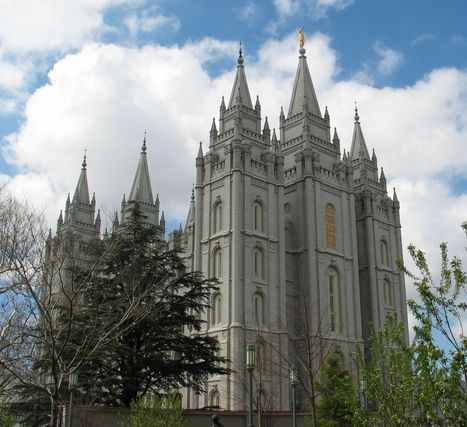
[Above: Mormonism's Salt Lake City temple, Wikipedia]

Shazoolo's YouTube channel under his video, Pt 1 of Does Mormonism "Bash" Other Churches?

I may add to these other main reasons why I consider Mormonism to be false. I intend to eventually post a separate page on each of these main reasons, which will be hyperlinked back to this page, making it a main index of reasons why I consider Mormonism to be false. I also intend to post a similar list of the main reasons why I consider Jehovah's Witnessism is false.


MAIN REASONS WHY MORMONISM IS FALSE

1. Joseph Smith, Mormonism's founder, was a liar, fraudster, occultist, adulterer, criminal and false prophet.

2. Smith's first vision of 1820 never happened, therefore Mormonism is based on a lie.

3. The Book of Mormon is a fraud, being a plagiarisation of the KJV Bible and other books, containing many anachronisms, errors, and contradictions of Mormonism itself.

4. Smith's golden plates were not used in translating the Book of Mormon and therefore are superfluous and never existed.

5. The Doctrines & Covenants contains changed revelations, immoral revelations (e.g. to condone Smith's adulteries), and false prophecies .

6. The Pearl of Great Price's Book of Abraham is a proven fraud of Joseph Smith's, being a common Egyptian funerary text that has nothing to do with Abraham. Yet it contains many of Mormonism's distinctive doctrines.

7. Mormonism's Law of Eternal Progression: "As man now is, God once was; as God now is, man may become" is unbiblical and blasphemous.

8. Mormonism's flesh-and-bones God the Father had physical sex with the virgin Mary doctrine is unbiblical and blasphemous.

9. There never was a total apostasy of Christianity which is a fundamental premise of Mormonism.

10. Mormonism is not the restoration of Christianity but an anti-Christian attempted replacement of it, with unbiblical priesthoods, temples, rituals, baptisms for the dead, three-tier heaven, salvation by works, and eternal polygamous physical sex with wives endlessly bearing millions of literal children.

See `tagline' quotes below (emphasis italics original; emphasis bold mine), on some of these reasons why Mormonism is false, from Anthony Hoekema's "The Four Major Cults" (1963) and Walter Martin's "The Kingdom of the Cults" (1977).

Stephen E. Jones.
My other blogs: CreationEvolutionDesign & TheShroudofTurin


"We must at this point assert, in the strongest possible terms, that Mormonism does not deserve to be called a Christian religion. It is basically anti-Christian and anti-Biblical. The Mormon contention that `after the book [the Bible] hath gone forth through the hands of the great and abominable church ... there are many plain and precious things taken away from the book...' (1 Nephi 13:28), is completely contrary to fact. The many copies of Old Testament manuscripts which we now possess do vary in minor matters - the spelling of words, the omission of a phrase here and there - but there is no evidence whatsoever that any major sections of Old Testament books have been lost. The manuscripts found among the Dead Sea Scrolls, generally dated from about 200 to 50 B.C., include portions of every Old Testament book except Esther; studies have revealed that these documents - older by a thousand years than previously discovered Old Testament manuscripts - are substantially identical to the text of the Old Testament which had been previously handed down. As far as New Testament manuscripts are concerned, the oldest of which go back to the second century A.D., the situation is substantially the same. The variations that are found in these manuscripts -- all copies of the originals or of copies made from the originals - are of a relatively minor nature. There is no indication whatever that any large sections of material found in the originals have been lost. Most of the manuscript variations concern matters of spelling, word order, tense, and the like; no single doctrine is affected by them in any way. There is, further, not a shred of evidence to show that any translations of the Bible ... omitted any portions of these manuscripts or failed to reproduce any major sections of the Bible. The Bible itself, moreover, clearly indicates that it is the final revelation of God to man, and that it does not need to be supplemented by additional revelation." (Hoekema, A.A., 1963, "The Four Major Cults: Christian Science, Jehovah's Witnesses, Mormonism, Seventh-day Adventism," Paternoster: Exeter UK, Reprinted, 1969, pp.30-31).

"Mormons claim that the Book of Mormon is a book of divine revelation, given us by God in addition to the Bible. Let us see whether the facts concerning the alleged writing and transmission of the Book of Mormon bear out this claim. The Bible, as we know, was written in languages which were known and spoken by many: Hebrew, Aramaic, and Greek. The Old Testament was written in the Hebrew language which was spoken in Palestine at the time when these writings were produced, with the exception of a few short sections in Aramaic ... The New Testament was written in Greek, which was at that time the common language of the Roman Empire and the literary language of Palestine. ... the purpose of communicating His revelation to man, the discovery during the last sixty years of thousands of extra-Biblical papyri dating from New Testament times, mostly commercial documents written in Greek, has proved that the Koine Greek of the New Testament was simply the everyday language which was in common use throughout the empire at that time. If, now, God intended to issue another set of sacred books, it would be expected that He would do so in another well-known language, the existence and character of which would be testified to by extra-canonical documents. Mormons claim, however, that the language in which the plates allegedly original to the Book of Mormon were written was `Reformed Egyptian' (Mormon 9:32); two verses later the following qualification is added: `But the Lord knoweth the things which we have written, and also that none other people knoweth our language; therefore he hath prepared means for the interpretation thereof.' `Reformed Egyptian,' therefore, is not a known language; neither do we possess documents or inscriptions of any sort which attest the existence of this language or help us understand its character. Is it likely that God would give us His newest and allegedly greatest Book of Scripture in a language completely unknown?" (Hoekema, 1963, pp.75-76).

"In I Nephi 1:2 we hear Nephi saying, `Yea, I make a record in the language of my father, which [the language?] consists of the learning of the Jews and the language of the Egyptians.' But where did Lehi learn `the language of the Egyptians'? Were not Lehi and his sons Hebrew-speaking Jews? Mormon missionaries have told the author that the reason Nephi and the Nephites wrote in Egyptian was that they were descendants of Joseph (who was the father of Manasseh), and that Joseph had lived in Egypt. True enough, but the entire nation of Israel had lived in Egypt for over 400 years; yet they did not speak and write Egyptian but Hebrew. Moses himself, who was trained in all the culture of the Egyptians, wrote not in Egyptian but in Hebrew. Why, then, should Nephi, who apparently had never lived in Egypt, write in Egyptian? Why should this small group of Jews from the tribe of Manasseh form a linguistic exception to the prevalence of Hebrew in Palestine?" (Hoekema, 1963, p.78).

"This brings us to the further question of the character of this `Reformed Egyptian' language in which Nephi and subsequent Nephite scribes reportedly recorded the history of their nation. .... Why did God choose to use this language and this script for His alleged latest book of revelation? Why, in other words, did God make Nephi and his descendants change from Hebrew to Egyptian? One can very easily understand why the change from Hebrew to Greek was made when the New Testament manuscripts were written: Greek was then the common language of the Greco-Roman world, the language in which the gospel would be able to command the widest hearing. There is a second reason: Greek is more highly inflected than Hebrew, having, for example, seven tenses instead of the two found in Hebrew, and thus providing opportunity for many additional shades of meaning. The language of the New Testament, therefore, is well adapted to convey the more advanced revelation about God and the plan of salvation which is given in the New Testament. But now the question begins to pinch: why the shift from Hebrew to Egyptian? ... As far as the Nephites themselves were concerned, what good reason would there be for their not continuing to talk and write in Hebrew, which they already knew and understood? Furthermore, neither can the reason be found in any possible superiority of the Egyptian language over the Hebrew as a mode of conveying divine revelation. For, as we have seen, all the types of Egyptian script were non-alphabetic, whereas Hebrew is a language written in alphabetic script. Does it seem likely, now, that God would, for His alleged final sacred book, shift from an alphabetically written language like Hebrew to a more primitive, non-alphabetically written language like Egyptian, which would be obviously less precise in conveying fine shades of meaning than either Hebrew or Greek? If, finally, Egyptian were a language in some respects superior to Hebrew, and admirably suited to convey the new and final revelation, why did God permit all traces of this language to be lost and all these original documents to be removed from the earth? If God's intent from the beginning was to leave with us only an English translation of these documents, why could not this translation have been just as effectively made from Hebrew as from `Reformed Egyptian'?" (Hoekema, 1963, pp.79-80).

"I return now to the central character of our survey, Joseph Smith, Jr. The year 1820 proved to be the real beginning of the prophet's call, for in that year he was allegedly the recipient of a marvelous vision in which God the Father and God the Son materialized and spoke to young Smith as he piously prayed in a neighboring wood. The prophet records the incident in great detail in his book, The Pearl of Great Price (Writings of Joseph Smith, Section 2, verses 1-25), where he reveals that the two `personages' took a rather dim view of the Christian church, and for that matter of the world at large, and announced that a restoration of true Christianity was needed, and that he, Joseph Smith, Jr., had been chosen to launch the new dispensation. It is interesting to observe that Smith could not have been too much moved by the heavenly vision, for he shortly took up once again the habit of digging for treasure along with his father and brother, who were determined to unearth Captain Kidd's plunder by means of `peep stones,' `divining rods,' or just plain digging. History informs us that the Smith clan never succeeded at these multitudinous attempts at treasure hunting, but innumerable craters in the Vermont and New York countryside testify to their apparent zeal without knowledge." (Martin, W.R., 1977, "The Kingdom of the Cults: An Analysis of the Major Cult Systems in the Present Christian Era," Bethany Fellowship: Minneapolis MN, pp.150-151).

"In later years, the `prophet' greatly regretted these superstitious expeditions of his youth and even went on record as denying that he had ever been a money-digger. Said Prophet Smith on one such occasion: `In the month of October, 1825, I hired with an old gentleman, by the name of Josiah Stoal, who lived in Chenango county, State of New York. He had heard something of a silver mine having been opened by the Spaniards in Harmony, Susquehannah county, State of Pennsylvania; and had, previous to my hiring with him, been digging, in order if possible, to discover the mine. After I went to live with him, he took me, among the rest of his hands, to dig for the silver mine, at which I continued to work for nearly a month, without success in our undertaking, and finally I prevailed with the old gentleman to cease digging after it. Hence arose the very prevalent story of my having been a money digger. [Pearl of Great Price: Joseph Smith-History, 1:56] This explanation may suffice to explain the prophet's treasure hunting fiascos to the faithful and to the historically inept; but to those who have access to the facts, it is at once evident that Smith played recklessly, if not fast and loose, with the truth. In fact, it often appeared to be a perfect stranger to him. The main source for promoting skepticism where the veracity of the Prophet's explanation is concerned, however, is from no less an authority than Lucy Smith, his own mother, who, in her account of the very same incident, wrote that Stoal `came for Joseph on account of having heard that he possessed certain keys by which he could discern things invisible to the natural eye' (Linn, The Story of the Mormons, page 16)." (Martin, 1977, p.151).

"Further evidence, in addition to Mrs. Smith's statement (and prima facie evidence, at that), proves beyond a reasonable doubt that the prophet was a confirmed `Peek Stone' addict, that he took part in and personally supervised numerous treasure-digging expeditions, and further that he claimed supernatural powers which allegedly aided him in these searches. To remove all doubt the reader may have as to Smith's early treasure hunting and `Peek Stone' practices, we shall quote three of the best authenticated sources which we feel will sustain our contention that Smith was regarded as a fraud by those who knew him best. It should also be remembered that Joseph Smith, Sr., in an interview, later published in the Historical Magazine of May, 1870, clearly stated that the prophet had been a Peek Stone enthusiast and treasure-digger in his youth, and, further, that he had also told fortunes and located lost objects by means of a `Peek Stone' and the alleged supernatural powers therein. Substantiating Joseph's father's account of his rather odd activities is the testimony of the Reverend Dr. John A. Clark after `exhaustive research' in the Smith family's own neighborhood. `Long before the idea of a Golden Bible entered their minds, in their excursions for money digging ... Joe used to be usually their guide, putting into a hat a peculiar stone he had through which he looked to decide where they should begin to dig' (Gleanings by the Way, page 225, 1842). The proceedings of a court trial dated March 20, 1826-New York vs. Joseph Smith-revealed that Joseph Smith `had a certain stone which he had occasionally looked at to determine where hidden treasures in bowels of the earth were ... and had looked for Mr. Stoal several times.' [Frazer's Magazine, Vol. 7, February, 1873, p.229] Therefore the court found the defendant guilty of money digging.'" (Martin, 1977, pp.151-152).

"Joseph Smith, Jr., in 1820, claimed a heavenly vision which, he said, singled him out as the Lord's anointed prophet for this dispensation, though it was not until 1823, with the appearance of the angel Moroni at the quaking Smith's bedside, that Joe began his relationship to the fabulous `golden plates,' or what was to become the Book of Mormon. According to Smith's account of this extraordinary revelation, which is recorded in The Pearl of Great Price (Writings of Joseph Smith, Section 2 [sic], verses 29-54), the angel Moroni, the glorified son of one Mormon, the man for whom the famous book of the same name is entitled, appeared beside Joseph's bedside and thrice repeated his commission to the allegedly awestruck treasure hunter. Smith did not write this account down until some years later, but even that fails to excuse the blunder he made in transmitting the angelic proclamation. This confusion appears chiefly in the earlier edition of The Pearl of Great Price wherein the former Moroni is named as messenger; yet in the latter Joseph, with equal prophetic authority, identifies the messenger as Nephi, an entirely different character found in the Book of Mormon! This unfortunate crossing up of the divine communication system, was later remedied by thoughtful Mormon scribes who have exercised great care to ferret out all the historical and factual blunders not readily explainable in the writings of Smith, Young and other early Mormon writers. In current editions, therefore, both the `revelations' agree by identifying Moroni as the midnight visitor." (Martin, 1977, p.152).

"Archeological Evidence The Book of Mormon purports to portray the rise and development of two great civilizations. As to just how great these civilizations were, some excerpts from the book itself adequately illustrate: `The whole face of the land had become covered with buildings, and the people were as numerous almost, as it were the sand of the sea' (Mormon 1:7). ` . . fine workmanship of wood, in buildings, and in machinery, and also in iron and copper, and brass and steel, makings [sic.] all manners of tools ... ` (Jarom 1:8 and 2 Nephi 5:15). ` ... grain ... silks ... cattle ... oxen ... cows ... sheep ... swine ... goats ... horses ... asses ... elephants ... ` (See Ether 9:17-19). `... did multiply and spread ... began to cover the face of the whole earth, from the sea south to the sea north, from the sea west to the sea east' (Heleman 3:8). `... had been slain ... two millions' [Jaredites] (See Ether 15:2). ... their shipping and their building of ships, and their building of temples, and of synagogues and their sanctuaries ...' (Heleman 3:14. See also 2 Nephi 5:15, 16 and Alma 16:13). ` ... there were ten more who did fall ... with their ten thousand each...' (See Mormon 6:10-15). ... swords ... cimeters ... breastplates ... arm-shields ... shields ... head-plates ... armor' (See Alma 43:18, 19; 3:5 and Ether 15:15). `... multiplied exceedingly, and spread upon the face of the land, and became exceeding rich ...' (Jarom 1:8). See 3 Nephi 8:9, 10, 14 and 9:4, 5, 6, 8: where cities and inhabitants were sunk in the depths of the sea and earth. In addition to the foregoing statements from the Book of Mormon which indicate the tremendous spread of the culture of these races, there are some thirty-eight cities catalogued in the Book of Mormon, evidence that these were indeed mighty civilizations which should, by all the laws of archeological research into the culture of antiquity, have left vast amounts of `finds' to be evaluated. But such is not the case as we shall show. The Mormons have yet to explain the fact that leading archeological researchers not only have repudiated the claims of the Book of Mormon as to the existence of these civilizations, but have adduced considerable evidence to show the impossibility of the accounts given in the Mormon Bible." (Martin, 1977, pp.161-162. Ellipses Martin's).

"The Mongoloid Factor It is one of the main contentions of Mormon theology that the American Indians are the descendants of the Lamanites and that they were of the Semitic race, in fact of Jewish origin. As we have seen, this claim is extensive in Mormon literature; and if evidence could be adduced to show that the American Indian could not possibly be of Semitic extraction, the entire story of Nephi and his trip to America in 600 B.C. would be proven false. It is, therefore, of considerable value to learn that in the findings compiled by anthropologists and those who specialize in genetics, the various physical factors of the Mediterranean races from which the Jewish or Semitic race spring bear little or no resemblance to those of the American Indian! Genotypically, there is therefore little if any correlation, and phenotypically speaking the American Indians are considered to be Mongoloid in extraction, not Mediterranean Caucasoids. Now, if the Lamanites, as the Book of Mormon tells it, were the descendants of Nephi, who was a Jew of the Mediterranean Caucasoid type, then their descendants, the American Indians, would by necessity have the same blood factor genotypically; and phenotypic, or apparent characteristics, would be the same. But this is not at all the case. Instead, the American Indian, so say anthropologists, is not of Semitic extraction and has the definite phenotypical characteristic of a Mongoloid." (Martin, 1977, p.163).

"Corrections, Contradictions and Errors There is a great wealth of information concerning the material contained in the Book of Mormon and the various plagiarisms, anachronisms, false prophecies and other unfortunate practices connected with it. At best then we can give but a condensation of that which has been most thoroughly documented. Since the publication of the Book of Mormon in 1830, the first edition has undergone extensive `correction' in order to present it in its present form. Some of these `corrections' should be noted. 1. In the book of Mosiah, chapter 21, verse 28, it is declared that `King Mosiah had a gift from God'; but in the original edition of the book, the name of the king was Benjamin - an oversight which thoughtful Mormon scribes corrected. This is, of course, no typographical error as there is little resemblance between the names Benjamin and Mosiah; so it appears that either God made a mistake when He inspired the record or Joseph made a mistake when he translated it. But the Mormons will admit to neither, so they are stuck, so to speak, with the contradiction. 2. I Nephi 19:16-20:1, when compared with the edition of 1830, reveals more than fifty changes in the `inspired Book of Mormon,' words having been dropped, spelling corrected, and words and phraseology added and turned about. This is a strange way to treat an inspired revelation from God! 3. In the book of Alma 28:14-29: 1-11, more than thirty changes may be counted from the original edition, and on page 303 of the original edition the statement, `Yea, decree unto them that decrees which are unalterable,' has been expurged. (See Alma 29:4) 4. On page 25 of the edition of 1830, the Book of Mormon declares: `And the angel said unto me, Behold the Lamb of God, yea, even the eternal Father.' Yet in I Nephi 11:21, the later editions of the book read: `And the angel said unto me: Behold the Lamb of God, yea even the son of the eternal Father!' 5. The Roman Catholic Church should be delighted with page 25 of the original edition of the Book of Mormon which confirms one of their dogmas, namely, that Mary is the mother of God. `Behold, the virgin which thou seest, is the mother of God.' Noting this unfortunate lapse into Romanistic theology, considerate Mormon editors have changed I Nephi 11:18 so that it now reads: `Behold, the virgin whom thou seest, is the mother of the son of God.' From the foregoing which are only a handful of examples of the more than two thousand changes to be found in the Book of Mormon over a period of 131 years, the reader can see that it is in no sense to be accepted as the Word of God. The Scripture says: `The word of the Lord endureth for ever' (I Peter 1:25) ; and our Saviour declared: `Sanctify them through thy truth: thy word is truth' (John 17:17). The record of the Scripture rings true. The Book of Mormon, on the other hand, is patently false in far too many places to be considered coincidence." (Martin, 1977, p.164).

"The testimony of the three witnesses which appear at the front of the Book of Mormon (Oliver Cowdery, David Whitmer, and Martin Harris) declares that ` ... an angel of God came down from heaven, and he brought and laid before our eyes, that we beheld and saw the plates, and the engraving thereon ...' It is quite noteworthy that Martin Harris, in his conversation with Professor Anthon relative to the material `translated' from these miraculous plates, denied that he had actually seen them. In fact, when pressed, he stated that he only saw them `with the eye of faith,' which is vastly different from a revelation by an angelic messenger. The Mormons are loath to admit that all three of these witnesses later apostatized from the Mormon faith and were described in most unflattering terms ('thieves and counterfeiters') by their Mormon contemporaries. A careful check of early Mormon literature also reveals that Joseph Smith and his brother Hyrum wrote three articles against the character of the witnesses of the Book of Mormon, which, in itself, renders their testimony suspect if not totally worthless." (Martin, 1977, p.165).

"Added to the evidence of various revisions, the Book of Mormon also contains plagiarisms from the King James Bible, anachronisms, false prophecies and errors of fact which cannot be dismissed. ... Plagiarisms-The King James Version According to a careful survey of the Book of Mormon, it contains at least 25,000 words from the King James Bible. In fact, verbatim quotations, some of considerable length, have caused the Mormons no end of embarrassment for many years. The comparison of Moroni chapter 10 with 1 Corinthians 12:1-11, II Nephi 14 with Isaiah 4, and II Nephi 12 with Isaiah 2 reveals that Joseph Smith made free use of his Bible to supplement the alleged revelation of the golden plates. The book of Mosiah, chapter 14 in the Book of Mormon, is a reproduction of the fifty-third chapter of Isaiah the prophet; and III Nephi 13:1-18 copies Matthew 6:1-23. The Mormons naively suggest that when Christ allegedly appeared on the American continent after His resurrection and preached to the Nephites he quite naturally used the same language as recorded in the Bible. They also maintain that when Nephi came to America he brought copies of the Hebrew Scriptures, which account for quotations from the Old Testament. The only difficulty with these excuses is that the miraculous plates upon which they were all inscribed, somehow or another, under translation, came out in perfect King James English without variation approximately a thousand years before this 1611 version was written. Such reasoning on the part of the Mormons strains at the limits of credulity and only they are willing to believe it." (Martin, 1977, p.165).

"There are other instances of plagiarisms from the King James Bible including paraphrases of certain verses. One of these verses (I John 5:7) is reproduced in III Nephi 11:27, 36. The only difficulty with the paraphrase here is that the text is considered by scholars to be an interpolation missing from all the major manuscripts of the New Testament but present in the King James Bible from which Smith paraphrased it not knowing the difference. Another example of this type of error is found in III Nephi 11:33-34, and is almost a direct quotation from Mark 16:16, a passage now known to be an addition to that gospel by an overzealous scribe. But Joseph Smith was not aware of this either, so he even copied in translational errors, another proof that neither he nor the alleged golden plates were inspired of God." (Martin, 1977, p.165).

"Two further instances of plagiarisms from the King James Bible which have backfired on the Mormons are worth noting. In the third chapter of the book of Acts, Peter's classic sermon at Pentecost paraphrases Deuteronomy 18:15-19. While in the process of writing III Nephi, Joseph Smith puts Peter's paraphrase in the mouth of Christ when the Saviour was allegedly preaching to the Nephites. The prophet overlooked the fact that at the time that Christ was allegedly preaching his sermon, the sermon itself had not yet been preached by Peter. In addition to this, III Nephi makes Christ out to be a liar, when in verse 23 of chapter 20 Christ attributes Peter's words to Moses as a direct quotation when, as we have pointed out, Peter paraphrased the quotation from Moses; and the wording is quite different. But Joseph did not check far enough, hence this glaring error." (Martin, 1977, pp.165-166).

"Secondly, the Book of Mormon follows the error of the King James translation which renders Isaiah 4:5: `For upon all the glory shall be a defence' (See II Nephi 14:5). Modern translations of Isaiah point out that it should read `For over all the glory there will be a canopy,' not a defence. The Hebrew word, chuppah, does not mean defence but a protective curtain or canopy, Smith, of course, did not know this nor did the King James translators from whose work he copied. ... The Revised Standard Version of the Bible renders Isaiah 5:25: `And their corpses were as refuse in the midst of the streets,' correctly rendering the Hebrew suchah as refuse, not as `torn.' The King James Bible renders the passage: `And their carcases were torn in the midst of the streets.' The Book of Mormon (II Nephi 15:25) repeats the King James' text word for word, including the error of mistranslating suchah, removing any claim that the Book of Mormon is to be taken seriously as reliable material." (Martin, 1977, p.166).

"Anachronisms and Contradictions Not only does the Book of Mormon plagiarize heavily from the King James Bible, but it betrays a great lack of information and background on the subject of world history and the history of the Jewish people. The Jaredites enjoyed `glass' windows in the miraculous barges in which they crossed the ocean; and `steel' and a `compass' were known to Nephi despite the fact that neither had been invented, demonstrating once again that Joseph Smith was a poor student of history and of Hebrew customs. Laban, one of the characters of the Book of Mormon (I Nephi 4:9), makes use of a steel sword; and Nephi himself claims to have had a steel bow (the Mormons justify this by quoting Psalm 18:34 as a footnote in the Book of Mormon), but modern translations of the Scripture indicate that the word translated steel in the Old Testament (since steel was non-existent) is more properly rendered bronze. Mormons sometimes attempt to defend Nephi's possession of a compass (not in existence in his time) by the fact that Acts 28:13 states: `And from thence we fetched a compass.' Modern translations of the Scripture, however, refute this subterfuge by correctly rendering the passage: `And from there we made a circle.'" (Martin, 1977, p.166).

"Added to the preceding anachronisms is the fact that the Book of Mormon not only contradicts the Bible, but contradicts other revelations purporting to come from the same God who inspired the Book of Mormon. The Bible declares that the Messiah of Israel was to be born in Bethlehem (Micah 5:2), and the gospel of Matthew (chapter 2, verse 1) records the fulfillment of this prophecy. But the Book of Mormon (Alma 7:9, 10) states: `... the son of God cometh upon the face of the earth. And behold, he shall be born of Mary, at Jerusalem, which is the land of our forefathers ...' The Book of Mormon describes Jerusalem as a city (I Nephi 1:4) as was Bethlehem, so the contradiction is irreconcilable." (Martin, 1977, pp.166-167).

"There are also a number of instances where God did not agree with Himself, if indeed it is supposed that He had anything to do with the inspiration of the Book of Mormon, The Pearl of Great Price, Doctrine and Covenants, or the other recorded utterances of Joseph Smith. In the Book of Mormon, for instance, (III Nephi 12:2 and Moroni 8:11) the remission of sins is the result of baptism: `Yea, blessed are they who shall ... be baptized, for they shall ... receive the remission of their sin ... Behold baptism is unto repentance to the fulfilling of the commandments unto the remission of sin.' But in the book, Doctrine and Covenants. (Chapter 20, verse 37) the direct opposite is stated: `All who humble themselves ... and truly manifest by their works that they have received of the spirit of Christ unto the remission of their sins, shall be received by baptism into his church.' This particular message from the heavenlies almost provoked a riot in the Mormon Church, and Mormon theologians conspicuously omit any serious discussion of the contradiction." (Martin, 1977, pp.166-167).

"Joseph Smith did not limit his contradictions to baptism; indeed polygamy is a classic example of some of his maneuvers. `God commanded Abraham, and Sarah gave Hagar to Abraham to wife. And why did she do it'? Because this was the law; and from Hagar sprang many people ... Go ye, therefore, and do the works of Abraham; enter ye into my law and ye shall be saved' (Doctrine and Covenants, Section 132, Verses 34 and 32). The Book of Mormon, on the other hand, categorically states: `Wherefore, I the Lord God will not suffer that this people shall do like unto them of old . ... for there shall not any man among you have save it be one wife; and concubines he shall have none; for I, the Lord God, delight in the chastity of woman' (Jacob 2:26-28). It appears that Joseph could manufacture revelations at will, depending upon his desires. In the last instance, his reputation and subsequent actions indicate that sex was the motivating factor." (Martin, 1977, p.167).

"A final example of the confusion generated between the Book of Mormon and the other `inspired' revelations is found in the conflict between the book of Moses and the book of Abraham. `I am the Beginning and the End, the Almighty God; by mine Only Begotten I created these things; yea, in the beginning I created the heaven, and the earth upon which thou standest' (Moses 2:1). The book of Abraham, on the other hand, repudiates this monotheistic view and states: `And then the Lord said: Let us go down. And they went down at the beginning, and they, that is the Gods, organized and formed the heavens and the earth' (Abraham 4: 1) . Just how it is possible to reconcile these two allegedly equal pronouncements from Mormon revelation escapes this author, and the Mormons themselves appear reluctant to furnish any concrete explanation." (Martin, 1977, p.167).

"The question of false prophecies in Mormonism has been handled adequately in a number of excellent volumes, but it should be pointed out that Joseph Smith drew heavily upon published articles both in newspapers and magazines. In fact, one of his famous prophecies concerning the Civil War is drawn chiefly from material published in New York State at the time. Smith declared in Doctrine and Covenants, Section 87: `...At the rebellion of South Carolina... the Southern States will call on other nations, even the nation of Great Britain... and then war shall be poured out upon all nations ...And...slaves shall rise up against their masters... and that the remnants... shall vex the Gentiles with a sore vexation.' Though the Civil War did break out some years after Smith's death (1844), England did not become involved in war against the United States. `All nations' were not involved in war as prophesied. The slaves did not rise up against `their masters,' and the `remnants' who were Indians were themselves vexed by the Gentiles, being defeated in war and confined to reservations." (Martin, 1977, pp.167-168).

"Prophet Smith was an extremely ineffective prophet here, as he was when in Doctrine and Covenants he also prophesied that he would possess the house he built at Nauvoo `for ever and ever' (Section 124, verses 22, 23, and 59). The fact of the matter is that neither Joseph nor his seed `after him' lived from `generation to generation' in Nauvoo house, which was destroyed after Smith's death, and the Mormons moved on to Utah." (Martin, 1977, p.168).