Sunday, January 13, 2008

Is Jesus Christ Michael the archangel? #1

As well as my book outline, "Jesus is Jehovah!: In the New World Translation," I will post here on topics which I consider to be major weak points in the Watchtower Bible & Tract Society's teachings.
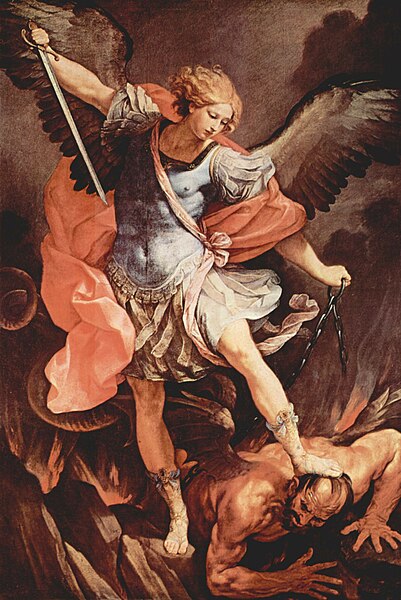
[Left: Guido Reni's, The Archangel Michael (1635) defeating Satan, Wikipedia.]

I had originally posted this is a question-based format, but I found that is too long-winded. So I am reposting it in a simpler Watchtower quote and then my comment format.

The aim of these topics is to chip away at the credibility of the Watchtower, so as to undermine JW's faith in it as "the true religion ... Of all the religious groups on earth" (my emphasis):

"How can we identify the true religion? ... Let us consider six features that identify those who practice true religion. Those who practice the true religion worship only Jehovah and make his name known. ... On the basis of what we have just considered, ask yourself: `What religious group bases all its teachings on the Bible and makes known Jehovah's name? What group practices godly love, exercises faith in Jesus, is no part of the world, and proclaims that God's Kingdom is the only real hope for mankind? Of all the religious groups on earth, which one meets all these requirements?' The facts clearly show that it is Jehovah's Witnesses.-Isaiah 43:10-12." ("What Does the Bible Really Teach?" Watchtower Bible & Tract Society of New York: Brooklyn NY, 2005, pp.144, 146, 151. Emphasis original)

so that those poor Watchtower slaves may "turn... to God from" that "idol... to slave for a living and true God" (1Th 1:9 NWT), who is "Jesus Christ. ... the true God and life everlasting." (1Jn 5:20 NWT)!

My first such topic (which I have split into two posts) is the Watchtower's claim that "Jesus himself is the archangel Michael":

"The foremost angel, both in power and authority, is the archangel, Jesus Christ, also called Michael. (1 Thessalonians 4:16; Jude 9) Under his authority are seraphs, cherubs, and angels." ("The Truth About Angels," The Watchtower, November 1, 1995).

This is clearly a major claim of the Watchtower, being about who Jesus Christ really is, yet its degree of Bible support is very weak (to put it mildly)! I will base my discussion points on an Appendix, "Who Is Michael the Archangel?"at pages 218-219 of the Watchtower Bible & Tract Society's current home Bible study booklet, "What Does the Bible Really Teach?":

Who Is Michael the Archangel?

THE spirit creature called Michael is not mentioned often in the Bible. However, when he is referred to, he is in action. In the book of Daniel, Michael is battling wicked angels; in the letter of Jude, he is disputing with Satan; and in Revelation, he is waging war with the Devil and his demons. By defending Jehovah's rulership and fighting God's enemies, Michael lives up to the meaning of his name-'Who Is Like God?' But who is Michael? At times, individuals are known by more than one name. For example, the patriarch Jacob is also known as Israel, and the apostle Peter, as Simon. (Genesis 49:1, 2; Matthew 10:2). Likewise, the Bible indicates that Michael is another name for Jesus Christ, before and after his life on earth. Let us consider Scriptural reasons for drawing that conclusion.

Archangel. God's Word refers to Michael `the archangel.' (Jude 9) This term means `chief angel.' Notice that Michael is called the archangel. This suggests that there is only one such angel. In fact, the term `archangel' occurs in the Bible only in the singular, never in the plural. Moreover, Jesus is linked with the office of archangel. Regarding the resurrected Lord Jesus Christ, l Thessalonians 4:16 states: `The Lord himself will descend from heaven with a commanding call, with an archangel's voice.' Thus the voice of Jesus is described as being that of an archangel. This scripture therefore suggests that Jesus himself is the archangel Michael.

Army Leader. The Bible states that `Michael and his angels battled with the dragon ... and its angels.' (Revelation 12:7) Thus, Michael is the Leader of an army of faithful angels. Revelation also describes Jesus as the Leader of an army of faithful angels. (Revelation 19:14-16) And the apostle Paul specifically mentions `the Lord Jesus' and `his powerful angels.' (2 Thessalonians 1:7; Matthew 16:27; 24:31; 1 Peter 3: 22) So the Bible speaks of both Michael and `his angels' and Jesus and `his angels.' (Matthew 13:41) Since God's Word nowhere indicates that there are two armies of faithful angels in heaven-one headed by Michael and one headed by Jesus-it is logical to conclude that Michael is none other than Jesus Christ in his heavenly role.

I will now quote the above Appendix sentence-by-sentence and then comment on it. I have bolded the words in the Appendix to distinguish them from my words.

My first point is that the above is a major claim of the Watchtower Bible & Tract Society, since it is about who Jesus Christ really is. And therefore if the Watchtower Society is wrong about this claim, "that Jesus himself is the archangel Michael" (see below) then that would seriously undermine its credibility as "the true religion" which "bases all its teachings on the Bible"!

THE spirit creature called Michael is not mentioned often in the Bible. That "Michael is not mentioned often in the Bible" (in fact he is mentioned only five times-see below) is itself evidence against the Watchtower's claim that "Jesus himself is the archangel Michael" (see below)? Such an important topic, as to who Jesus really is, should be clearly mentioned many times in the Bible, especially in the teachings of Jesus Himself in the gospels and also in the epistles of Paul.

In the book of Daniel, Michael is battling wicked angels ... There are in fact three references to "Michael ... in the book of Daniel." Here they are the JW's online New World Translation:

Dan 10:13 NWT. But the prince of the royal realm of Persia was standing in opposition to me for twenty-one days, and, look! Mi´cha•el, one of the foremost princes, came to help me; and I, for my part, remained there beside the kings of Persia.

Note in the above that Michael is only "one of the foremost princes." That is, he is not unique but is one among many of the same rank. Therefore on that basis alone Michael the archangel cannot be Jesus Christ, who as God's only Son is unique and distinguished in the Bible from "the angels," which includes archangels, e.g. :

Heb 1:5,13 NWT. For example, to which one of the angels did he ever say: "You are my son ... with reference to which one of the angels has he ever said: "Sit at my right hand, until I place your enemies as a stool for your feet"? (my italics).

Note again in this second reference to "Michael ... in the book of Daniel," that Michael is only a "prince" in rank:

Dn 10:21 NWT. However, I shall tell you the things noted down in the writing of truth, and there is no one holding strongly with me in these [things] but Mi´cha•el, the prince of YOU people. (my italics).

And also in this third reference to "Michael ... in the book of Daniel," he is again only a "prince" in rank.

Dn 12:1 NWT. "And during that time Mi´cha•el will stand up, the great prince who is standing in behalf of the sons of your people.

So in all three of these references to "Michael ... in the book of Daniel," Michael is only a "prince," albeit a "foremost prince" and a "great prince." But he far lower in rank to Jesus Christ who is called, "Lord of lords and King of kings" (my emphasis):

Rev 17:14 NWT. "These will battle with the Lamb, but, because he is Lord of lords and King of kings, the Lamb will conquer them.

as the Watchtower itself states in this very booklet:

Who is the King of God's Kingdom? Jesus Christ. Jesus as King is greater than all human rulers and is called "the King of those who rule as kings and Lord of those who rule as lords." (1 Timothy 6:15)" ("What Does the Bible Really Teach?" Watchtower Bible & Tract Society of New York: Brooklyn NY, 2005, p.77. My emphasis)

And note that in none of these above three references to "Michael ... in the book of Daniel" is it stated, or even implied, that "Jesus himself is the archangel Michael"!

... in the letter of Jude, he [Michael] is disputing with Satan ... This fourth of the five reference to "Michael ... in the Bible" is in fact the only place in the Bible where letter of Jude" NWT where the term "Mi´cha•el the archangel" appears:

Jude 9 NWT. But when Mi´cha•el the archangel had a difference with the Devil and was disputing about Moses' body, he did not dare to bring a judgment against him in abusive terms, but said: "May Jehovah rebuke you."

Again, there is nothing in this verse which states that "Jesus himself is the archangel Michael"!

Jude in fact mentions "Jesus Christ" six times in his short letter:

Jude 1 NWT. Jude, a slave of Jesus Christ, but a brother of James, to the called ones who are loved in relationship with God [the] Father and preserved for Jesus Christ:

Jude 4 NWT. ... ungodly men, turning the undeserved kindness of our God into an excuse for loose conduct and proving false to our only Owner and Lord, Jesus Christ.

Jude 17 NWT. As for YOU, beloved ones, call to mind the sayings that have been previously spoken by the apostles of our Lord Jesus Christ,

Jude 21 NWT. keep yourselves in God's love, while YOU are waiting for the mercy of our Lord Jesus Christ with everlasting life in view. ...

Jude 25 NWT. to [the] only God our Savior through Jesus Christ our Lord, be glory, majesty, might and authority for all past eternity and now and into all eternity. Amen.

with no indication that "Mi´cha•el the archangel" and "Jesus Christ" are one and the same.

Indeed, the very fact that "Mi´cha•el the archangel ... did not dare to bring a judgment against" the Devil is itself evidence that Michael is not Jesus Christ, because Jesus did in fact rebuke Satan and drove him away:

Mt 4:10-11 NWT. Then Jesus said to him: "Go away, Satan! For it is written, `It is Jehovah your God you must worship, and it is to him alone you must render sacred service.'" Then the Devil left him ...

... and in Revelation, he is waging war with the Devil and his demons. Again, in this, the last of the only five verses of the Bible that mention "Michael" the archangel, at there is nothing which states that "Jesus himself is the archangel Michael":

Rev 12:7 NWT. And war broke out in heaven: Mi´cha•el and his angels battled with the dragon, and the dragon and its angels battled

So in all five verses of the Bible where "Michael" the archangel is mentioned, there is nothing about his being "another name for Jesus Christ"!

By defending Jehovah's rulership and fighting God's enemies, Michael lives up to the meaning of his name-'Who Is Like God?' Note the question mark, i.e. Michael's name does not mean that he is like God, but that no one is like God who is not God. The same thought is expressed in the following verses:

Ex 15:11 NWT. Who among the gods is like you, O Jehovah?

Ps 35:10 NWT. Let all my bones themselves say: "O Jehovah, who is there like you,

Ps 113:5 NWT. Who is like Jehovah our God, Him who is making his dwelling on high?

And even if "By defending Jehovah's rulership and fighting God's enemies" Michael "lives up to the meaning of his name- 'Who Is Like God?'" again there is no statement in that verse Michael and Jesus are one and the same, even though the same chapter Rev 12 mentions Jesus six times as: "Jesus" (v.17), "Christ" (v.10), "the Lamb" (v.11) and "child" (v.4,5,13).

But who is Michael? At times, individuals are known by more than one name. For example, the patriarch Jacob is also known as Israel, and the apostle Peter, as Simon. (Genesis 49:1, 2; Matthew 10:2). Those two verses cited by the Watchtower to show that "individuals" in the Bible can be "known by more than one name"

Gn 49:1,2 NWT. Later on Jacob called his sons and said: "Gather yourselves together that I may tell YOU what will happen to YOU in the final part of the days. 2 Assemble yourselves and listen, YOU sons of Jacob, yes, listen to Israel YOUR father.

Mt 10:2 NWT. The names of the twelve apostles are these: First, Simon, the one called Peter, and Andrew his brother; and James the [son] of Zeb´e•dee and John his brother;

actually weaken their argument further (if that is possible)! That is because in those verses it is clearly stated that "Jacob is also known as Israel, and the apostle Peter, as Simon." So where are the equivalent verses which state that Michael the archangel is also known as Jesus Christ? If the Watchtower had any such verses they would quote them.

Likewise, the Bible indicates that Michael is another name for Jesus Christ, before and after his life on earth. On the contrary, as the above critique shows, the Bible does not "indicate... that Michael is another name for Jesus Christ..." at all, before and after his life on earth. Therefore, that there are no verses in the Bible which show that "Jesus himself is the archangel Michael"?

And notice the weak word "indicates." Compare that to the examples given where "the patriarch Jacob is also known as Israel, and the apostle Peter, [is also known] as Simon". The Watchtower cannot say that "the Bible" states "that Michael is another name for Jesus Christ"

This concludes the first paragraph of the above Appendix, except for the last sentence of it which is the lead in to the second paragraph, which I will therefore critique in part #2.

So as we have seen in the above critique, in none of the Bible verses, cited or implied in the above Appendix, does "the Bible" state or even "indicate... that Michael is another name for Jesus Christ." So how can the Watchtower Bible & Tract Society, honestly claim that it "bases all its teachings on the Bible"?

PS: See `tagline' quotes all from Watchtower literature in support of its claim that Jesus Christ is Michael the archangel, i.e. "Michael is another name for Jesus Christ," "Jesus himself is the archangel Michael" and "Michael is none other than Jesus Christ ..." In the next part #2 of this two-part post, I will quote from non-Watchtower literature critical of that Watchtower's claim.

Stephen E. Jones.
My other blogs: CreationEvolutionDesign & TheShroudofTurin


"There [in heaven, Jesus Christ is] known as Michael, as shown by comparison of scriptures Jude 9 `When Michael the archangel had a difference with the Devil and was disputing about Moses' body, he did not dare to bring a judgment against him in abusive terms.' (Compare with 1 Thess. 4:16.) Dan. 10:13 `Look! Michael, one of the foremost princes, came to help me.' (Compare with Isa. 9:6.) Dan. 12:1 `During that time Michael will stand up, the great prince who is standing in behalf of the sons of your people. And there will certainly occur a time of distress such as has not been made to occur since there came to be a nation until that time. And during that time your people will escape, every one who is found written down in the book.' (Compare with Matt. 24: 3, 21, 30.) Rev. 12:7, 8 `War broke out in heaven: Michael and his angels battled with the dragon, and the dragon and its angels battled but it did not prevail." (Compare with 1 John 3:8.)" (WB&TS, 1965, "Make Sure of All Things, Hold Fast to What Is Fine," Watchtower Bible & Tract Society of New York: Brooklyn NY, p.288. Emphasis original).

"MICHAEL ... [Who is like God?]. 1. The only holy angel other than Gabriel named in the Bible, and the only one called `archangel:' (Jude 9) The first occurrence of the name is in the tenth chapter of Daniel, where Michael is described as `one of the foremost princes' that came to the aid of a lesser angel who was opposed by the `prince of the royal realm of Persia.' Michael was called `the prince of [Daniel's] people,' `the great prince who is standing in behalf of the sons of [Daniel's] people.' (Dan. 10:13, 20, 21; 12:1) This points to Michael as the angel who led the Israelites through the wilderness. (Ex. 23:20, 21, 23; 32:34; 33:2) Lending support to this conclusion is the fact that `Michael the archangel had a difference with the Devil and was disputing about Moses' body.' Jude 9." (WB&TS, 1971, "Aid to Bible Understanding," [1969], Watchtower Bible & Tract Society: Brooklyn NY, Second edition, p.1152. Emphasis original).

"Scriptural evidence indicates that the name Michael applied to God's Son before he left heaven to become Jesus Christ and also after his return. Michael is the only one said to be the `archangel,' meaning `chief angel' or `principal angel.' The term occurs in the Bible only in the singular. This seems to imply that there is but one whom God has designated chief or head of the angelic host. At 1 Thessalonians 4:16 the voice of the resurrected Lord Jesus Christ is described as : being that of an archangel, suggesting that he is, in fact, himself the archangel. This text depicts him as descending from heaven with a `commanding call.' It is only logical, therefore, that the voice expressing this commanding call be described by a word that would not diminish or detract from the great authority that Christ Jesus now has as King of kings and Lord of lords. (Matt. 28:18; Rev. 17:14) If the designation `archangel' applied, not to Jesus Christ, but to other angels, then the reference to an `archangel's voice' would not be appropriate. In that case it would be describing a voice of lesser authority than that of the Son of God." (WB&TS, 1971, p.1152).

"There are also other correspondencies establishing that Michael is actually the Son of God. Daniel, after making the first reference to Michael (10:13), recorded a long-range prophecy reaching down to `the time of the end' (11:40), and then stated: `And during that time Michael will stand up' (12:1), that is, will take-up power or begin to reign as king. (Compare Daniel 8:22, 23; 11:2, 3, 7, 20, 21.) This implies that a period of being seated preceded his standing up as king. In agreement therewith Hebrews 10:12, 13 says regarding Christ Jesus: `This man offered one sacrifice for sins perpetually and sat down at the right hand of God, from then on awaiting until his enemies should be placed as a stool for his feet.' Michael's standing up was to lead to a `time of distress such as has not been made to occur since there came to be a nation until that time.'-Dan. 12:1." (WB&TS, 1971, p.1152).

"The book of Revelation (12:7, 10, 12) mentions Michael in connection with the establishment of God's kingdom and links this event with trouble for the earth: `And war broke out in heaven: Michael and his angels battled with the dragon. and, the dragon and his angels battled. And I heard a loud voice in heaven say: Now I have come to pass the salvation and the power and the kingdom of our God and the authority of his Christ, because the accuser of our brothers has been hurled down, ... On this account be glad, you heavens and you who reside in them! Woe for the earth and for the sea.' ` Jesus Christ is later depicted as leading the heavenly armies in war against the nations of the earth. (Rev. 19:11-16) This would mean a period of distress for them, which would logically be included in the `time of distress' to-follow Michael's standing up. (Dan. 12:1) Since the Son of God is to fight the nations, it is only reasonable that he was the one who with his angels earlier battled against the superhuman dragon, Satan the Devil, and his angels." (WB&TS, 1971, p.1152).

"In his prehuman existence Jesus was called `the Word.' (John 1:1) He also had the personal name Michael. By retaining the name Jesus after his resurrection (Acts 9:5), the `Word' shows that he is identical with the Son of God on earth. His resuming his heavenly name Michael and his title (or, name) `The Word of God' (Rev. 19:13) ties him in with his prehuman existence. The very name Michael, asking as it does, `Who is like God?', points to the fact that Jehovah God is without like or equal and that Michael his archangel is his great Champion or Vindicator." (WB&TS, 1971, p.1152).

"MICHAEL (Mi'cha.el) [Who is like God?].1. The only holy angel other than Gabriel named in the Bible, and the only one called "archangel:" (Jude 9) ... 2. The father of chieftain Sethur of the tribe of Asher who was one of the twelve sent to spy out Canaan.- Num. 13:2, 13. 3. Forefather of Asaph; of the family of Gershom, the son of Levi.-1 Chron. 6:39, 40, 43. 4. One of the heads of the tribe of Issachar; of the family of Tola.-1 Chron. 7:1-3. 5. A chieftain of the tribe of Manasseh who deserted to David at Ziklag.-1 Chron. 12:20. 6. The father of Omri, the head of a paternal house of Issachar during David's reign.-1 Chron. 27:18. 7. One of the sons of King Jehoshaphat of Judah ... -2 Chron. 21:1-4. 8. A Gadite and descendant of Buz ... -1 Chron. 5:11, 13, 14. 9. A Gadite, and first of seven sons of Abihail ....-1 Chron. 5:11-17. 10. A Benjamite; descendant of Shaharaim by his wife Hushim through Elpaal and Beriah.-1 Chron. 8:1, 8, 11-13, 16. 11. Father of the Zebadiah who went up to Jerusalem from Babylon with Ezra in 468 B.C.E.-Ezra 8:1, 8." ("Aid to Bible Understanding," [1969], Watchtower Bible & Tract Society: Brooklyn NY, Second edition, 1971, p.1152. Emphasis original).

"Is Jesus Christ the same person as Michael the archangel? The name of this Michael appears only five times in the Bible. The glorious spirit person who bears the name is referred to as `one of the chief princes,' `the great prince who has charge of your [Daniel's] people,' and as `the archangel.' (Dan. 10:13[,21]; 12:1; Jude 9, RS) Michael means `Who Is Like God?' The name evidently designates Michael as the one who takes the lead in upholding Jehovah's sovereignty and destroying God's enemies. At 1 Thessalonians 4:16 (RS), the command of Jesus Christ for the resurrection to begin is described as `the archangel's call,' and Jude 9 says that the archangel is Michael. Would it be appropriate to liken Jesus' commanding call to that of someone lesser in authority? Reasonably, then, the archangel Michael is Jesus Christ. (Interestingly, the expression `archangel' is never found in the plural in the Scriptures, thus implying that there is only one.) Revelation 12:7-12 says that Michael and his angels would war against Satan and hurl him and his wicked angels out of heaven in connection with the conferring of kingly authority on Christ. Jesus is later depicted as leading the armies of heaven in war against the nations of the world. (Rev. 19:11-16) Is it not reasonable that Jesus would also be the one to take action against the one he described as `ruler of this world,' Satan the Devil? (John 12:31) Daniel 12:1 (RS) associates the `standing up of Michael' to act with authority with `a time of trouble, such as never has been since there was a nation till that time.' That would certainly fit the experience of the nations when Christ as heavenly executioner takes action against them. So the evidence indicates that the Son of God was known as Michael before he came to earth and is known also by that name since his return to heaven where he resides as the glorified spirit Son of God." (WB&TS, 1989, "Reasoning from the Scriptures," [1985], Watchtower Bible & Tract Society of New York: Brooklyn NY, Second edition, p.218. Emphasis original. Bible version NIV. Verse in square brackets added).

Thursday, January 3, 2008

Jesus is Jehovah! (JiJ): Bibliography

This is the Bibliography of books and articles that I will probably refer to in my book outline, "Jesus is Jehovah!: In the New World Translation."

[Left: The late Anglican Bishop Edward Henry Bickersteth's, "The Trinity" (1860), Amazon.com. See PS and `tagline' quotes all from this book.]

It saves time to post these Bibliography references in advance and later remove any that I didn't use, rather than add them piecemeal. I will hyperlink inline references (e.g. Bowman., 1989, p.108) back to the book or article on this Bibliography page.


JESUS IS JEHOVAH!: IN THE NEW WORLD TRANSLATION
© Stephen E. Jones

CONTENTS

BIBLIOGRAPHY

Bickersteth, E.H., 1860, "The Trinity: Scripture Testimony to the One Eternal Godhead of the Father, and of the Son, and of the Holy Spirit," Kregel: Grand Rapids MI, Third Printing, 1965.
Bowman, R.M., Jr., 1989a, "The Jehovah's Witnesses, Jesus Christ, and the Gospel of John," Baker: Grand Rapids MI, Reprinted, 1995.
Bowman, R.M., 1989b, "Why You Should Believe in the Trinity: An Answer to Jehovah's Witnesses," Baker: Grand Rapids MI, Third printing, 1990.
Buswell, J.O., Jr., 1962, "A Systematic Theology of the Christian Religion," Zondervan: Grand Rapids MI, Vol. I, Second printing, 1968.

Dabney, R.L., 1878, "Systematic Theology," [1871], Banner of Truth: Edinburgh, Second edition, Reprinted, 1985.

Geisler, N.L., 1999, "Baker Encyclopedia of Christian Apologetics," Baker Books: Grand Rapids MI.
Green, J.P., Sr., ed., 1986, "The Interlinear Bible: One Volume Edition," [1976], Hendrickson Publishers: Peabody MA., Second edition.
Green, J.P., Sr, 2005, "A Literal Translation of the Bible," Sovereign Grace Publishers: Lafayette IN.
Gruss, E.C., 1970, "Apostles of Denial: An Examination and Expose of the History Doctrines and Claims of the Jehovah's Witnesses," Presbyterian & Reformed: Phillipsburg NJ, Eleventh printing, 1986.

Hendriksen, W., 1964, "A Commentary on the Gospel of John: Two Volumes Complete and Unabridged in One,"
[1954], Banner of Truth: London, Third edition.
Hoekema, A.A., 1974, "Jehovah's Witnesses," [1963], Eerdmans: Grand Rapids MI.

Kruse, C.G., 2003, "The Gospel According to St. John: An Introduction and Commentary," The Tyndale New Testament Commentaries, Inter-Varsity Press: Leicester UK.

Martin, W.R., 1957, "Jehovah's Witnesses," Bethany House: Minneapolis MN, Reprinted, 1969.
Martin, W.R., 1977, "The Kingdom of the Cults: An Analysis of the Major Cult Systems in the Present Christian Era," Bethany Fellowship: Minneapolis MN.
Martin, W.R. & Klann, N., 1953, "Jehovah of the Watchtower," Bethany House Publishers: Bloomington MN, Reprinted, 1981.
Metzger, B.M., 1953, "The Jehovah's Witnesses and Jesus Christ," Reprint of article in Theology Today, April, pp.65-85, Princeton Theological Seminary: Princeton NJ.
Milne, B., 1982, "Know the Truth: A Handbook of Christian Belief," Inter-Varsity Press: Leicester UK, Fifth printing, 1988.

Nave, O.J., ed., 1897, "Nave's Topical Bible: A Digest of the Holy Scriptures," Moody Press: Chicago IL, Reprinted, 1969.

Reed, D.A., 1986, "Jehovah's Witnesses Answered Verse by Verse," Baker: Grand Rapids MI, Thirty-first printing, 2006.
Reed, D.A., ed., 1990, "Index of Watchtower Errors, 1879 to 1989," Compiled by Steve Huntoon and John Cornell, Baker: Grand Rapids MI.
Reed, D.A., 1993, "Jehovah's Witness Literature: A Critical Guide to Watchtower Publications," Baker: Grand Rapids MI
Reed, D.A., 1996, "Answering Jehovah's Witnesses: Subject by Subject," Baker: Grand Rapids MI.
Rhodes, R., 1993, "Reasoning from the Scriptures with the Jehovah's Witnesses," Harvest House: Eugene OR, Reprinted, 2006.

Schnell, W.J., 1959, "Who Are Jehovah's Witnesses?," Osterhus Pub. House: Minneapolis, MN.
Shedd, W.G.T., 1888, "Dogmatic Theology," Zondervan: Grand Rapids MI, Reprinted, 1969, Vol. I.
Stevens, S., 1994, "Unmasking the Watchtower: Who Are Jehovah's Witnesses?," Jubilee Resources: Wellington, New Zealand
Strong, A.H., 1907, "Systematic Theology," Judson Press: Valley Forge PA, Twenty-fifth printing, 1967.

Thiessen, H.C. & Doerksen, V.D., 1979, "Lectures in Systematic Theology," [1949], Eerdmans: Grand Rapids MI, Revised.
Torrey, R. A., 1957, "What the Bible Teaches: A Thorough and Comprehensive Study of What the Bible Has to Say Concerning the Great Doctrines of Which it Treats," Oliphants: London, Third impression, 1963.

Vincent, M.R., 1887, "Word Studies in the New Testament," Eerdmans: Grand Rapids MI, 4 Vols, Reprinted, 1969.

Warfield, B.B., 1976, "The Lord of Glory: A Study of the Designations of Our Lord in the New Testament with Especial Reference to His Deity, Baker: Grand Rapids MI.
WB&TS, 1952, "Let God Be True," [1946], Watchtower Bible & Tract Society: Brooklyn NY.
WB&TS, 1961, "New World translation of the Holy Scriptures," Watchtower Bible & Tract Society of New York: Brooklyn NY, Third revision with footnotes.
WB&TS, 1965a, "Make Sure of All Things, Hold Fast to What Is Fine," Watchtower Bible & Tract Society of New York: Brooklyn NY.
WB&TS, 1965b, "Things in Which it is Impossible for God to Lie," Watchtower Bible & Tract Society of New York: Brooklyn NY.
WB&TS, 1968, "The Truth that Leads to Eternal Life," Watchtower Bible & Tract Society of New York: Brooklyn NY.
WB&TS, 1969, "The Kingdom Interlinear Translation of the Greek Scriptures," Watchtower Bible & Tract Society, Brooklyn NY.
WB&TS, 1971a, "Aid to Bible Understanding," [1969], Watchtower Bible & Tract Society: Brooklyn NY, Second edition.
WB&TS, 1971b, "New World translation of the Holy Scriptures," [1961], Watchtower Bible & Tract Society of New York: Brooklyn NY, Third revision with footnotes.
WB&TS, 1980, "Happiness-How to Find It," Watchtower Bible & Tract Society of New York: Brooklyn NY.
WB&TS, 1984, "New World translation of the Holy Scriptures," [1961], Watchtower Bible & Tract Society of New York: Brooklyn NY, Revised.
WB&TS, 1989a, "Reasoning from the Scriptures," [1985], Watchtower Bible & Tract Society of New York: Brooklyn NY, Second edition.
WB&TS, 1989b, "You Can Live Forever in Paradise on Earth," [1982], Watchtower Bible & Tract Society of New York: Brooklyn NY, Second edition.
WB&TS, 2005, "What Does the Bible Really Teach?," Watchtower Bible & Tract Society of New York: Brooklyn NY.

PS: In the following `tagline' quotes (My emphasis bold) from Bickersteth's "The Trinity" (1860), I have converted his versification from Roman numerals to decimals, put them in square brackets, and made other formatting changes, without changing the text. I had wanted to add these quotes to my CED blog post, "Jesus is Jehovah!" but they would have made it too long.

I bought Bickersteth's book in 1968, according to my signed and dated inscription in it, so it is probably from reading these very pages, and especially John's application of Isaiah seeing with his own "eyes ... Jehovah of hosts" (Isa 6:5) to Jesus (Jn 12:41) that I relied upon in that lunchtime Bible study with an older JW workmate, nearly 40 years ago (as mentioned in my introductory post to JiJ)!

Stephen E. Jones.
My other blogs: CreationEvolutionDesign & TheShroudofTurin


"It remains that we consider the explicit assertions that Jesus Christ is Jehovah and God. These assertions are neither few nor obscure. ... Now we find certain prophetic declarations in the Old Testament regarding Jehovah fulfilled, as ruled by the New Testament, in Christ Jesus. This is, perhaps, the most conclusive evidence that could be adduced-an inspired interpretation of an inspired text ... `The voice of him that crieth in the wilderness, Prepare ye the way of Jehovah, make straight in the desert a highway for our God.' [Isa 40:3] `This is he that was spoken of by the prophet Esaias, saying, The voice of one crying in the wilderness, Prepare ye the way of the Lord.' [Mat 3:3] Now John Baptist's voice, without controversy, was heard in the wilderness, preparing the way for Christ. Therefore, Christ is Jehovah, our God." (Bickersteth, E.H., 1860, "The Trinity: Scripture Testimony to the One Eternal Godhead of the Father, and of the Son, and of the Holy Spirit," Kregel: Grand Rapids MI, Third Printing, 1965, pp.71-72).

"`Sanctify Jehovah of hosts himself; and let him be your fear, and let him be your dread. And he shall be for a sanctuary; but ... a stone of stumbling and for a rock of offence to both the houses of Israel.' [Isa 8:13-14]. `Unto you therefore which believe he (Christ) is precious; and a rock of offence, even to but for a stone of stumbling them which stumble at the word, being disobedient.' [1Pet 2:7-8]. The stone of stumbling, as Isaiah affirms, is `Jehovah of hosts himself,' but as Peter interprets it, (for he is referring to what is contained in the Scripture, ver. 6,) this stone is Christ. Therefore Christ is Jehovah of hosts himself." (Bickersteth, 1860, p.73).

"`And I (Jehovah, which stretcheth forth the heavens, etc., see ver. 1) will pour upon the house of David, and upon the inhabitants of Jerusalem, the Spirit of grace and of supplications: and they shall look upon me whom they have pierced.' [Zec 12:10]. And again another Scripture saith, `They shall look on him (Christ) whom they pierced.' [Jn 19:37]. The prophet declares the one who is pierced is Jehovah speaking of himself, but according to John's inspired interpretation, Christ crucified is here predicted. Therefore Christ is `Jehovah which stretcheth forth the heavens, and layeth the foundation of the earth, and formeth the spirit of man within him.'" (Bickersteth, 1860, p.73).

"`Mine eyes have seen the King, Jehovah of hosts.' [Isa 6:5]. `These things said Esaias, when he saw his glory and spake of him.' [Jn 12:41]. The message recorded determines the occasion to be the same. Therefore Jesus Christ, of whom the inspired apostle is speaking, is Jehovah of hosts, before whom the seraphim veiled their faces in lowliest adoration." (Bickersteth, 1860, p.73).

"`I (Jehovah) have sworn by myself ... that unto me every knee shall bow, every tongue shall swear.' [Isa 45:23] `We shall all stand before the judgment-seat of Christ. For it is written, As I live, saith the Lord, every knee shall bow to me, and every tongue shall confess to God.' [Rom 14:10-11]. Paul incontrovertibly establishes his assertion, that we shall stand at the judgment-seat of Christ, by this solemn oath of Jehovah, recorded by Isaiah. Therefore, Christ is Jehovah, who says, (ver. 21,) `There is no God else beside me; a just God and a Saviour: there is none beside me.' When we remember the solemn protest of Him who calls himself the jealous God-`I am Jehovah: that is my Name: and my glory will I not give to another:' [Isa 42:8] -and when we reflect on the awful judgments denounced on those who render to the creature the supreme worship due to the Creator, the above comparison of Scripture with Scripture, wherein the Holy Ghost interprets, explains, and applies his own language, presents the most irrefragable proof that Jesus Christ is the Eternal, Increate, Alone, Jehovah of hosts, the Highest, the Lord our God." (Bickersteth, 1860, pp.73-74).

"And here may be the most convenient place to introduce a few remarks on the witness we derive from the word `Lord.' No doubt it is often used by classical, and sometimes by the sacred writers, as a human appellation. But then the facts remain, that it is the word, equivalent to Adonai, which the Jews, through their reluctance to pronounce the awful name Jehovah, continually employed as its synonym; that it is the word by which Jehovah is uniformly translated by the Septuagint, even in Exodus 6:3; and further, that standing by itself in the New Testament, it designates in multiplied passages the Infinite Father. We must look; therefore, broadly to its general use by Christ and his apostles. And what is the result? The word Kurios occurs 737 times in the New Testament-of these, in 18 instances it is confessedly applied to man or men. In 54 instances it appears in the discourses and parables of Christ, where the master, described as Lord, represents or typifies the Father or himself: and in 665 cases, the vast remainder, it is applied indiscriminately to the Eternal Father or to the Son. ... Now in these eighteen instances (with scarcely an exception) there was not the remotest possibility of divine worship being intended to the person thus designated: indeed, in twelve of these cases, the word is in the plural. But what of those very numerous instances in which it is applied to Jesus Christ? Therein he is described as `Lord of all:' [Acts 10:36] as the Lord, even Jesus, he appeared to Saul in vision [Acts 9:17]: as the Lord, Paul besought him to remove his thorn in the flesh [2Cor 12:8-9]: he is declared to be the second man, the Lord from heaven [1Cor 15:47]: and as the Lord, the righteous Judge, he will give a crown of righteousness to all them that love his appearing [2Tim 4:8]. Now to one thus described as Lord, seeing that the name is applied to the Father and the Son indiscriminately, so that, in many places, the difficulty is very great of knowing whether the Eternal Father or the Lord Jesus Christ be intended, the risk of ascribing divine worship would be imminent indeed. The collation of two passages from the Old, with two passages from the New Testament, seems to clinch the argument: `Hear, O Israel: the LORD our God is one LORD' (Kurios ho Theos emon, Kurios eis esti - LXX) [Dt 6:4]. `There is one Lord' (eis Kurios) [Eph 4:5]. `And the LORD shall be king over all the earth. In that day shall there be one Lord, and his name One (Kurios eis kaito onoma autou en-LXX) [Zec 14:9]. `To us...... there is...... one Lord (eis Kurios) Jesus Christ, by whom are all things, and we by him.' [1Cor 8:6]. Here the apostle uses the very words to which the Jews clung with such tenacity as establishing the fundamental truth of the Unity of God; and adopting the very words of the common version, the Septuagint, applies them to Jesus Christ. There appears, therefore, in this name of Christ, as used in the New Testament, explicit declaration that he is the Eternal Jehovah." (Bickersteth, 1860, pp.75-76. Emphasis & ellipses original).

Wednesday, January 2, 2008

Jesus is Jehovah! (JiJ): Contents

This is the Contents page of my book outline, "Jesus is Jehovah!: In the New World Translation." As with my other two online

[Above (click to enlarge): "Jesus is Yahweh" wheel, on back of Cetnar, W.I. & J., "Questions for Jehovah's Witnesses," [1983], Bill & Joan Cetnar: Kunkletown PA, Reprinted, 2001]

book outlines, "Problems of Evolution" and "The Shroud of Turin: Burial Sheet of Jesus?" which I am progressively posting to my CreationEvolutionDesign and TheShroudofTurin blogs respectively, I will post sections and subsections one to a page, the heading hyperlinked to each chapter, which in turn will be hyperlinked back to this main Contents page. These headings may change. If I update a page, I will not normally repost it or mention it. This is a work in progress.


JESUS IS JEHOVAH!: IN THE NEW WORLD TRANSLATION
© Stephen E. Jones


CONTENTS

1. INTRODUCTION
2. JESUS HAS NAMES & TITLES OF JEHOVAH
3. OLD TESTAMENT PASSAGES ABOUT JEHOVAH APPLIED TO JESUS
4. JESUS HAS ATTRIBUTES OF JEHOVAH
5. JESUS DOES WORKS OF JEHOVAH
6. JESUS RECEIVES WORSHIP DUE TO JEHOVAH
7. OBJECTIONS TO JESUS BEING JEHOVAH
8. CONCLUSION

BIBLIOGRAPHY

PS: The following `tagline' quotes (my emphases bold) are copied from my CED blog post, Jesus is Jehovah! The Bible verse hyperlinks are not to the NWT because at that stage my strategy was to assemble from mainstream translations those verses which showed that Jesus is Jehovah.

Stephen E. Jones.

My other blogs: CreationEvolutionDesign & TheShroudofTurin


"Jesus Is Yahweh ... A comparison of the Old and New Testaments provides powerful testimony to Jesus' identity as Yahweh. Support for this is found, for example, in Christ's crucifixion. In Zechariah 12:10 Yahweh is speaking prophetically: `They will look on me, the one they have pierced.' Though Yahweh is speaking, this is obviously a reference to Christ's future crucifixion. We know that `the one they have pierced' is Jesus, for He is described this same way by the apostle John in Revelation 1:7. ... The Septuagint provides us with additional insights on Christ's identity as Yahweh. The Septuagint is a Greek translation of the Hebrew Old Testament that dates prior to the birth of Christ. It renders the Hebrew phrase for `I AM' (God's name) in Exodus 3:14 as ego eimi. On a number of occasions in the Greek New Testament, Jesus used this term as a way of identifying Himself as God. For example, in John 8:24 (NASB) Jesus declared, `Unless you believe that I am [I AM or ego eimi] He, you shall die in your sins.' The original Greek text for this verse does not have the word he. The verse is literally, `If you do not believe that I AM, you shall die in your sins.' Then, according to verse 28, Jesus told the Jews, `When you lift up the Son of Man, then you will know that I am [I AM, or ego eimi] He.' Again, the original Greek text reads, `When you lift up the Son of Man, then you will know that I AM' (there is no he). Jesus purposely used the phrase as a means of pointing to His identity as Yahweh. It is also highly revealing that Old Testament passages about Yahweh were directly applied to Jesus in the New Testament. For instance, Isaiah 40:3 says: `In the desert prepare the way for the LORD [Yahweh]; make straight in the wilderness a highway for our God [Elohim].' Mark's Gospel tells us that Isaiah's words were fulfilled in the ministry of John the Baptist preparing the way for Jesus Christ (Mark 1:2-4). Still another illustration is Isaiah 6:1-5, where the prophet recounts his vision of Yahweh `seated on a throne, high and exalted' (verse 1). He said, `Holy, holy, holy is the LORD [Yahweh] Almighty; the whole earth is full of his glory' (verse 3). Isaiah also quotes Yahweh as saying: `I am the LORD; that is my name! I will not give my glory to another' (42:8). Later, the apostle John-under the inspiration of the Holy Spirit-wrote that Isaiah `saw Jesus' glory' (John 12:41). Yahweh's glory and Jesus' glory are equated." (Rhodes, R., "Reasoning from the Scriptures with the Jehovah's Witnesses," [1993], Harvest House: Eugene OR, Reprinted, 2006, pp.62-64. Emphasis & parentheses original).

"Jesus as Jehovah The amount of material in the Bible supporting the teaching that Jesus Christ is Jehovah God is actually quite staggering. Here we can summarize only some of the remaining highlights. Mention has already been made of Philippians 2:9-11, which says that Jesus has been given `the name which is above every name,' the name Lord, or Jehovah. Even clearer is Romans 10:9-13. Here we are told to confess Jesus as Lord (vv. 9-10), confident that no one trusting in him, that is, in Jesus, the rock over which the Jews stumbled, will be disappointed (v. 11; cf. 9:33), because he is Lord for both Jew and Greek, rich to all who call upon him for salvation (v. 12). Then verse 13 concludes that whoever will call upon the name of the Lord will be saved. In context, this must be Jesus, because he is the Lord on whom all must call to be saved, as verses 9-12 have said; but the NWT translates `Lord' here as `Jehovah,' because it is a quote from Joel 2:32, where the original Hebrew has the divine name! Thus Jesus is here identified as Jehovah. Similar is 1 Peter 2:3, which is nearly an exact quotation from Psalm 34:8, where the Lord is Jehovah; but from verses 4-8 it is also clear that the Lord in verse 3 is Jesus. Besides the name Jehovah and the title God, Jesus has other titles belonging exclusively to Jehovah. Jesus is the first and the last (Rev. 1:17; 22:13; cf. Isa. 44:6). He is the King of kings and Lord of lords (1 Tim. 6:15; Rev. 17:14; 19:16). Used in a spiritual, ultimate sense, Jesus is revealed to be God by his having the titles Savior (Luke 2:11; John 4:42; 1 John 4:14; cf. Isa. 43:11; 45:21-22; 1 Tim. 4:10), Shepherd (John 10:11; Heb. 13:20; cf. Ps. 23:1; Isa. 40:11), and Rock (1 Cor. 10:4; cf. Isa. 44:8). Jesus also receives the honors due to Jehovah God alone. He is to receive the same honor given to the Father (John 5:23). He is to be feared (Eph. 5:21), to receive absolute love (Matt. 10:37), and to be the object of the same faith we have in God (John 3:16; 14:1). He receives prayer (John 14:14; Acts 7:59-60 compared with Luke 23:34, 46; Rom. 10:12-13; 1 Cor. 1:2; etc.), worship (Matt. 28:17; Heb. 1:6), and sacred service (Rev. 22:3). Jesus also possesses the unique characteristics, or attributes, of God. He is exactly like God, the very image of his Father (Col. 1:15; Heb. 1:3). All the fullness of God's nature dwells in Christ in bodily form (Col. 2:9). In another book the JWs make this interesting comment on Colossians 2:9: `Being truly `divinity,' or of `divine nature,' does not make Jesus as the Son of God coequal and coeternal with the Father, any more than the fact that all humans share `humanity' or `human nature' makes them coequal or all the same age.' Of course people who share human nature are not the same age, but that is in keeping with the fact that all human beings have a beginning. But the point is that just as a human son is just as `human' as his father, so Jesus Christ, who is said in Colossians 2:9 to be fully `divine,' is therefore no less divine than his Father. The Bible also names specific attributes unique to God that are possessed by Christ. He is self-existent (John 5:26); unchanging (Heb. 1:10-12; 13:8); eternal (John 1:1-2; 8:58; 17:5; Col. 1:17; Heb. 1:2, 12), omnipresent, an attribute that JWs deny even to God (Matt 18:20; 28:20; Eph. 1:23; 4:10; Col. 3:11); and beyond human comprehension (Matt. 11:25-27). This last point bears emphasizing. The biblical teaching that Jesus Christ is Jehovah, the Lord of all, God in the flesh, is found throughout the New Testament. Yet it remains hidden from those who seek God on their own terms, who demand that he be comprehensible to them. No one can know that Jesus Christ is the Lord Jehovah apart from the revelation of the Holy Spirit (1 Cor. 12:3)." (Bowman, R.M., "Why You Should Believe in the Trinity: An Answer to Jehovah's Witnesses," [1989], Baker: Grand Rapids MI, Third printing, 1990, pp.108-110).

"JESUS' IDENTITY WITH YAHWEH/JEHOVAH The NT attributes to Jesus many of the perfections of Yahweh (or, Jehovah), the creator/redeemer God of the OT. There are seven main points of identity. God's name When the OT was translated into Greek in the 2nd and 3rd centuries BC (the Septuagint), the sacred name of God, YHWH, usually rendered Yahweh or Jehovah, was translated by the Greek word Kyrios (Lord); there are approaching 7,000 instances of this. This sacred and exalted title was attributed directly to Jesus (Rom. 10:9; 1 Cor. 12:3; Phil. 2:11; etc., cf. also Lord of lords, 1 Tim. 6:15; Rev. 17:14; 19:16). Indeed the confession Jesus is Lord is probably the earliest confession of faith (Rom. 10:9; 1 Cor. 12:3; 2 Cor. 4:5). On several occasions NT writers apply OT passages concerning Yahweh directly to Jesus (Acts 2:34f.; Rom. 8:34; Heb. 10:12f.; 1 Pet. 3:22 apply Ps. 110:1. Rom. 10:13 applies Joel 2:32. Phil. 2:9-11 applies Is. 45:23. Jn. 12:41 applies Is. 6:10. Eph. 4:8 applies Ps. 68:18). These passages clearly identify Jesus with Yahweh. Another link is provided by self-designations of God appropriated by Jesus or referred to him. Supremely significant is the I AM (Ex. 3:14; cf. Jn. 8:58; 6:35; 8:12,24; 11:25; 14:6; 18:5f.; Mk. 14:62). Others are bridegroom (Is. 62:5; Je. 2:2; Ezk. 16:8; cf. Mk. 2:19f.; Jn. 3:29; 2 Cor. 11:2; Rev. 19:7); shepherd (Pss. 23:1; 80:1; Is. 40:11; Ezk. 34:15; cf. Jn. 10:11-16; Heb. 13:10; 1 Pet. 2:25; 5:4); the first and the last (Is. 44:6; 48:12; cf. Rev. 2:8; 22:13). God's glory God's glory is the visible manifestation of his majesty (Ex. 24:15-18; 40:34f.; Lv. 9:6,23f.; 2 Ch. 7:1-3; Is. 6:1-4; Ezk. 1:28). In Judaism it served as a reverential substitute for the sacred name itself. God's glory is incommunicable (Is. 42:8; 48:11), yet the NT speaks of Isaiah 6:1f. as the manifestation of Jesus' glory (Jn. 12:41), and of Jesus as the manifestation of the glory of God (1 Cor. 2:8; 2 Cor. 4:4; Heb. 1:3; Jas. 2:1; cf. Jn. 17:5). God's worship To offer worship to any other being than the LORD God (Yahweh) was for the Jew unthinkably offensive, the most fundamental of all sins (Ex. 20:3-6; Dt. 6:4f.,13-15). Yet the earliest disciples, Jews to a man, directed worship to Jesus. It is this fact which, despite their comparative infrequency, makes the NT ascriptions of deity to Christ so overwhelmingly impressive. Doxologies are ascribed to Christ (Rom. 9:5; 2 Tim. 4:18; 2 Pet. 3:18; Rev. 1:5f.); two are addressed to both Father and Son (Rev. 5:13; 7:10). Prayers are addressed to Christ (Acts 7:59f.; 9:13f.; 1 Cor. 16:22; Rev. 22:20). OT worship passages are transferred from Yahweh to Christ (Is. 8:13f. in Rom. 9:33; 1 Pet. 2:7f.; 3:15; the Septuagint version of Dt. 32:43 in Heb. 1:6). Worship is used in connection with Christ: in the Septuagint the common translation of shalah (worship, bow down) is proskyneia. In Jesus' teaching it describes the attitude we should adopt to God alone (Mt. 4:10). The evangelists, however, use the word to describe people's attitude to Jesus (Mt. 2:2,8,11; 14:33; Mk. 5:6; Jn. 9:38). Hence the reaction of the disciples to the risen Christ is typical: `they worshipped him' (Mt. 28:17; Lk. 24:52), a response echoed by the angelic company of heaven: `Worthy is the Lamb, who was slain, to receive ... honour and glory and praise!' (Rev. 5:12), an unambiguous assertion of deity. God's creation That Yahweh created all things and is therefore Lord of all was axiomatic for OT faith (Gn. 1:1f.; Pss. 33:6-9; 148:5f.; Is. 42:5; 48:13; 51:9-16). Yet the NT freely applies this divine function to Jesus. ... Through him all things came to be (Jn. 1:1,3; Heb. 1:3; cf. Col. 1:16; 1 Jn. 1:1); he is the sustainer and upholder of all things (Mt. 28:18; 1 Cor. 8:6; Col. 1:17; Heb. 1:3); he is the one in whom the universe is destined to be brought to its goal (Rom. 11:36; Eph. 1:9f.; Col. 1:16); and the `new creation' is nothing other than the realization of the purpose of God in Jesus Christ (Is. 65:17; 66:22 ... cf. Jn. 3:5; 20:22; 2 Cor. 5:17; Phil. 3:20; Col. 3:10; 2 Pet. 3; Rev. 21-22).God's salvation Yahweh is a saviour God, another bedrock of OT conviction. In contrast with other gods, he alone has power to save: `I, even I am the LORD, and apart from me there is no saviour' (Is. 43:11; cf. 45:21; Je. 3:23; 11:12). His deliverance came frequently by way of human `saviours' (Jos. 10:6; Jdg. 2:16,18; 6:14f.), but the forgiving of sins and the raising from death to eternal life are prerogatives of God alone. Yet the NT attributes these to Jesus. At birth he was hailed as the one who `will save his people from their sins' (Mt. 1:21). He claimed the power to grant forgiveness (Mk. 2:7-10; Lk. 7:48) and is seen as the saviour of sinners (Jn. 3:17; Acts 4:12; 5:31; 15:11; Gal. 1:4; Eph. 5:23; Heb. 7:25; Rev. 1:5). He raised the dead (Mk. 5:35-43; Lk. 7:11-17,22; Jn. 11) and through him eternal life is given now to all who believe in him (Mk. 10:21; Jn. 3:16; 5:24; 1 Jn. 5:11f.) and will be fully experienced by them in the future (Mk. 10:30; 1 Cor. 15:22f.,54; 1 Thes. 1:10; 2 Tim. 1:10). God's judgment For the OT Yahweh alone is judge. His holiness and majesty are essentially expressed in his righteous judgments (Dt. 32:4; Ps. 99; Is. 5:16). Certain forms of divine judgment were realized through human agents (Dt. 1:16f.; Is. 10:5; 45:1), but final judgment was God's prerogative (Dn. 7:9f.; Ec. 12:14; Joel 2:31). Once again these uniquely divine functions are both claimed by Jesus and freely attributed to him (Mt. 25:31-46; Mk. 8:38; Jn. 5:22-30; Acts 17:31; 2 Cor. 5:10; 2 Thes. 1:7-10; Rev. 14:14-20). At the Last Day Jesus will submit `the secrets of men' (Rom. 2:16) to definitive, divine judgment. God's witness One final link between Jesus and Yahweh may be noted. In the OT God commissions his people ` "You are my witnesses," declares the LORD' (Is. 43:10); yet in Acts 1:8 Jesus sends out his apostles with identical words `You will be my witnesses'." (Milne, B., "Know the Truth: A Handbook of Christian Belief," [1982], Inter-Varsity Press: Leicester UK, Fifth printing, 1988, pp.129-132. Emphasis original).

"The doctrine of the deity of Christ is crucial to the Christian faith. `What think you of Christ?' is the paramount question of life (cf. Matt. 16:15; 22:42). Surely Jesus Christ is the greatest of all men, but he is infinitely more than mere man. It can be demonstrated that he is God in several ways.... His identification with the Old Testament Jehovah. Things that are in the Old Testament said of Jehovah are in the New Testament said of Christ. He was the creator (Ps. 102:24-27; Heb. 1:10-12), was seen by Isaiah (Isa. 6:1-4; John 12:41), was to be preceded by a forerunner (Isa. 40:3; Matt. 3:3), disciplines his people (Num. 21:6f.; 1 Cor. 10:9), is to be regarded as holy (Isa. 8:13; 1 Pet. 3:15), is to lead captivity captive (Ps. 68:18; Eph. 4:8), and is to be the object of faith (Joel 2:32; Rom. 10:9, 13)." (Thiessen, H.C. & Doerksen, V.D., 1979, "Lectures in Systematic Theology," [1949], Eerdmans: Grand Rapids MI, Revised, pp.92-93. My emphasis).

"Jesus Is Jahweh Not only is Jesus called God in the New Testament but he is called Lord in quotations from the Old Testament where the Old Testament word is Jahweh. In the prophecy of Zacharias (Luke 1:76) it is said of John the Baptist, `And thou, child, shalt be called Prophet of the Most High; thou shalt go before the face of the Lord to prepare his ways.' It is obvious that Luke understood this prophecy as referring to John as the forerunner of Jesus. But Zacharias was alluding to Malachi 3:1 in which the word `the Lord' is Jahweh. `Behold I will send my messenger and he shall prepare the way before me, saith Jahweh of hosts:' Thus `the Lord,' whose ways John was to prepare, is none other than Jahweh Himself. Paul gives great emphasis to the prophecy of Joel. `Whosoever will call upon the name of the Lord will be saved' (Rom. 10:13). It is clear in the context that Paul is calling Christ `the Lord,' but in Joel 2:32, in the phrase, `Whosoever shall call upon the name of the Lord shall be delivered,' `the Lord' in the Hebrew text is Jahweh. In the Romans 14:10 reference to the judgment of the saints, Paul adds a quotation from Isaiah 45:23. `As I live saith the Lord, every knee will bow to me and every tongue will confess to God:' That Jahweh is the speaker in Isaiah's words is evident from verses 24 and 25. These passages indicate that Christ and God and Jahweh are one." (Buswell, J.O., Jr., "A Systematic Theology of the Christian Religion," [1962], Zondervan: Grand Rapids MI, Vol. I, 1968, Second printing, pp.104-105. Emphasis original).

"Jesus Claimed to Be Yahweh. Yahweh (YHWH; sometimes appearing in English translations as `Jehovah' or in small capital letters as `LORD') is the special name given by God for himself in the Old Testament. It is the name revealed to Moses in Exodus 3:14, when God said, `I AM WHO I AM.' Other titles for God may be used of humans, such as Adonai ('Lord') in Gen. 18:12, or false gods, such as elohim ('gods') in Deut. 6:14. Yahweh, however, only refers to the one true God. No other person or thing was to be worshiped or served (Exod. 20:5), and his name and glory were not to be given to another. Isaiah wrote, `This is what the LORD says.... I am the first, and I am the last; apart from me there is no God' (Isa. 44:6) and, `I am the LORD; that is my name! I will not give my glory to another, or my praise to idols' (42:8). Jesus claimed to be Yahweh. He prayed, `And now, O Father, glorify thou me with thine own self with the glory which I had with thee before the world was' (John 17:5). But Yahweh of the Old Testament said, `my glory will I not give to another' (Isa. 42:8). Jesus also declared, `I am the first and the last' (Rev. 1:17)-precisely the words used by Jehovah in Isaiah 42:8 [Isa 44:6]. He said, `I am the good shepherd' (John 10:11), but the Old Testament said, `Yahweh is my shepherd' (Ps. 23:1). Further, Jesus claimed to be the judge of all people (Matt. 25:31f.; John 5:27f.), but Joel quotes Jehovah as saying, `for there I will sit to judge all the nations on every side' (Joel 3:12). Likewise, Jesus spoke of himself as the `bridegroom' (Matt. 25:1) while the Old Testament identifies Jehovah in this way (Isa. 62:5; Hos. 2:16). While the Psalmist declares, `The LORD is my light' (Ps. 27:1), Jesus said, `I am the light of the world' (John 8:12). Perhaps the strongest claim Jesus made to be Yahweh is in John 8:58, where he says, `Before Abraham was, I am.' This statement claims not only existence before Abraham, but equality with the `I AM' of Exodus 3:14. The Jews around him clearly understood his meaning and picked up stones to kill him for blaspheming (cf. John 8:58 and 10:31-33). The same claim is made in Mark 14:62 and John 18:5-6." (Geisler, N.L., "Baker Encyclopedia of Christian Apologetics," Baker Books: Grand Rapids MI, 1999, p.129. Emphasis original).

"Statements which in the Old Testament are made distinctly of Jehovah, God, [are] taken in the New Testament to refer to Jesus Christ. (1) Ps. 102:24-27-`I said, O my God, take me not away in the midst of my days: thy years are throughout all generations. Of old hast thou laid the foundation of the earth: and the heavens are the work of thy hands. They shall perish, but thou shalt endure: yea, all of them shall wax old like a garment; as vesture shalt thou change them, and they shall be changed: But thou art the same, and thy years shall have no end.' In Heb. 1:10-12-`And thou, Lord, in the beginning hast laid the foundation of the earth; and the heavens are the works of Thy hands. They shall perish; but thou remainest; and they all shall wax old as doth a garment. And as a vesture shalt thou fold them up, and they shall be changed: but thou art the same, and thy years shall not fail'-this statement is interpreted as referring to JESUS CHRIST. (2) Is. 40:3, 4-`The voice of him that crieth in the wilderness, Prepare ye the way of the LORD (Jehovah), make straight in the desert the highway for our God. Every valley shall be exalted, and every mountain and hill shall be made low: and the crooked shall be made straight, and the rough places plain.' In Matt. 3:3; Luke 1:68, 69, 76-`Blessed be the Lord God of Israel; for he hath visited and redeemed his people. And hath raised up an horn of salvation for us in the house of his servant David. And thou, child shall be called the prophet of the highest: for thou shalt go before the face of the Lord to prepare his ways'-JESUS is the Lord before whose face the messenger goes. (3) Jer. 11:20 -'But, O LORD of hosts, that judgest righteously, that triest the reins and the heart, let me see thy vengeance on them: for unto thee have I revealed my cause.' Jer. 17:10 -'I, the LORD, search the heart, I try the reins, even to give every man according to his ways, and according to the fruit of his doings.' In Rev. 2:23-`And I will kill her children with death; and all the churches shall know that I am he which searcheth the reins and hearts: and I will give unto every one of you according to your works'-it is JESUS who does what is distinctly said of Jehovah in the Old Testament passage. (4) Is. 60:19 -'The sun shall be no more thy light by day; neither for brightness shall the moon give light unto thee: but the LORD shall be unto thee an everlasting light, and thy God thy glory.' (See also Zech. 2:5.) This is said of Jesus in Luke 2:32 -'A light to lighten the Gentiles, and the glory of thy people Israel.' (5) Is. 6:1, 3, 10 -'In the year that king Uzziah died I saw also the LORD sitting upon a throne high and lifted up, and his train filled the temple. And one cried unto another and said, Holy, holy, holy is the LORD of hosts: the whole earth is full of his glory. Make the heart of this people fat, and make their ears heavy and shut their eyes; lest they see with their eyes, and hear with their ears, and understand with their heart, and convert and be healed.' (Compare Jno. 12:37-41 -'But though he had done so many miracles before them, yet they believed not on him. That the Saying of Esaias the prophet might be fulfilled which he spake, Lord, who hath believed our report? and to whom hath the arm of the Lord been revealed? Therefore they could not believe, because that Esaias said again, He hath blinded their eyes and hardened their hearts; that they should not see with their eyes, nor understand with their hearts and be converted, and I should heal them. These things said Esaias when he saw his glory, and spake of him.') In the Old Testament passage it was when he saw the glory of Jehovah of hosts that Isaiah spoke these things, but in the New Testament John says it was when Isaiah saw the glory of JESUS CHRIST that he said this. The inference is simple. (6) Is. 8:13, 14 -'Sanctify the LORD of hosts himself: and let him be your fear, and let him be your dread. And he shall be for a sanctuary; but for a stone of stumbling and for a rock of offense to both the houses of Israel, for a gin and for a snare to the inhabitants of Jerusalem.' (Compare 1 Pet. 2:7, 8 -'Unto you therefore which believe he is precious: but unto them which be disobedient, the stone which the builders disallowed, the same is made the head of the corner, and a stone of stumbling and a rock of offence, even to them which stumble at the word, being disobedient: whereunto also they were appointed.') In the Old Testament Jehovah is the stone of stumbling, etc. In the New Testament it is JESUS CHRIST. (7) Is. 8:12, 13 -'Say ye not, a confederacy, to all them to whom this people shall say, a confederacy; neither fear ye their fear, nor be afraid. Sanctify the LORD of hosts Himself; and let him be your fear, and let him be your dread.' (Compare 1 Pet. 3:14 -'But and if ye should suffer for righteousness' sake, blessed are ye: and fear not their fear neither be troubled; but sanctify in your hearts Christ as Lord: being ready always to give answer to every man that asketh you a reason concerning the hope that is in you, yet with meekness and fear.') (8) Num. 21:6, 7 -'And the LORD sent fiery serpents among the people, and they bit the people; and much people of Israel died. Therefore the people came to Moses, and said, We have sinned, for we have spoken against the LORD, and against thee; pray unto the LORD, that he take away the serpents from us, and Moses prayed for the people.' (Compare 1 Cor. 10:9 -'Neither let us tempt Christ, as some of them also tempted, and were destroyed of serpents.') (9) Ps. 23:1 -'The LORD is my shepherd; I shall not want.' Is. 40:10, 11 -'Behold, the Lord GOD will come with strong hand, and his arm shall rule for him: behold his reward is with him, and his work before him. He shall feed his flock like a shepherd: he shall gather the lambs with his arm, and carry them in his bosom, and shall gently lead those that are with young.' (Compare Jno. 10:11 -'I am the good shepherd: the good shepherd giveth his life for the sheep.') In the Old Testament Jehovah is the good shepherd; in the New Testament JESUS. (10) Ezek. 34:11, 12, 18 -'For thus saith the Lord GOD: Behold, I, even I, will both search my sheep, and seek them out. As a shepherd seeketh out his flock in the day that he is among his sheep that are scattered; so will I seek out my sheep, and will deliver them out of all places where they have been scattered in the cloudy and dark day. Seemeth it a small thing unto you to have eaten up the good pasture, but ye must tread down with your feet the residue of your pasture? and to have drunk of the deep waters, but ye must foul the residue with your feet? ` (Compare Luke 19:10 -'For the Son of Man is come to seek and to save that which was lost.') In the O. T. Jehovah, in the N.T. JESUS `seeks and saves the lost." (Torrey, R. A., "What the Bible Teaches: A Thorough and Comprehensive Study of What the Bible Has to Say Concerning the Great Doctrines of Which it Treats," [1957], Oliphants: London, Third impression, 1963, pp.77-80. Emphasis original).

"In the New Testament, there are passages in which what is said in the Old Testament concerning Jehovah is applied to Jesus Christ. Compare Numbers 14:2; 21:5, 6; Ps. 95:9, with 1 Cor. 10:9. Here the tempting of Jehovah is the tempting of Christ. ... In Heb. 1:10, 11, what is attributed to Jehovah in Ps. 102:26, is attributed to Christ. In John 12:40, 41, it is asserted that the language of Isaiah (6:9, 10) concerning Jehovah refers to Jesus Christ. Isa. 45:23, compared with Rom. 14:10, 11 ... shows that the judgment-seat of God is the judgment-seat of Christ. ... Joel 2:32 compared with Rom. 10:13, proves that the name of Jehovah is the name of Christ. In Eph. 4:8, 9, Christ gives the gifts that in Ps. 68:18 are given by Jehovah." (Shedd, W.G.T., "Dogmatic Theology," [1888], Zondervan: Grand Rapids MI, Reprinted, 1969, Vol. I, p.315).

"Old Testament descriptions of God are applied to him. This application to Christ of titles and names exclusively appropriated to God is inexplicable, if Christ was not regarded as being himself God. The peculiar awe with which the term 'Jehovah' was set apart by a nation of strenuous monotheists as the sacred and incommunicable name of the one self-existent and covenant-keeping God forbids the belief that the Scripture writers could have used it as the designation of a subordinate and created being. Mat. 3:3 = `Make ye ready the way of the Lord'-is a quotation from Is. 40:3 = `Prepare ye ... the way of Jehovah.' John 12:41 = `These things said Isaiah, because he saw his glory; and he spake of him' [i. e., Christ] -refers to Is. 6:1 -`In the year that King Uzziah died I saw the Lord sitting upon a throne;' So inEph. 4:7, 8 -`measure of the gift of Christ ... led captivity captive `-is an application to Christ of what is said of Jehovah in Ps. 68:18. In 1 Pet. 3:15, moreover, we read ... `sanctify in your hearts Christ as Lord'; here the apostle borrows his language from Is. 8:13, where we read: `Jehovah of hosts, him shall ye sanctify.' When we remember that, with the Jews, God's covenant-title was so sacred that for ... Jehovah there was always substituted ... Adonai, in order to avoid pronunciation of the great Name, it seems the more remarkable that the Greek equivalent of `Jehovah' should have been so constantly used of Christ. Cf. Rom. 10:9 = `confess ... Jesus as Lord'; 1 Cor. 12:3 = `no man can say, Jesus is Lord, but in the Holy Spirit' We must remember also the indignation of the Jews at Christ's assertion of his equality and oneness with the Father. [Jn 10:30-33] .... Yet James, the strongest of Hebrews, in his Epistle uses the word `Lord' freely and alternately of God the Father [Jas 1:7; 3:9; 4:10,15; 5:4,10-11,14-15] and of Christ the Son [Jas 1:1; 2:1; 5:7-8]. This would have been impossible if James had not believed in the community of essence between the Son and the Father." (Strong, A.H., "Systematic Theology," [1907], Judson Press: Valley Forge PA, Twenty-fifth printing, 1967, p.309).

"Divinity of Christ in Old Testament. ... The Messianic predictions of the Old Testament have formed the subject by themselves, of large volumes; I can, therefore, do little more than enumerate the most conclusive of them as to His divinity, giving the preference, of course, to those of them which are interpreted of, and applied to, Jesus Christ, by the infallible exposition of the New Testament. Compare, then, Num. xiv:22, and xxi:5, 6, and Ps. xcv:9, with I Cor. x:9. The tempting of the Lord of the Old Testament, is described by Paul as tempting Christ; in consequence of which they were destroyed of serpents. Ps. cii:26, ascribes to God an immutable eternity; but Heb. i:10, 11, applies it to Jesus Christ. In Is. vi, the prophet sees a vision of Jehovah, surrounded with every circumstance of divine majesty. But Jno. xii:41, explains: `These things said Esaias, when he saw His [Jesus'] glory, and spake of Him.' Is. xlv:22, 23; Jehovah says: 'Look unto me, and be ye saved, all ye ends of the earth;' but Rom. xiv:11, and I Cor. i:30, evidently apply the context to Jesus Christ. Thus, also, compare Ps. lxviii:18, with Eph. iv:8, 9; Joel ii:32, with Rom. x:13; Is. vii:14, with Matt, i:22, 23; Micah. v:2, with Matt. ii:6, and Mal. iii:1, with Mark i:2, and Luke i:76. The last three pairs of references contain a proof peculiarly striking. In Is. vii:14, the child born of a virgin is to be named `God with us.' In Matt. i:22, 23, a child, Jesus Christ, is born of a virgin, and receives, by divine injunction, through the mouth of an angel, the name `God with us;' because He was conceived of the Holy Ghost, and was to save His people from their sins. In Micah. v:2, Bethlehem is destined to the honor of bringing forth the Ruler whose attribute was eternity; in Matt. ii:6, it is declared that this prediction is fulfilled by the appearance of Jesus Christ. In Mal, iii:1, the Angel of the Covenant is foretold. He is identified with Jesus Christ by his forerunner, John, who is expressly declared to be the person here predicted, by Luke i:76. But that this Angel is divine, is clear from his propriety in the temple (his temple) which is God's house, and from the divine functions of judge and heart-Searcher, which He there exercises. In Ps. cx:1, David calls the Messiah 'adonai though his descendant according to the flesh. In Matt. xxii:45, Christ Himself applies this to the Messiah ('What think ye of Christ? Whose Son is He?') and challenges them (in substance) to account for it without granting His divinity. And this 110th Psalm, then proceeds to ascribe to this Being eternity of priesthood, (v. 4,) as expounded in Heb. vii:3, as having ` neither beginning of days, nor end of life,' supreme authority, and judgment over mankind. The Ps. ii, describes God as setting His King upon His holy hill of Zion: who is declared to be His eternal Son, (v. 7,) the Ruler of the whole earth, (v. 8,) the sovereign avenger of His opponents, (v. 9,) and the appointed object of religious trust. Surely these are divine attributes. Compare Jer. xvii:5. But Acts iv:25-28, attribute the whole prediction to Jesus Christ. So Ps. xlv:6, calls the king God, 'elohiym and attributes to Him an everlasting throne. But Heb. i:8, applies these words to the Son, afterwards defined to be Jesus Christ. So let the student compare for himself, (for time will fail me to go into explanation of every text,) Zech. xii:10, with John xix:37, Is. lxi:1;(Speaker calls Himself I, the LORD, v. 8,) with Luke iv:18-21. Examine, also, Is. iv:2; ix:5, 6, 7; xi:4, 10; Ps. lxxii:17, 5; Dan. vii:13, 14. Zech. chap. xiii:7, compared with xi:13; xii:10; Jer. xxiii:5, 6. Ps. xcvii:7, with Heb. i:6." (Dabney, R.L., "Systematic Theology," [1871], Banner of Truth: Edinburgh, Second edition, 1878, Reprinted, 1985, pp.185-186. Emphasis original. My transliteration of Heb. and Gk. words).

"Although Jehovah's Witnesses seek to differentiate sharply between Jehovah God and Jesus his creature, it is a remarkable fact that occasionally writers in the New Testament apply to Jesus Christ passages from the Old Testament which refer to Jehovah. ... (a) Isaiah promises that `Jehovah will be unto thee an everlasting light, and thy God thy glory' (60:19). Luke applies this to Jesus, quoting it in the form, `A light for revelation to the Gentiles, and the glory of thy people Israel' (2:32). (b) Isaiah's vision in the Temple (6:1, 3, 10) was of Jehovah. In the Gospel of John, however, it is said that Isaiah saw the glory of Jesus Christ and spoke of him (12:37-41, see especially verse 41). (c) In Psalm 28:1 and Isaiah 40:10-11, Jehovah is said to be our shepherd. In John 10:11 Jesus, with obvious reference to the Old Testament passages, claims to be the good shepherd. (d) Paul quotes the promise in Joel, `Whosoever shall call upon the name of Jehovah shall be delivered' (2:32), and refers it to Jesus: `If thou shalt confess with thy mouth Jesus as Lord, and shalt believe in thy heart that God raised him from the dead, thou shalt be saved ... for, whosoever shall call upon the name of the Lord shall be saved" (Rom. 10:9, 13)." (Metzger, B.M., "The Jehovah's Witnesses and Jesus Christ," Reprint of article in Theology Today, April, 1953, pp.65-85, Princeton Theological Seminary: Princeton NJ, 1953, pp.73-74).

"JESUS, THE CHRIST. ... DIVINITY OF: As Jehovah, Isa. 40:3, with Matt. 3:3; Jehovah of glory, Psa. 24:7,10, with 1 Cor. 2:8; Jas. 2:1; Jehovah our righteousness, Jer. 23:5,6, with 1 Cor. 1:30; Jehovah above all, Psa. 97:9, with John 3:31; Jehovah the first and the last, Isa. 44:6, with Rev. 1:17; Isa. 48:12-16, with Rev. 22:13; Jehovah's fellow and equal, Zech. 13:7; Phil, 2:6; Jehovah of hosts, Isa. 6:1-3, with John 12:41; Isa. 8:13,14, with 1 Pet. 2:8; Jehovah, Psa. 110:1, with Matt. 22:42-45; Jehovah the shepherd, Isa. 40:10,11; Heb. 13:20; Jehovah, for whose glory all things were created, Prov. 16:4, with Col. 1:16; Jehovah the messenger of the covenant, Mal. 3:1, with Luke 7:27. Invoked as Jehovah, Joel 2:32, with 1 Cor. 1:2; as the eternal God and Creator, Psa. 102:24-27, with Heb. 1:8,10-12; the mighty God, Isa. 9:6; the great God and Saviour, Hos. 13:4, with Tit. 2:13; God over all, Rom. 9:5; God the Judge, Eccl. 12:14, with 1 Cor. 4:5; 2 Cor. 5:10; 2 Tim. 4:1; Emmanuel, Isa. 7:14, with Matt. 1:23; King of kings and Lord of lords, Deut. 10:17, with Rev. 1:5; 17:14; the Holy One, 1 Sam. 2:2, with Acts 3:14; the Lord from heaven, 1 Cor. 15:47; Lord of the Sabbath, Gen. 2:3, with Matt. 12:8; Lord of all, Acts 10:36; Rom. 10:11-13; Son of God, Matt. 26:63-67; the only begotten Son of the Father, John 1:14, 18; 3:16,18; 1 John 4:9. His blood is called the blood of God, Acts 20:28. One with the Father, John 10:30,38; 12:45; 14:7-10; 17:10. As sending the Spirit equally with the Father, John 14:16, with John 15:26. As unsearchable equally with the Father, Prov. 30:4; Matt. 11:27. As Creator of all things, Isa. 40:28; John 1:3; Col. 1:16; supporter and preserver of all things, Neh. 9:6, with Col. 1:17; Heb. 1:3." (Nave, O.J., ed., "Nave's Topical Bible: A Digest of the Holy Scriptures," [1897], Moody Press: Chicago IL, Reprinted, 1969, p.665. Emphasis original. Typos corrected).