Sunday, November 9, 2008

Re: `Tartarus' is a Greek name for a type of prison that the demons were relegated to #2

Pam

Continuing from Re: `Tartarus' is a Greek name for a type of prison that the demons were relegated to #1 with my response to your
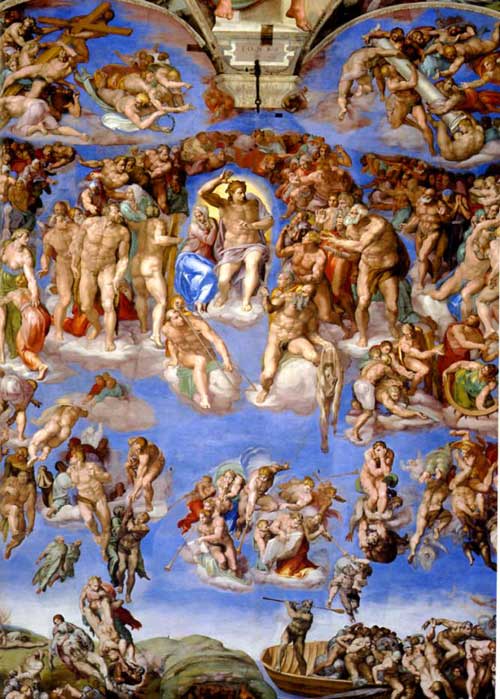
[Above (click to enlarge): The Last Judgement by Michelangelo, Sistine Chapel.]

comment under my post "Main reasons why Jehovah's Witnessism is false."

Here is what leading New Testament Greek lexicons and other reference works say about Tartarus (my emphasis is red below):

1. Tartarus is a place. Remember that the Watchtower Bible & Tract Society's claim is that:

"As we have seen, the Tartarus of the Bible is not a place but a condition and, therefore, is not the same as this Tartarus of Greek mythology." (WB&TS, 1988, "Insight on the Scriptures, Volume 2," p.1069).

But note the below language of place in New Testament Greek lexicons in respect of Tartarus: "abode of the damned"; "place lower than Hades," "place of punishment," "subterranean region," and "where they suffer punishment":

"... Tartaros, a Greek name for the under-world, esp. the abode of the damned ..." (Abbott-Smith, 1937, "A Manual Greek Lexicon of the New Testament," p.440).

"Tartaroo ... Tartarus, thought of by the Greeks as a subterranean place lower than Hades where divine punishment was meted out, was so regarded in Jewish apocalyptic as well ..." (Arndt & Gingrich, 1957, "A Greek-English Lexicon of the New Testament and Other Early Christian literature," p.813).

"tartarosas. ... the place of punishment of the fallen angels ...." (Robertson, 1933, "Word Pictures in the New Testament: Volume VI, p.162).

"tartarosas ... the name of a subterranean region, doleful and dark, regarded by the ancient Greeks as the abode of the wicked dead, where they suffer punishment for their evil deeds; it answers to the Gehenna of the Jews..." (Thayer, 1901, "A Greek-English Lexicon of the New Testament," p.615).

2. Tartarus contains human souls. The Watchtower Society claims that:

"... the mythological Tartarus was presented not as a place for humans but as a place for superhuman creatures. ... the Scriptural Tartarus is clearly not for the detention of human souls ... but is only for wicked superhuman spirits who are rebels against God." (WB&TS, 1988, Ibid., p.1069).

But New Testament Greek lexicons say that Tartarus of the Greeks was: "the abode of the damned"; the "abode of the wicked dead," i.e. not only of wicked gods but also of wicked humans, "where they suffer punishment":

"... Tartaros, a Greek name for the under-world, esp. the abode of the damned ..." (Abbott-Smith, 1937, Ibid, p.440).

"... tartarosas ... the dark and doleful abode of the wicked dead like the Gehenna of the Jews ... " (Robertson, 1933, Ibid, p.162).

"tartarosas ... the abode of the wicked dead, where they suffer punishment for their evil deeds ..." (Thayer, 1901, Ibid, p.615).

The whole point of Peter's parallel between the "false teachers" and the "angels when they sinned" is that just as "God ... sent them [the angels] to Tartarus, putting them into gloomy dungeons to be held for judgment," so also "the Lord" would "hold the unrighteous [false teachers] for the day of judgment, while continuing their punishment":

2 Peter 2:1-4,9 (NIV) 1 But there were also false prophets among the people, just as there will be false teachers among you. They will secretly introduce destructive heresies, even denying the sovereign Lord who bought them-bringing swift destruction on themselves. 2 Many will follow their shameful ways and will bring the way of truth into disrepute. 3 In their greed these teachers will exploit you with stories they have made up. Their condemnation has long been hanging over them, and their destruction has not been sleeping. 4 For if God did not spare angels when they sinned, but sent them to hell [Tartarus], putting them into gloomy dungeons to be held for judgment; ... 9 if this is so, then the Lord knows how to rescue godly men from trials and to hold the unrighteous for the day of judgment, while continuing their punishment.

Clearly the "gloomy dungeons" called "Tartarus," where the evil angels are "held for judgment," is the parallel equivalent of where "the Lord ... hold[s] unrighteous" humans "for the day of judgment, while continuing their punishment."

Peter's (and Jude's) is an a fortiori argument (from the greater to the less), as these quotes by Christian commentators point out:

"... the angels that had revolted. Neither their former rank, their dignity, nor their holiness, saved them from being thrust down to hell; and if God punished them so severely, then false teachers could not hope to escape. ... The argument in this verse is, that if God punished the angels who revolted from him, it is a fair inference that he will punish wicked men, though they were once professors of religion." (Barnes, 1962, "Barnes' Notes on the New Testament," p.1449-1450).

"[2Pet 2:]4. For if. ... As far as angels are concerned, the argument is from the greater to the less. Although they were far more exalted, yet their dignity did not save them from the hand of God. Much less, therefore, will mortal men who have followed their impiety escape." (Calvin, 1963, "The Epistle to the Hebrews and the First and Second Epistles of St. Peter," pp.347-348).

3. Tartarus is a place of conscious torment. The Watchtower Society claims that:

"The sinful angels and the dead human souls are not associated together in tar'taoros as a place of eternal conscious torment of creatures." (WB&TS, 1984, "New World Translation of the Holy Scriptures: With References," [1961], Watchtower Bible & Tract Society of New York: Brooklyn NY, p.1575).

I have agreed in part #1 that Tartarus is not "eternal" but an Intermediate State. So our disagreement is that Tartarus is a place and state of "conscious torment".

But the following New Testament Greek lexicons state that Tartarus was "where divine punishment was meted out,"and where "the wicked dead ... suffer punishment ":

"Tartaroo ... Tartarus, thought of by the Greeks as a subterranean place lower than Hades where divine punishment was meted out..." (Arndt & Gingrich, 1957, Ibid., p.813).

"tartarosas ... regarded by the ancient Greeks as the abode of the wicked dead, where they suffer punishment for their evil deeds; it answers to the Gehenna of the Jews..." (Thayer, 1901, Ibid., p.615).

And clearly "punishment" entails that whoever is being punished is "conscious" of that punishment. Indeed the Watchtower admits that in its claim that being "not conscious" entails "not suffering":

"Our dead loved ones are not conscious of anything. They are not suffering ...." (WB&TS, 1995, "Knowledge That Leads to Everlasting Life," pp.82-83).

4. The Tartarus of the Bible is based on the Tartarus of Greek mythology. That is, Peter and Jude (2Pet 2:4 & Jude 6) are quoting from the apocryphal "Book of Enoch," which in turn used the Greek mythological concept of Tartarus, being the place of confinement and punishment of the rebellious Greek gods, as an illustration of the place where the rebellious angels were confined and punished:

"[2Pet 2:4] ... Cast them down to hell (tartarosas). .... Tartaros occurs in Enoch 20:2 as the place of punishment of the fallen angels" (Robertson, 1933, "Word Pictures in the New Testament: Volume VI, p.162).

"tartaroo ... the subterranean abyss of Greek mythology where demigods were punished. It is mentioned in the pseudepigraphical book of Enoch as the place where fallen angels are confined. It is found only in its verbal form in 2 Pet. 2:4 .... Peter has adapted a word and not adopted a theology." (Zodhiates, 1992, "The Complete Word Study Dictionary: New Testament," p.1367).

Here is what New Testament Greek lexicons say about the Tartarus of the Bible being based on the Tartarus of Greek mythology:

"Tartaroo ... Tartarus, thought of by the Greeks as a subterranean place lower than Hades where divine punishment was meted out, was so regarded in Jewish apocalyptic as well ..." (Arndt & Gingrich, 1957, Ibid, p.813).

"tartarosas ... the abode of the wicked dead, where they suffer punishment for their evil deeds; it answers to the Gehenna of the Jews ..." (Thayer, 1901, Ibid, p.615).

"tartarosas ... It is strange to find Peter using this Pagan term, which represents the Greek hell ..." (Vincent, 1887, "Word Studies in the New Testament: Volume I," p.691).

Note that both "the Greeks" and "Jewish apocalyptic" had come to think of Tartarus as a "place lower than Hades where divine punishment was meted out," "the abode of the wicked dead," i.e. humans, "where they suffer punishment for their evil deeds," it representing "the Greek hell."

5. Tartarus does bear a relationship to Hades. The Watchtower claims that "Tartarus bears no relationship to Hades" and yet it also claims that "Tartarus is ... far below Hades. "

"In the Iliad, by the ancient poet Homer, the word tar'taoros denotes an underground prison ... below Hades ... In the inspired Scriptures, Tartarus bears no relationship to Hades ... " (WB&TS, 1984, Ibid, p.1575).

"Tartarus is, therefore, not the same as the Hebrew Sheol or the Greek Hades ... Tartarus is represented as an underground prison ... far below Hades. " (WB&TS, 1988, Ibid, pp.1068-1069).

But as I pointed out in part #1, this is self-refuting in that if Tartarus is "below Hades" then it bears a "relationship to Hades," namely below it!

And as previously quoted, both "the Greeks" and "Jewish apocalyptic" thought of Tartarus as bearing the same relationship to Hades as a "place lower than Hades where divine punishment was meted out"; and also that "Tartarus. .. is part of the realm of death designated in Scripture as She'ol ... in the OT and Hades ... in the NT":

"Tartaroo ... Tartarus, thought of by the Greeks as a subterranean place lower than Hades where divine punishment was meted out, was so regarded in Jewish apocalyptic as well ..." (Arndt & Gingrich, 1957, Ibid., p.813).

" tartaroo ... is found only in its verbal form in 2 Pet. 2:4 meaning to cast into or consign to Tartarus. It is part of the realm of death designated in Scripture as She'ol ... in the OT and Hades ... in the NT." (Zodhiates, 1992, Ibid., p.1367).

Indeed, "Tartarus ... in Greek mythology was the lower part ... of hades" and "answered to the Jewish word ... Gehenna":

"... Tartarus ... which in Greek mythology was the lower part, or abyss of hades, where the shades of the wicked were supposed to be imprisoned and tormented, and answered to the Jewish word ... Gehenna." (Barnes, 1962, Ibid.," p.1449-1450).

Besides, "the Iliad, by the ancient poet Homer" is "dated to the late 9th or 8th century BC," but in later Greek mythology, e.g. ~500 years later, by the time of "Plato (c. 400 BC)", Tartarus was held to be within Hades" and moreover human "souls... who received punishment were sent to Tartarus":

"Originally only great sinners like Ixion, Sisyphus, and Tityus, who had offended the gods personally, were punished in Tartarus. But ... Plato [c. 428-347 BC]. According to the latter, the dead were judged ... and were consigned either to Tartarus or to the Isles of the Blest." (Pollard, 1974, "Greek Religion," Encyclopaedia Britannica, p.8:408).

"In classic Greek mythology ... Tartarus... resides within Hades ... with Tartarus being the hellish component. ... Plato (c. 400 BC) wrote that souls were judged after death and those who received punishment were sent to Tartarus." ("Tartarus," Wikipedia, 15 September 2008).

"Originally, Tartarus was used only to confine dangers to the gods of Olympus. In later mythologies ... the judges of the dead ... chose who went to Tartarus .... to be punished in accordance with their sins." ("Tartarus in Greek Mythology," Wikipedia, 15 September 2008).

And the Watchtower conveniently ignores that there was also a Tartarus in Roman mythology, which meant " the underworld," "the infernal regions", i.e. "Of or relating to a lower world of the dead." ("infernal," The American Heritage Dictionary, 2000):

"Tartareus ... Of or belonging to the underworld ... The infernal regions, the underworld." (Glare, 1982, p.1908).

"1. Tartarus ... plur. - Tartara, the infernal regions ... Hence, A. Tartareus ... of or belonging' to the infernal regions, Tartarean, infernal ... Tartarean, infernal ..." (Lewis & Short, 1890, p.843).

To the Romans, Tartarus was the place where sinners are sent ... At the bottom of this pit lie the Titans ... and many other sinners" and "Still more sinners are contained inside Tartarus":

"In Roman mythology, Tartarus is the place where sinners are sent. Virgil describes it in the Aeneid [written ... between 29 and 19 BC ...] as a gigantic place .... There is a pit inside which is said to extend down into the earth twice as far as the distance from the lands of the living to Olympus. At the bottom of this pit lie the Titans, the twin sons of Aloeus and many other sinners. Still more sinners are contained inside Tartarus, with punishments similar to those of Greek myth." ("Roman Mythology's Tartarus," Wikipedia, 15 September 2008).

The Watchtower Society, with its vast Bethel library must know all this, so it can only be deliberately withholding this additional information about Tartarus from its members, in order to keep them in the dark. In which case, Jehovah's Witnesses should heed the Watchtower's own warning:

"Knowing these things, what will you do? ... `the God of truth' and who hates lies, will not look with favor on persons who cling to organizations that teach falsehood. ... And, really, would you want to be even associated with a religion that had not been honest with you? " (WB&TS, 1974, "Is This Life All There Is?,"p.46).

To be continued in, "There is no literal place of fiery torture for lost souls." Quotes referenced above are hyperlinked to the full quote in the `tagline' below (emphasis original italics, emphasis bold mine).

Stephen E. Jones.
My other blogs: CreationEvolutionDesign & TheShroudofTurin


"tartaroo, -o (< Tartaros, a Greek name for the under-world, esp. the abode of the damned), to cast into hell : II Pe 2:4 (v. Mayor, in l.)." (Abbott-Smith, G., 1937, "A Manual Greek Lexicon of the New Testament," [1921], T. & T. Clark: Edinburgh, Third edition, Reprinted, 1956, p.440. My transliteration).

"Tartaroo 1 aor. etartarosa (Acusilaus Hist. [V BC] 8 ed. AJC. I p. 50; Philodemus, p. euseb. 32, 19 Gomp.; Jo. Lydus, Men. 4, 158 p. 174, 26 W.; cf. Sext. Empir., Pyrrh. Hypot. 3, 24, 210 o Zeus ton Kronon katetartarosen. Tartarus, thought of by the Greeks as a subterranean place lower than Hades where divine punishment was meted out, was so regarded in Jewish apocalyptic as well: Job 41:24; En. 20, 2; Philo, Exs. 152; Jos., C. Ap. 2, 240; Sib. Or. 2, 302; 4, 186) hold captive in Tartarus 2 Pt 2:4." (Arndt, W.F. & Gingrich, F.W., 1957, "A Greek-English Lexicon of the New Testament and Other Early Christian literature," University of Chicago Press: Chicago IL, Fourth edition, 1952, Revised, p.813. Emphasis original. My transliteration).

"[2Pet 2:]4. For if God spared not the angels that sinned. The apostle now proceeds to the proof of the proposition that these persons would be punished. It is to be remembered that they had been, or were even then, professing Christians, though they had really, if not in form, apostatized from the faith, (vers. 20-22;) and a part of the proofs, therefore, are derived from the cases of those who had apostatized from the service of God. He appeals, therefore, to the case of the angels that had revolted. Neither their former rank, their dignity, nor their holiness, saved them from being thrust down to hell; and if God punished them so severely, then false teachers could not hope to escape. ... But cast them down to hell. Gr., tartarosas - `thrusting them down to Tartarus.' The word here used occurs nowhere else in the New Testament, though it is common in the classic writers. It is a verb formed from Tartaros (Tartarus,) which in Greek mythology was the lower part, or abyss of hades, where the shades of the wicked were supposed to be imprisoned and tormented, and answered to the Jewish word Geena -Gehenna. It was regarded, commonly, as beneath the earth; as entered through the grave; as dark, dismal, gloomy; and as a place of punishment. ... And delivered them into chains of darkness. `... The meaning seems to be, that they are confined in that dark prison-house as if by chains. We are not to suppose that spirits are literally bound; but it was common to bind or fetter prisoners who were in dungeons, and the representation here is taken from that fact. ... To be reserved unto judgment. Jude 6, ` to the judgment of the great day,' They will then, with the revolted inhabitants of this world, be brought to trial for their crimes. That the fallen angels will be punished after the judgment is apparent from Rev. xx. 10. The argument in this verse is, that if God punished the angels who revolted from him, it is a fair inference that he will punish wicked men, though they were once professors of religion." (Barnes, A., 1962, "Barnes' Notes on the New Testament," [1832], Cobbin, I., ed., Kregel: Grand Rapids MI, Fifth printing, 1970, p.1449-1450. Emphasis original).

"2Pet 2:]4. For if. We have said how much it helps us to know that the ungodly who corrupt the Church by their wicked teachings cannot escape the vengeance of God. He gives evidence of this by three notable examples of divine judgment-that He did not even spare the angels, that He once obliterated the whole world at the Flood, and that He reduced Sodom and other neighbouring cities to ashes. ... As far as angels are concerned, the argument is from the greater to the less. Although they were far more exalted, yet their dignity did not save them from the hand of God. Much less, therefore, will mortal men who have followed their impiety escape. ... To chains of darkness. This metaphor means that they are held bound in darkness to the last day. This comparison is drawn from criminals, who, after they are condemned, suffer half their punishment in the harshness of imprisonment until they are dragged out for the final penalty. Hence we may conclude not only what punishment the wicked endure after death, but also what is the condition of the children of God. They rest peacefully in the sure hope of blessedness, even though they do not yet enjoy it, just as the others endure terrible torture at the thought of the vengeance in store for them." (Calvin, J., 1963, "The Epistle to the Hebrews and the First and Second Epistles of St. Peter," [1549], Johnston, W.B., transl., Eerdmans: Grand Rapids MI, Sixth reprinting, 1980, pp.347-348).

"Tartareus ~a ~um, a. Of or belonging to the underworld, Tartarean. e ~a..plaga CIC. Tusc.2.22 (transl. Sophocles); ~i.. Acherontis ad undas VERG. A.6.296; ~um..custodem (i.e. Cerberus) 6.395; sorores ~ae (i.e. Furies) 7.328; ~as.. domos Ov.Fast.3.620; ~um..deum Tr.1.9.32; ~us canis SEN.Her.F.649; per ~os lacus Phaed.1179; ~i..patris (i.e. Pluto) V.FL.1.828; ~o ululatu 4.393: MART.5.34.4; ~i regina barathri STAT.Theb.1.85; ~o..Ioui (i.e. Pluto) SIL..2.674; (humorously) quos..capacis alui mersit ~o specu PHAED.4.7.10. ... Tartarus (~os) ~i, m. The infernal regions, the underworld. b (personified). ~us horriferos eructans faucibus aestus LUCR.3.1012; tum ~us ipse bis patet in praeceps tantum VERG. A.6.577; datum Pelea ~o HOR.Carm.3.7.17; Max.2.46; noscis ~on et procul nocentum audis uerbera STAT.Silv.2.7.117; (wrongly stated by Varro to have been regarded by Plato as a river in the underworld) VAR.L.7.37. b pater. ~us V.FL. 4.258; ex Aethere et Terra.~us HYG.Fab.3(18+12); 152.1." (Glare, P.G.W., ed., 1982, "Oxford Latin Dictionary," [1968], Clarendon Press: Oxford UK, p.1908).

"1. Tartarus or,. -os i, m., in plur. (on prosodial grounds): Tartara, orum, n., = Tartaros, plur. - Tartara, the infernal regions, Tartarus (poet.; in prose, inferi); sing., Lucr. 3, 1012.; Verg. A. 6, 577; Hor. C. 3, 7,17; Stat. S. 2, 7,116; plur., Lucr. 3, 42; 3, 966; 5;1126; Verg. A. 4, 243; 6, 135; Hor. C. 1, 28, 10, Ov. M. 1, 113; 5, 371; 5, 423; 10, 21 et saep. a1.-Personified : Tartarus pater, i.e. Pluto, Val. Fl. 4, 258.- Hence, A. Tartareus a, um, adj., of or belonging' to the infernal regions, Tartarean, infernal: tenebrica plaga, Cic. pout, Tusc. 2, 9, 22: antrum, i.e., the infernal regions, Luc. 6, 712; umbrae, Ov. M. 6, 676; 12, 257: custos, i.e. Cerberus; Verg. A. G, 395: Acheron, id. ib. 6, 295: 'Phlegethon, id. ib. 6, 551: sorores, i.e. the Furies, id. ib. 7, 328; Stat. Th. 5, 66;. hence, vox Alectus, Verg. A. 7, 514. - B. Tartarinus, a, um, adj., Tartarean, infernal; poet. for horrid, terrible: Tartarino cum dixit Ennius, horrendo et terribili Verrius vult accipi, a Tartaro, qui locus apud inferos, Fest. p, 359. Mull.: corpore Tartarino prognata Paluda virago, Enn. ap. Varr. L, L.7, 37 ib. - Trop.: delator, Amm. 15, 6, 1." (Lewis, C.T. & Short, C.S. , 1890, "A Latin Dictionary," Clarendon Press: Oxford UK, p.843).

"Eschatology. In Homer [c. 850 BC] only the gods were immortal, but Elysium was reserved for their favoured sons-in-law, who were also exempt from death. Heracles alone gained a place on Olympus by his own efforts. The ordinary hero hated death, for the dead were regarded as strengthless doubles who had to be revived with drafts of blood, mead, wine, and water in order to enable them to speak. They were conducted, it was believed, to the realm of Hades by Hermes; but the way was barred, according to popular accounts, by the marshy river Styx. Across this, Charon ferried all who had received at least token burial, and coins were placed in the mouths of corpses to pay the fare. Originally only great sinners like Ixion, Sisyphus, and Tityus, who had offended the gods personally, were punished in Tartarus. But the doctrines of the Orphics influenced Pindar, Empedocles, and, above all, Plato [c. 428-347 BC]. According to the latter, the dead were judged in a meadow by Aeacus, Minos, and Rhadamanthus and were consigned either to Tartarus or to the Isles of the Blest. Long periods of purgation were required before the wicked could regain their celestial state, while some were condemned forever. The dead were permitted to choose lots for their next incarnation, but usually their choice was unwise. Subsequently they drank from the stream of Lethe, the river of oblivion, and forgot all." (Pollard, J.R.T., 1974, "Greek Religion," in Encyclopaedia Britannica, Benton: Chicago IL, 15th Edition, Reprinted, 1984, Vol. 8, p.408).

"[2Pet 2:4] ... Cast them down to hell (tartarosas). First aorist active participle of tartaroo, late word (from tartaros, old word in Homer, Pindar, LXX Job 40:15; 41:23, Philo, inscriptions, the dark and doleful abode of the wicked dead like the Gehenna of the Jews), found here alone save in a scholion on Homer. Tartaros occurs in Enoch 20:2 as the place of punishment of the fallen angels, while Gehenna is for apostate Jews. Committed (paredoken). First aorist active indicative of paradidomi, the very form solemnly used by Paul in Rom. 1:21, 26, 28. To pits of darkness (seirois zophou). Zophos (kin to gnophos, nephos) is an old word, blackness, gloom of the nether world in Homer, in N.T. only here, verse 17; Jude 13; Heb. 12:18. The MSS. vary between seirais (seira, chain or rope) and seirois (seiros, old word for pit, underground granary). Seirois is right (Aleph A B C), dative case of destination. To be reserved unto judgment (eis krisin teroumenous). Present (linear action) passive participle of tereo. `Kept for judgment.' Cf. 1 Pet. 1:4. Aleph A have kolazomenous terein as in verse 9. Note krisis (act of judgment)." (Robertson, A.T., 1933, "Word Pictures in the New Testament: Volume VI: General Epistles, Revelation and John," Broadman Press: Nashville TN, p.162).

"tartaroo, -o: aor. ptcp. tartarosas; (tartaros, the name of a subterranean region, doleful and dark, regarded by the ancient Greeks as the abode of the wicked dead, where they suffer punishment for their evil deeds; it answers to the Gehenna of the Jews, see geenna); to thrust down. to Tartarus (sometimes in the Scholiasts) [cf. W. 25. (24) n.] ; to hold captive in Tartarus: tina seirais [q. v.] zophou, 2 Pet. ii. 4 [A. V. cast down to hell (making the dat. depend on paredoken)]." (Thayer, J.H., 1901, "A Greek-English Lexicon of the New Testament," T & T. Clark: Edinburgh, Fourth edition, Reprinted, 1961, p.615. My transliteration).

"[2Pet 2:4]. The angels. No article. Angels. So Rev. Compare Jude 6. Cast them down to hell (tartarosas). Only here in New Testament. From Tartaros, Tartarus. It is strange to find Peter using this Pagan term, which represents the Greek hell, though treated here not as equivalent to Gehenna, but as the place of detention until the judgment. Chains of darkness (serais zuphou). Zeira is a cord or band, sometimes of metal. Compare Septuagint, Prov. v. 22 Wisd. of Sol. xvii. 2, 18. The best texts, however, substitute sirois or seirois, pits or caverns. Ziros originally is a place for storing corn. Rev., pits of darkness. Of darkness (zuphou). Peculiar to Peter and Jude. Originally of the gloom of the nether world, So Homer: ...Odyssey, xx., 355 ... , xi., 155. Compare Jude 13." (Vincent, M.R., 1887, "Word Studies in the New Testament: Volume I: Synoptic Gospels; Acts of the Apostles; Epistles of Peter, James, and Jude," Eerdmans: Grand Rapids MI, Reprinted, 1969, p.691. Emphasis original. My transliteration).

"Knowing these things, what will you do? It is obvious that the true God, who is himself `the God of truth' and who hates lies, will not look with favor on persons who cling to organizations that teach falsehood. (Psalm 31:5; Proverbs 6:16-19; Revelation 21:8) And, really, would you want to be even associated with a religion that had not been honest with you? " (WB&TS, 1974, "Is This Life All There Is?," Watchtower Bible & Tract Society of New York: Brooklyn NY, p.46).

"In the inspired Scriptures, Tartarus bears no relationship to Hades, which is the common grave of the human dead. The sinful angels and the dead human souls are not associated together in tar'taoros as a place of eternal conscious torment of creatures. Tartarus will pass away when the Supreme Judge destroys the rebellious angels presently in that condition of abasement..." (WB&TS, 1984, "New World Translation of the Holy Scriptures: With References," [1961], Watchtower Bible & Tract Society of New York: Brooklyn NY, p.1575).

"In Homer's Iliad this mythological Tartarus is represented as an underground prison `as far below Hades as earth is below heaven.' In it were imprisoned the lesser gods, Cronus and the other Titan spirits. As we have seen, the Tartarus of the Bible is not a place but a condition and, therefore, is not the same as this Tartarus of Greek mythology. However, it is worth noting that the mythological Tartarus was presented not as a place for humans but as a place for superhuman creatures. So, in that regard there is a similarity, since the Scriptural Tartarus is clearly not for the detention of human souls (compare Mt 11:23) but is only for wicked superhuman spirits who are rebels against God." (WB&TS, 1988, "Insight on the Scriptures, Volume 2: Jehovah - ZuZim," Watchtower Bible & Tract Society: Brooklyn NY, p.1069).

"Solomon further explained what death means, saying: `The living are conscious that they will die; but as for the dead, they are conscious of nothing at all.' Yes, the dead know absolutely nothing. In view of this, Solomon urged: `All that your hand finds to do, do with your very power, for there is no work nor devising nor knowledge nor wisdom in Sheol, the place to which you are going.' (Ecclesiastes 9:5, 10) Where do the dead go? To Sheol (Hebrew, she'ohl'), the common grave of mankind. Our dead loved ones are not conscious of anything. They are not suffering, and they cannot affect us in any way." (WB&TS, 1995, "Knowledge That Leads to Everlasting Life," [1984], Watchtower Bible & Tract Society of New York: Brooklyn NY, Second edition, pp.82-83).

"In Roman mythology, Tartarus is the place where sinners are sent. Virgil describes it in the Aeneid as a gigantic place, surrounded by the flaming river Phlegethon and triple walls to prevent sinners from escaping from it. It is guarded by a hydra with fifty black gaping jaws, which sits at a screeching gate protected by columns of solid adamantine, a substance akin to diamond - so hard that nothing will cut through it. Inside, there is a castle with wide walls, and a tall iron turret. Tisiphone, one of the Erinyes who represents revenge, stands guard sleepless at the top of this turret lashing a whip. There is a pit inside which is said to extend down into the earth twice as far as the distance from the lands of the living to Olympus. At the bottom of this pit lie the Titans, the twin sons of Aloeus and many other sinners. Still more sinners are contained inside Tartarus, with punishments similar to those of Greek myth." ("Roman Mythology's Tartarus," Wikipedia, 15 September 2008).

"In classic Greek mythology, below Heaven, Earth, and Pontus is Tartarus, or Tartaros (Greek Tartaros, deep place). It is either a deep, gloomy place, a pit, or an abyss used as a dungeon of torment and suffering that resides within Hades (the entire underworld) with Tartarus being the hellish component. In the Gorgias, Plato (c. 400 BC) wrote that souls were judged after death and those who received punishment were sent to Tartarus. As a place of punishment, it can be considered a hell. The classic Hades, on the other hand, is more similar to Old Testament Sheol." ("Tartarus," Wikipedia, 15 September 2008).

"In Greek mythology, Tartarus is both a deity and a place in the underworld even lower than Hades. ... It is a dank and wretched pit engulfed in murky gloom. ... While, according to Greek mythology, Hades is the place of the dead, Tartarus also has a number of inhabitants. ... Originally, Tartarus was used only to confine dangers to the gods of Olympus. In later mythologies, Tartarus became the place where the punishment fits the crime. ... According to Plato (c. 400), Rhadamanthus, Aeacus and Minos were the judges of the dead and chose who went to Tartarus. Rhadamanthus judged Asian souls; Aeacus judged European souls and Minos was the deciding vote and judge of the Greek. Plato also proposes the concept that sinners were cast under the ground to be punished in accordance with their sins." ("Tartarus in Greek Mythology," Wikipedia, 15 September 2008).

"tartaroo; contracted tartaro, fut. tartaroso, from Tartaros (n.f.), the subterranean abyss of Greek mythology where demigods were punished. It is mentioned in the pseudepigraphical book of Enoch as the place where fallen angels are confined. It is found only in its verbal form in 2 Pet. 2:4 meaning to cast into or consign to Tartarus. It is part of the realm of death designated in Scripture as She'ol (7585, OT) in the OT and Hades (86) in the NT. These angels are being held in this netherworld dungeon until the day of final judgment. Peter's usage of this term is not evidence either that Christianity was a syncretistic religion or that Peter himself believed in the pagan myths about Tartarus. Peter has adapted a word and not adopted a theology." (Zodhiates, S., 1992, "The Complete Word Study Dictionary: New Testament," AMG Publishers: Chattanooga TN, Third printing, 1994, p.1367. My transliteration).

Friday, November 7, 2008

Re: `Tartarus' is a Greek name for a type of prison that the demons were relegated to #1

Pam

Continuing from Re: `Gehenna' is a symbol for complete destruction #2, of my response to your comment under my

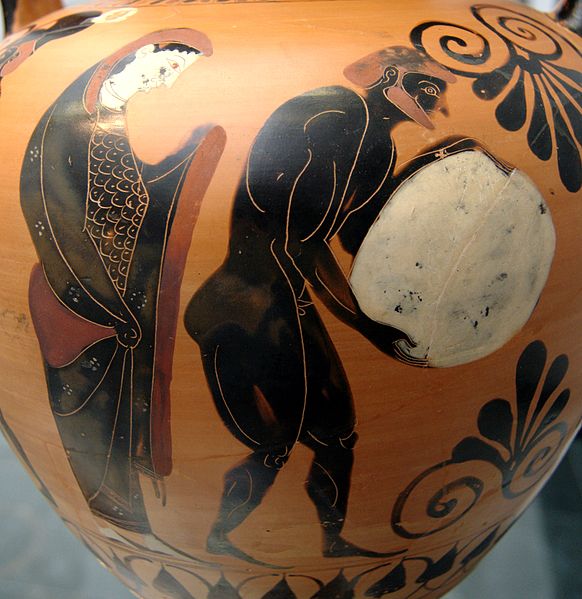
[Above (click to enlarge): The Greek god Sisyphus, who was sentenced by Zeus to Tartarus, where he must endlessly roll a large rock up a mountainside, which when he reached the top, the rock rolled back down again, and again, and again ...!: Wikipedia]

post "Main reasons why Jehovah's Witnessism is false."

Yours and the Watchtower Bible & Tract Society's words are bold to distinguish them from my response. My emphasis is red below

>and "Tartarus" is a Greek name for a type of prison that the demons were relegated to when they disobeyed God in the days of Noah....it is a situation of spiritual darkness for the demons.

As a Christian, I have no problem with the above. But I do have a problem what it does not say, but implies, that Tartarus: 1) is only for "demons," not for the souls of the wicked human dead; and 2) it is only a condition of "spiritual darkness," not a place of conscious punishment.

The Greek word tartarosas is only found in the Bible in 2Pet 2:4, where it is translated Tartarus in the NIV margin:

"For if God did not spare angels when they sinned, but sent them to hell [Tartarus], putting them into gloomy dungeons to be held for judgment;"

Here are quotes of what the Watchtower Society has claimed about Tartarus, since at least 1943 (click on the hyperlink for the full quote):

1. "Tartarus of the Bible is not a place but a condition":

"The angels that so sinned... Jehovah God. ... debased them to the state or condition symbolically called `Tartarus'. ... in their state of Tartarean degradation they await the execution of that sentence with Satan the Devil at the judgment day. The inspired revelation concerning this says: `... For if God spared not angels when they sinned, but cast them down to Tartarus, and committed them to pits of darkness, to be reserved unto judgment.' (2 Peter 2: 3, 4 ...) `And the angels which kept not their first estate, but left their own habitation, he hath reserved in everlasting chains under darkness unto the judgment of the great day.'- Jude 6." (WB&TS, 1943, "The Truth Shall Make You Free," pp.131-132).

"... `God did not hold back from punishing the angels that sinned, but, by throwing them into Tartarus, delivered them to pits of dense darkness to be reserved for judgment.' (2 Peter 2:4) ... Jude 6 ... adds: `The angels that did not keep their original position but forsook their own proper dwelling place ... There is no Scriptural basis for concluding that these disobedient angels are in a place like the mythological Tartarus .... `throwing into Tartarus' need not be viewed as suggesting the existence of an actual place, but as suggesting a condition." (WB&TS, 1974, "Is This Life All There Is?," pp.84-85).

"The apostle Peter continues ...if God did not hold back from punishing the angels that sinned, but, by throwing them into Tartarus, delivered them to pits of dense darkness to be reserved for judgment ... Jehovah knows how ... to reserve unrighteous people for the day of judgment to be cut off ....'-2 Peter 2:3-10. ... angels ...who later became unfaithful were ...`thrown into Tartarus,' that is, debased to the lowest degree. ... the disobedient angels find themselves in a condition comparable to `pits of dense darkness,' awaiting executional judgment ..." (WB&TS, 1979, "Choosing the Best Way of Life," pp.152-153).

"TARTARUS ... A prisonlike, abased condition into which God cast disobedient angels in Noah's day. ... Tartarus is a condition rather than a particular location ... Tartarus of the Bible is not a place but a condition ..." (WB&TS, 1988, "Insight on the Scriptures, Volume 2, pp.1068-1069).

"Instead, the Bible says that `God did not hold back from punishing the angels that sinned, but, by throwing them into Tartarus, delivered them to pits of dense darkness to be reserved for judgment.'-2 Peter 2:4. These wicked angels were not thrown into a literal place called Tartarus. Rather, Tartarus, which is mistranslated `hell' in some Bibles, refers to the abased or fallen condition of these angels. They were cut off from the spiritual light of God's organization, and they have only everlasting destruction awaiting them. (James 2:19; Jude 6)" (WB&TS, 1989, "You Can Live Forever in Paradise on Earth," pp.94-95).

The Society's fallacy here is that of false alternative: there is no reason why Tartarus could not be both a place and a condition. And note what the very Bible verses quoted by the Watchtower say: "cast them down," "left their own habitation," "committed them to pits of darkness," "forsook their own proper dwelling place," "throwing them into Tartarus," "delivered them to pits." This is clearly the language of place. In fact the Watchtower's own New World Translation of Jude 6 says: "forsook their own proper dwelling place" meaning they are now in an another "dwelling place," which the parallel passage 2Pet 2:4 says is "Tar´ta•rus"!

Moreover, since angels are not omnipresent, they must be in a place somewhere, and in the case of the wicked angels, that place, the Bible tells us, is Tartarus.

2. The "Scriptural Tartarus is ... not for the detention of human souls" :

"2 Peter 2:4 - `Tar'ta•rus' ... derived from the Greek verb tar•ta•ro'o) ... denotes an underground prison ... below Ha'des ... confined in it were not human souls, but the lesser gods... The inspired Scriptures do not consign any human souls to tar'ta•ros ..." (WB&TS, 1950, "New World Translation of the Christian Greek Scriptures," pp.785-786).

"... the word tar'ta•ros denotes an underground prison ... below Hades ... in it were not human souls, but the lesser gods ... tar'ta•ros was reputed to be a place for confining, not human souls, but Titan spirits ... The inspired Scriptures do not consign any human souls to tar'ta•ros but consign there only spirit creatures." (WB&TS, 1984, New World Translation of the Holy Scriptures: With References, p.1575).

"Tartarus ....in pre-Christian heathen mythologies. ... In it were imprisoned the lesser gods ... the mythological Tartarus was presented not as a place for humans ... the Scriptural Tartarus is clearly not for the detention of human souls ...." (WB&TS, 1988, Ibid, pp.1068-1069).

But this is another example of the Watchtower's fallacious argument that a word can only ever mean one thing. That is, if originally "Tartarus ....in pre-Christian heathen mythologies" meant a place in which "were imprisoned the lesser gods," that does not mean that Tartarus could not later come to mean a place in which were also imprisoned wicked human souls. Which in fact it did (see part #2).

Indeed, what would be the point of Peter's parallel between "God ... punishing the angels that sinned, but, by throwing them into Tar´ta•rus ... to be reserved for judgment" and "Jehovah knows how to ... reserve unrighteous people for the day of judgment" (2Pet 2:1, 4, 9), if the "angels that sinned" and "unrighteous people" were not both thrown "into Tar´ta•rus ... to be reserved for judgment"?

3. Tartarus is not "a place of eternal conscious torment":

"The sinner angels and the dead human souls are not associated together in tar'ta•ros as a place of eternal conscious torment of creatures." (WB&TS, 1950, Ibid., pp.785-786).

"The sinful angels and the dead human souls are not associated together in tar'ta•ros as a place of eternal conscious torment of creatures." (WB&TS, 1984, Ibid., p.1575).

These are the only two places (which are effectively one) that I can find where the Watchtower denies that Tartarus is a place of conscious torment. Agreed that Tartarus is not "eternal," since it is a place (and a state) of being "reserved for judgment." That is, it is an Intermediate State of the unrighteous dead while they awaiting final judgment after which they will be consigned to the Final State, Hell, which is "eternal."

Whether the wicked angels are "associated" together with the wicked human dead, the Bible does not say. But the clear impression is that the wicked angels are, as in an earthly prison, "conscious" but restrained by "bonds" (Jude 6), which would be unnecessary if the prisoners were unconscious. However, to be conscious but restrained in "bonds" for thousands, if not millions of years, would be a form of "torment," especially if they know they are "reserved for judgment."

4. The "Tartarus of the Bible ... is not the same as this Tartarus of Greek mythology":

"There is no Scriptural basis for concluding that these disobedient angels are in a place like the mythological Tartarus" (WB&TS, 1974, Ibid, pp.84-85).

"Tartarus is, therefore, not the same as the Hebrew Sheol or the Greek Hades ...in pre-Christian heathen mythologies. ... the Tartarus of the Bible ... is not the same as this Tartarus of Greek mythology." (WB&TS, 1988, Ibid, pp.1068-1069).

This is a fallacious half-truth. Obviously, to the extent it is "mythology," the "Tartarus of Greek mythology," by definition, has no real existence. But that does not mean that the basic concept of the pagan Greek (and Roman) Tartarus, of a place and/or state in the afterlife where the wicked gods (and wicked humans - see part #2), are punished, has much truth in common with the Biblical teaching of the afterlife.

Indeed, the very fact that the Biblical writers Peter and Jude used the same name, "Tartarus" of "Greek mythology," as an illustration of the Biblical teaching of the afterlife, is sufficient evidence that the "Tartarus of Greek mythology" and "the Tartarus of the Bible," on the points mentioned, are effectively the same. Clearly Peter and Jude's ex-pagan Greek Christian readers would have understood by "Tartarus" the same "Tartarus of Greek mythology"that they knew.

5. "In the inspired Scriptures, Tartarus bears no relationship to Hades" :

"In the Iliad, by the ancient poet Homer, the word tar'ta•ros denotes an underground prison ... below Hades ... In the inspired Scriptures, Tartarus bears no relationship to Hades ... " (WB&TS, 1984, Ibid, p.1575).

"Tartarus is, therefore, not the same as the Hebrew Sheol or the Greek Hades ... Tartarus is represented as an underground prison ... far below Hades. " (WB&TS, 1988, Ibid, pp.1068-1069).

This is self-refuting. If "tar'ta•ros denotes an underground prison ... below Hades" then by definition Tartarus bears a "relationship to Hades," namely below it! In fact, as we shall see in part #2, Tartarus was the lower part of Hades.

Continued in part #2. My emphasis is bold below.

Stephen E. Jones.
My other blogs: CreationEvolutionDesign & TheShroudofTurin


"The angels that so sinned came under sentence from Jehovah God. He degraded them from their blessed position in his lofty organization of light and truth, and debased them to the state or condition symbolically called `Tartarus'. Not having the light of the truth of God's purposes, they are not free, but are under God's continual surveillance as his opponents. Thus they are as in chains. They can never break free from His sentence of destruction upon them, but in their state of Tartarean degradation they await the execution of that sentence with Satan the Devil at the judgment day. The inspired revelation concerning this says: `Whose sentence now from of old lingereth not, and their destruction slumbereth not. For if God spared not angels when they sinned, but cast them down to Tartarus, and committed them to pits of darkness, to be reserved unto judgment.' (2 Peter 2: 3, 4, A.R.V., margin) `And the angels which kept not their first estate, but left their own habitation, he hath reserved in everlasting chains under darkness unto the judgment of the great day.'- Jude 6." (WB&TS, 1943, "The Truth Shall Make You Free," Watchtower Bible & Tract Society: Brooklyn NY, pp.131-132).

"2 Peter 2:4 - `Tar'ta•rus' (here derived from the Greek verb tar•ta•ro'o) `Tar'ta•rus' is included in the Greek verb (tar•ta•ro'o), and so in rendering the verb we have used the phrase, `by throwing them into Tar'ta•rus.' In the ancient poet Homer's Iliad the word tar'ta•ros denotes an underground prison as far below Ha'des as the earth was below heaven. Those confined in it were not human souls, but the lesser gods, spirits, namely, the Titans and Cronus, who had rebelled against Zeus (Jupiter). It was the prison established by the mythical gods for the spirits whom they had driven from the celestial regions, and so it was below the Ha'des where human souls were supposed to be confined at death. Thus tar'ta•ros was the lowest of the lower regions, and was a place of darkness. It enveloped all the underworld the same as the heavens enveloped all that was above the earth. We note, therefore, that tar'ta•ros was reputed to be a place for confining, not human souls, but Titan spirits, and that it was a place of darkness and of abasement. The word ... was used to signify a low place, yes, the `lowest part' of the abyss. Therefore it denotes a place or position of abasement. The inspired Scriptures do not consign any human souls to tar'ta•ros, but consign there only the `angels that sinned', namely, spirit creatures. Their being cast into tar'ta•ros denotes for them the deepest abasement while they are still alive, this in punishment for their sin of rebellion against the Most High God. The apostle Peter associates darkness with their low condition, saying further: God `delivered them to pits of dense darkness to be reserved for judgment'. (2 Peter 2:4) Doubtless, the pagans in their mythological traditions concerning Cronus and the rebellious Titan gods copied the inspired Scriptures. Peter's use of the verb tar•ta•ro'o meaning to `cast into tartarus' does not signify the `angels that sinned' were cast into the pagan mythological tartarus; but that they were debased by Almighty God from their heavenly place and privileges and were delivered over to dense mental darkness concerning God's bright purposes. Also they had only a dark outlook as to their own eternal destiny, which the Scriptures show is everlasting destruction with their ruler, Satan the Devil. In the inspired Scriptures, therefore, tar'ta•ros bears no relationship to Ha'des, which corresponds with the common grave of the human dead. The sinner angels and the dead human souls are not associated together in tar'ta•ros as a place of eternal conscious torment of creatures. Technically, therefore, tartarus will pass away when the Supreme Judge destroys the rebellious angels at present occupying that low, dark place or position." (WB&TS, 1950, "New World Translation of the Christian Greek Scriptures," Watchtower Bible & Tract Society of New York: Brooklyn NY, pp.785-786).

"... Genesis 6:1-4. During the Flood these sons of God lost their wives and their hybrid offspring. They themselves had to dematerialize. Respecting what happened to them thereafter, the Bible reports: `God did not hold back from punishing the angels that sinned, but, by throwing them into Tartarus, delivered them to pits of dense darkness to be reserved for judgment.' (2 Peter 2:4) And at Jude 6 it adds: `The angels that did not keep their original position but forsook their own proper dwelling place he has reserved with eternal bonds under dense darkness for the judgment of the great day.' As these descriptions relate to spirit creatures, it is evident that the `pits of dense darkness' and `eternal bonds' are not literal. These expressions simply convey to us a picture of restraint, a condition of debasement separated from all divine enlightenment. There is no Scriptural basis for concluding that these disobedient angels are in a place like the mythological Tartarus of Homer's Iliad, that is, in the lowest prison where Cronus and the other Titan spirits were said to be confined. The apostle Peter did not believe in any such mythological gods. So there is no reason to conclude that his use of the Greek expression `throwing into Tartarus' even hinted at the existence of the mythological place referred to by Homer some nine centuries earlier. In fact, in Greek the expression `throwing into Tartarus' is only one word, a verb, tar•ta•ro'o. It is also used to mean debasing to the lowest degree. ... the Greek verb rendered `throwing into Tartarus' need not be viewed as suggesting the existence of an actual place, but as suggesting a condition." (WB&TS, 1974, "Is This Life All There Is?," Watchtower Bible & Tract Society: Brooklyn NY, pp.84-85).

"The apostle Peter continues: `As for them, the judgment from of old is not moving slowly, and the destruction of them is not slumbering. Certainly if God did not hold back from punishing the angels that sinned, but, by throwing them into Tartarus, delivered them to pits of dense darkness to be reserved for judgment; and he did not hold back from punishing an ancient world, but kept Noah, a preacher of righteousness, safe with seven others when he brought a deluge upon a world of ungodly people; and by reducing the cities Sodom and Gomorrah to ashes he condemned them, setting a pattern for ungodly persons of things to come; and he delivered righteous Lot, who was greatly distressed by the indulgence of the law-defying people in loose conduct-for that righteous man by what he saw and heard while dwelling among them from day to day was tormenting his righteous soul by reason of their lawless deeds-Jehovah knows how to deliver people of godly devotion out of trial, but to reserve unrighteous people for the day of judgment to be cut off, especially, however, those who go on after flesh with the desire to defile it and who look down on lordship.'-2 Peter 2:3-10. The executional judgment that God has decreed `from of old' against all who come to belong to the `serpent's seed' will without fail be carried out. (Genesis 3:15; John 8:44; Jude 14, 15) Though originally stated about 6,000 years ago and repeated since then, this judgment is `not moving slowly' as if it will never arrive. The destruction is sure to come, for it is not dormant. It is still very much alive in God's purpose. As Peter noted, even angels who had enjoyed being in the very presence of God but who later became unfaithful were not spared being `thrown into Tartarus,' that is, debased to the lowest degree. Cut off from all divine enlightenment, debarred from their original position in the heavens and limited in their activities, the disobedient angels find themselves in a condition comparable to `pits of dense darkness,' awaiting executional judgment at the hands of Jesus Christ. (Compare Revelation 20:1-3, 7-10.)" (WB&TS, 1979, "Choosing the Best Way of Life," Watchtower Bible & Tract Society: Brooklyn NY, pp.152-153).

"'Tartarus' is found only in 2Pe 2:4. It is included in the Greek verb tar•ta•ro'o, and so in rendering the verb, the phrase `by throwing them into Tartarus' has been used. In the Iliad, by the ancient poet Homer, the word tar'ta•ros denotes an underground prison as far below Hades as the earth is below heaven. Those confined in it were not human souls, but the lesser gods, spirits, namely, Cronus and the other Titans who had rebelled against Zeus (Jupiter). It was the prison established by the mythical gods for the spirits whom they had driven from the celestial regions, and it was below the Hades where human souls were thought to be confined at death. In mythology tar'ta•ros was the lowest of the lower regions and a place of darkness. It enveloped all the underworld just as the heavens enveloped all that was above the earth. Therefore, in pagan Greek mythology tar'ta•ros was reputed to be a place for confining, not human souls, but Titan spirits, and a place of darkness and abasement. ... The inspired Scriptures do not consign any human souls to tar'ta•ros but consign there only spirit creatures, namely, `the angels that sinned.' Their being cast into tar'ta•ros denotes the deepest abasement for them while they are still living. This serves as punishment for their sin of rebellion against the Most High God. The apostle Peter associates darkness with their low condition, saying that God `delivered them to pits of dense darkness to be reserved for judgment.'-2Pe 2:4. The pagans in their mythological traditions concerning Cronus and the rebellious Titan gods presented a distorted view regarding the abasement of rebellious spirits. In contrast, Peter's use of the verb tar•ta•ro'o, `cast into Tartarus,' does not signify that `the angels that sinned' were cast into the pagan mythological Tartarus, but that they were abased by the Almighty God from their heavenly place and privileges and were delivered over to a condition of deepest mental darkness respecting God's bright purposes. Also they had only a dark outlook as to their own eventuality, which the Scriptures show is everlasting destruction along with their ruler, Satan the Devil. Therefore, Tartarus denotes the lowest condition of abasement for those rebellious angels. In the inspired Scriptures, Tartarus bears no relationship to Hades, which is the common grave of the human dead. The sinful angels and the dead human souls are not associated together in tar'ta•ros as a place of eternal conscious torment of creatures. Tartarus will pass away when the Supreme Judge destroys the rebellious angels presently in that condition of abasement." (WB&TS, 1984, "New World Translation of the Holy Scriptures: With References," [1961], Watchtower Bible & Tract Society of New York: Brooklyn NY, p.1575).

"TARTARUS (Tar'ta•rus). A prisonlike, abased condition into which God cast disobedient angels in Noah's day. This word is found but once in the inspired Scriptures, at 2 Peter 2:4. The apostle writes: `God did not hold back from punishing the angels that sinned, but, by throwing them into Tartarus, delivered them to pits of dense darkness to be reserved for judgment.' The expression `throwing them into Tartarus' is from the Greek verb tar•ta•ro'o and so includes within itself the word `Tartarus.' A parallel text is found at Jude 6: `And the angels that did not keep their original position but forsook their own proper dwelling place he has reserved with eternal bonds under dense darkness for the judgment of the great day.' Showing when it was that these angels `forsook their own proper dwelling place,' Peter speaks of `the spirits in prison, who had once been disobedient when the patience of God was waiting in Noah's days, while the ark was being constructed.' (1Pe 3:19, 20) This directly links the matter to the account at Genesis 6:1-4 concerning `the sons of the true God' who abandoned their heavenly abode to cohabit with women in pre-Flood times and produced children by them, such offspring being designated as Nephilim. ... From these texts it is evident that Tartarus is a condition rather than a particular location, inasmuch as Peter, on the one hand, speaks of these disobedient spirits as being in `pits of dense darkness,' while Paul speaks of them as being in `heavenly places' from which they exercise a rule of darkness as wicked spirit forces. (2Pe 2:4; Eph 6:10-12) The dense darkness similarly is not literally a lack of light but results from their being cut off from illumination by God as renegades and outcasts from his family, with only a dark outlook as to their eternal destiny. Tartarus is, therefore, not the same as the Hebrew Sheol or the Greek Hades, both of which refer to the common earthly grave of mankind. This is evident from the fact that, while the apostle Peter shows that Jesus Christ preached to these `spirits in prison,' he also shows that Jesus did so, not during the three days while buried in Hades (Sheol), but after his resurrection out of Hades.-1Pe 3:18-20. ... The word `Tartarus' is also used in pre-Christian heathen mythologies. In Homer's Iliad this mythological Tartarus is represented as an underground prison `as far below Hades as earth is below heaven.' In it were imprisoned the lesser gods, Cronus and the other Titan spirits. As we have seen, the Tartarus of the Bible is not a place but a condition and, therefore, is not the same as this Tartarus of Greek mythology. However, it is worth noting that the mythological Tartarus was presented not as a place for humans but as a place for superhuman creatures. So, in that regard there is a similarity, since the Scriptural Tartarus is clearly not for the detention of human souls (compare Mt 11:23) but is only for wicked superhuman spirits who are rebels against God." (WB&TS, 1988, "Insight on the Scriptures, Volume 2: Jehovah - ZuZim," Watchtower Bible & Tract Society: Brooklyn NY, pp.1068-1069).

"Instead, the Bible says that `God did not hold back from punishing the angels that sinned, but, by throwing them into Tartarus, delivered them to pits of dense darkness to be reserved for judgment.'-2 Peter 2:4. These wicked angels were not thrown into a literal place called Tartarus. Rather, Tartarus, which is mistranslated `hell' in some Bibles, refers to the abased or fallen condition of these angels. They were cut off from the spiritual light of God's organization, and they have only everlasting destruction awaiting them. (James 2:19; Jude 6)" (WB&TS, 1989, "You Can Live Forever in Paradise on Earth," [1982], Watchtower Bible & Tract Society of New York: Brooklyn NY, Second edition, pp.94-95).

Thursday, September 18, 2008

Re: `Gehenna' is a symbol for complete destruction #2

Pam

Continued from Re: `Gehenna' is a symbol for complete destruction #1 with this part #5 (see #1, #2, #3, #4) of my multi-

[Above (click to enlarge): Valley of Hinnom, Jerusalem (Heb. Ge Hinnom, Gk. geena, Lat. Gehenna), "Gehenna": Wikipedia]

part response to your comment under my post "Main reasons why Jehovah's Witnessism is false" and specifically to:

9. The Watchtower's doctrine of annihilation, denies the Bible's clear teaching of eternal punishment (Mt 25:46; 2Th 1:9; Rev 20:10) of the sins of those who reject God's offer of salvation through the death of His Son Jesus.

Again, your words are bold to distinguish them from my response.

"Gehenna" is a symbol for complete destruction,

Again, the original and primary meaning of the word "destruction" is "ruin", i.e. de-structure:

"destruction - noun 1 the action of destroying or the state of being destroyed. 2 a cause of someone's ruin. - ORIGIN Latin, from destruere `destroy'." (Compact Oxford English Dictionary).

as opposed to the original and primary meaning of the word "annihilation", which is "reduce to nothing":

"Annihilate ... - verb 1 destroy completely. 2 informal defeat completely. - DERIVATIVES annihilation noun annihilator noun. - ORIGIN Latin annihilare `reduce to nothing'." (Compact Oxford English Dictionary).

The primary Greek words rendered "destroy" or "destruction" in the New Testament, in the context of after death, are: apoleia, apollumi and olethros. According to the following New Testament Greek lexicons, the basic meaning of these words is destruction in the sense of ruin, not annihilation.

Apoleia The noun apoleia in the New Testament means, "destruction, waste, loss, perishing," and "ruin," with the special sense of "eternal destruction":

"apoleia ... destruction, waste, loss, perishing ... in special sense of ... the loss of eternal life, perdition ...." (Abbott-Smith, 1937, "A Manual Greek Lexicon of the New Testament," p.56).

"apoleia. ... `destruction,' `ruin,' b. `perishing,' c. `loss:' .... Eternal destruction is signified ..." (Kittel & Friedrich, 1985, "Theological Dictionary of the New Testament," p.67).

"apoleia... destroying, utter destruction ... perishing, ruin, destruction ... the destruction which consists in the loss of eternal life, eternal misery, perdition ..." (Thayer, 1901, "A Greek-English Lexicon of the New Testament, pp.70-71).

Specifically apoleia does not mean annihilation or extinction, but rather "final loss, not annihilation," "Endless perdition... not annihilation," "loss of well-being, not of being," and "must never be construed as meaning extinction":

"[Rom 9:22] Unto destruction (eis apoleian). Endless perdition... not annihilation." (Robertson, 1931, "Word Pictures in the New Testament," Vol. IV, p.385).

"[Jn 17:12] But the son of perdition (ei me ho huios tes apoleias). ... It means the son marked by final loss, not annihilation ..." (Robertson, Ibid: Vol. V, p.278).

"APOLEIA ... indicating loss of well-being, not of being ... of things, signifying their waste, or ruin ... of persons, signifying their spiritual and eternal perdition" (Vine, 1940, "An Expository Dictionary of New Testament Words," Vol. I., p.303).

"apoleia ... to destroy fully. ... the state after death wherein exclusion from salvation is a realized fact ... Apoleia and the verb apollumi ... must never be construed as meaning extinction. ... Neither the body becomes extinct, nor the spirit." (Zodhiates, 1992, "The Complete Word Study Dictionary: New Testament," p.246).

Apollumi A verb of apoleia is apollumi, which in the New Testament means, "destroy," "perish," "ruined," "loss of eternal life," "consigned to eternal misery":

apollumi ... to destroy utterly ... to perish ... loss of eternal life ... completion of the process of destruction ... of spiritual destitution and alienation from God ..." (Abbott-Smith, Ibid, p.52).

"'ap-ollumi ... to destroy ... to perish. ... ruin ... to ... give over to eternal misery .... to be lost, ruined, destroyed ... to incur the loss of ... eternal life; to be delivered up to eternal misery ... to be consigned to eternal misery ..." (Thayer, Ibid, pp.64-65).

And again, by apollumi in this context, "Destroy ...is not annihilation, but eternal punishment," "The idea is not extinction but ruin, loss, not of being, but of well-being":

"[Mt 10:28] Destroy both soul and body in hell (kai psuchen kai soma apolesai en geennei). Note `soul' here of the eternal spirit, not just life in the body. `Destroy' here is not annihilation, but eternal punishment in Gehenna (the real hell) for which see on 5:22." (Robertson, Ibid: Vol. I, pp.82-83).

"APOLLUMI ... The idea is not extinction but ruin, loss, not of being, but of well-being. ... of the loss of well-being in the case of the unsaved hereafter" (Vine, Ibid, Vol. I., p.302).

"apollumi .... To destroy ... perish. ... eternal death, i.e., future punishment ... In all these instances the verb must not be thought of as indicating extinction ..." (Zodhiates, Ibid, pp.230-231).

Olethros The verb olethros is derived from apollumi and therefore also means, "to destroy ... ruin, destruction, death," "eternal destruction," "after death ... misery," "final, eternal and irrevocable ... ruin":

"olethros ... to destroy ... ruin, destruction, death: 1 Th 5:3; 1 Ti 6:9; aionios, II Th 1:9 ..." (Abbott-Smith, Ibid, p.315).

"olethros. ...`corruption,' ... `death,' .... In 2 Th. 1:9 eternal destruction will come on those who reject the gospel ... In 1 Tim. 6:9 .... temptations that will plunge them into complete ruin..." (Kittel & Friedrich, Ibid, p.681).

"olethros ... to destroy .... down, ruin, destruction, death: 1 Th. v. 3; 1 Tim. vi. 9 ... destruction of the flesh ... 1 Co. v. 5 ... after death ... misery ... 2 Th. i. 9 ..." (Thayer, Ibid, p.443).

"OLETHROS ... ruin, destruction ... 1 Cor. 5:5 ... 1 Thess. 5:3 and 2 Thess. 1:9, of the effect of the Divine judgments upon men ... 1 Tim. 6:9 ... the final, eternal and irrevocable character of the ruin." (Vine, Ibid, Vol. I., p.304).

But again, "Destruction ... does not mean here annihilation, but ... an eternity of woe," "Not annihilation, but eternal punishment," "The fundamental thought is not annihilation ... but unavoidable distress and torment":

[2Th 1:9] "Destruction ... does not mean here annihilation, but ... separation from the face of the Lord ... an eternity of woe ... See on Matt. 25:46 " (Robertson, Ibid: Vol. IV, p.44).

[1Tim 6:9] "in destruction and perdition' (eis olethron kai apoleian)" is "Not annihilation, but eternal punishment." (Robertson, Ibid, p.593).

"olethros ... to destroy, kill. Ruin, destruction. ... divine punishment (1 Cor. 5:5; 1 Thess. 5:3; 2 Thess. 1:9; 1 Tim. 6:9 .... The fundamental thought is not annihilation ... but unavoidable distress and torment." (Zodhiates, Ibid, p.1036).

So while Gehenna is indeed "a symbol for complete destruction" by "destruction" is not meant annihilation, but rather Gehenna is "a designation for the place of eternal punishment"; it "represents ... the place ... where the wicked would be punished for eternity"; it "denote[s] the place of eternal torment"; and it "became the representative or image of the place of everlasting punishment ... the eternal state of the wicked as forever separated from God .... Thus is represented the punishment of the wicked":

"Hell. ... The place of woe. In this sense it is the rendering of Gr. Geenna. ... the valley of Hinnom became a type of sin and woe ... a designation for the place of eternal punishment ..." (Gehman & Davis, 1944, "The Westminster Dictionary of the Bible," pp.235-236).

"Gehenna. ... represents ... the place ... where the wicked would be punished for eternity" (Myers, 1987, "The Eerdmans Bible Dictionary," pp.478-479).

"... Jews applied the name of this valley-Ge Hinnom, Gehenna ... to denote the place of eternal torment. In this sense the word is used by our Lord." (Peloubet, 1990, "Smith's Bible Dictionary," pp.249-250).

"Gehen'na ... became the representative or image of the place of everlasting punishment ... the eternal state of the wicked as forever separated from God .... Thus is represented the punishment of the wicked." (Unger, 1966, "Unger's Bible Dictionary," pp.394-395).

To be continued in "There is no literal place of fiery torture for lost souls."

Stephen E. Jones
My other blogs: CreationEvolutionDesign & TheShroudofTurin


"apollumi ... [in LXX for 'obdan, etc. (38 words in all)]. 1. Act., (1) to destroy utterly, destroy, kill: Mk 12:4; 9:22; al.; t. psuche, Mt 10:28; al.; (2) to lose utterly: Mt 10:42; al.; metaph., of failing to save, Jo 6:39; 18:9; (3) in pf. intrans., to perish: Mt 10:6. 2. Mid., (1) to perish; (a) of things: Mt 5:29; Jo 6:12; He 1:11 (LXX); al.; (b) of persons: Mt 8:25; al. Metaph., of loss of eternal life, Jo 3:15,16 10:28; 17:12; Ro 2:12; 1 Co 8:11; 15:18; II Pe 3:9. In oi apollumenoi, the perishing, contrasted in 1 Co 1:18; al., with oi sozomenoi, the ` perfective ` force of the verb, wh. `implies the completion of the process of destruction,' is illustrated (v. M, Pr., 114 f.; M, Th., ii, 2:10); (2) to be lost: Lk 15:4; 21:18. Metaph., on the basis of the relation between shepherd and flock, of spiritual destitution and alienation from God: Mt 10:6; 15:24; Lk 19:10 (MM, s.v.; DCG, i, 191 f., ii, 76, 554; Cremer, 451)." (Abbott-Smith, G., 1937, "A Manual Greek Lexicon of the New Testament," [1921], T. & T. Clark: Edinburgh, Third edition, Reprinted, 1956, p.52. My transliteration).

"apoleia, -as, e (< apollumi), [in LXX (Cremer, 797) for etc.; destruction, waste, loss, perishing (in p., of money, v. MM, s.v.) : Mt 26:8; Mk 14:4, Ac 8:20; Ro 9:11; 1 Ti 6:9; II Pe 2:1; in special sense of ... the loss of eternal life, perdition, the antithesis of (soteria: Mt 7:13; Jn 17:12; Phl 1:28; 3:19; II Th 23; He 10:39; II Pe 2:3; 3:7,16; Re 17:8,11 (DB, iii, 744)." (Abbott-Smith, 1937, p.56. My transliteration).

"olethros, -ou, o (< ollumi, to destroy), [in LXX for sheber, etc.;] ruin, destruction, death: 1 Th 5:3; 1 Ti 6:9; aionios, II Th 1:9 (L, txt., olethrios, q.v.) ; eis o. tes sarkos, for physical discipline, to destroy carnal lusts, 1 Co 5:5." (Abbott-Smith, 1937, p.315. My transliteration).

"Hell. ... 2. The place of woe. In this sense it is the rendering of Gr. Geenna. in Matt. 5:22, 29, 30; 10:28; 18:9; 22:15, 33; Mark 9:47; Luke 12:5, and James 3:6. This word is the Gr. form of Heb. Ge Hinnom, valley of Hinnom, where children were burnt to Molech. From the horrible sins practiced in it, its pollution by .Josiah, and perhaps also because offal was burnt in it, the valley of Hinnom became a type of sin and woe, and the name passed into use as a designation for the place of eternal punishment (Matt. 18:8, 9; Mark 9:43). From the scenes witnessed in the valley, imagery was borrowed to describe the Gehenna of the lost (Matt. 5:22; cf. ch. 13: 42; Mark 9:48). In II Peter 2:4, `to cast down to hell' is the rendering of the verb tartaroo, meaning `to cast down to Tartarus.' The Tartarus of the Romans, the Tartaros of the Greeks, was their place of woe, situated as far below Hades as Hades was below heaven. Gehenna and Tartarus are both the place of punishment for the lost." (Gehman, H.S. & Davis, J.D., 1944, "The Westminster Dictionary of the Bible," [1898], Collins: London, 1924, Revised, pp.235-236).

"apoleia. Rare in secular Greek, this means a. `destruction,' `ruin,' b. `perishing,' c. `loss:' It is common in the LXX in sense b. (cf. Job 26:6). In the NT the curse of Acts 8:20 has an OT ring. Eternal destruction is signified in Mt. 7:13; Rom. 9:22; Phil. 1:28; 2 Th. 2:3; Jn. 17:12; 2 Pet. 2:1; Rev. 17:8, 11." (Kittel, G. & Friedrich, G., eds., 1985, "Theological Dictionary of the New Testament: Abridged in one Volume," Bromiley, G.W., transl., Eerdmans: Grand Rapids MI, Reprinted, 1988, p.67).

"olethros. This word means a. `corruption,' especially `death,' and b. `that which brings corruption.' It is common in the LXX; the prophets use it often for eschatological `destruction' (Jer. 48:3). The sense is eschatological in two NT instances. In 2 Th. 1:9 eternal destruction will come on those who reject the gospel when Christ is revealed from heaven. In 1 Tim. 6:9 the conscience of those who seek wealth is seared, and they are thus in danger of falling into temptations that will plunge them into complete ruin. The point is rather different in 1 Cor. 5:5, where Paul seems to be saying that physical destruction (i.e., death) will follow when the congregation, with whom Paul will be present in spirit and with the power of the Lord, delivers the incestuous person to Satan (cf. Acts 5:5, 10; also Ignatius Ephesians 13.1 for the divine power at work when the church gathers)." (Kittel & Friedrich, 1985, p.681).

"Gehenna. The word Gehenna represents the nearest biblical approach to the developed doctrine of hell as the place of the damned. Thus the RSV employs the English word `hell' almost exclusively for Gehenna (Gk. geenna). The name comes from the Hebrew expressions ge hinnom, ... `valley of Hinnom,' ...where children were offered to the god Molech during the reigns of such wicked kings of Judah ... In later Jewish thought the name of this place of infamy and horror became associated with the growing belief in the existence of a place where the wicked would be punished for eternity (cf. Isa. 66:24). ... The New Testament use of Gehenna continues the development of the concept of a place of eternal punishment. ... the Gospels characterize Gehenna as a place of `unquenchable fire' (Matt. 5:22; 18:9; Mark 9:43; Jas. 3:6 ...)." (Myers, A.C., ed., 1987, "The Eerdmans Bible Dictionary," Eerdmans: Grand Rapids MI, Reprinted, 2000, pp.478-479).

"Hin'nom (lamentation), Valley of ... a deep and narrow ravine, with steep, rocky sides, to the south and west of Jerusalem ... the later idolatrous kings. Ahaz and Manasseh made their children `pass through the fire' in this valley, 2 Kings 16:3; 2 Chron. 28:3; 33:6 .... From its ceremonial defilement, and from the detested and abominable fire of Molech, if not from the supposed ever-burning funeral piles, this later Jews applied the name of this valley-Ge Hinnom, Gehenna (land of Hinnom)-to denote the place of eternal torment. In this sense the word is used by our Lord. Matt. 5:29; 10:28; 23:15; Mark 9:43; Luke 12:5." (Peloubet, F.N. & M.A., eds, 1987, "Smith's Bible Dictionary," [1863], Thomas Nelson Publishers: Nashville TN, Revised, 1990, pp.249-250. Emphasis original).

"[Mt 10:28] Destroy both soul and body in hell (kai psuchen kai soma apolesai en geennei). Note `soul' here of the eternal spirit, not just life in the body. `Destroy' here is not annihilation, but eternal punishment in Gehenna (the real hell) for which see on 5:22." ( Robertson, A.T., 1930, "Word Pictures in the New Testament: Volume I: The Gospel According to Matthew & The Gospel According to Mark," Broadman Press: Nashville TN, pp.82-83).

"[2Th 1:9] Who (hoitines). Qualitative use, such as. Vanishing in papyri though surviving in Paul (I Cor. 3:17; Rom. 1:25; Gal. 4:26; Phil. 4:3). Shall suffer punishment (diken tisousin). Future active of old verb tino, to pay penalty (diken, right, justice), here only in N.T., but apotino once also to repay Philemon 19. In the papyri dike is used for a case or process in law. This is the regular phrase in classic writers for paying the penalty. Eternal destruction (olethron aionion). Accusative case in apposition with diken (penalty). This phrase does not appear elsewhere in the N.T., but is in IV Macc. 10:15 ton aionion tou turannou olethron the eternal destruction of the tyrant (Antiochus Epiphanes). Destruction (cf. I Thess. 5:3) does not mean here annihilation, but, as Paul proceeds to show, separation from the face of the Lord (apo prosopou tou kuriou) and from the glory of his might (kai apo tes doxes tes ischuos autou), an eternity of woe such as befell Antiochus Epiphanes. Aionios in itself only means age-long and papyri and inscriptions give it in the weakened sense of a Caesar's life (Milligan), but Paul means by age-long the coming age in contrast with this age, as eternal as the New Testament knows how to make it. See on Matt. 25:46 for use of aionios both with zoen, life, and kolasin, punishment." (Robertson, A.T., 1931, "Word Pictures in the New Testament: Volume IV: The Epistles of Paul," Broadman Press: Nashville TN, p.44).

"[Rom 9:22] Unto destruction (eis apoleian). Endless perdition (Matt. 7:13; II Thess. 2:3; Phil. 3:19), not annihilation." (Robertson, 1931, Vol. IV, p.385).

"[1Tim 6:9] Desire to be rich (boulomenoi ploutein). The will (boulomai) to be rich at any cost and in haste (Prov. 28:20). Some MSS. have `trust in riches' in Mark 10:24.. Possibly Paul still has teachers and preachers in mind. Fall into (empiptousin eis). See on 3:6 for en-eis and 3:7 for pagida (snare). Foolish (anoetous). See Gal. 3:1, 3. Hurtful (blaberas). Old adjective from blapto, to injure, here alone in N.T. Drown (buthizousin). Late word (literary Koine) from buthos (bottom), to drag to the bottom. In N.T. only here and Luke 5:7 (of the boat). Drown in the lusts with the issue `in destruction and perdition' (eis olethron kai apoleian). Not annihilation, but eternal punishment. The combination only here, but for olethros, see I Thess. 5:3; II Thess. 1:9; I Cor. 5:5 and for apoleia, see II Thess. 2:3; Phil. 3:19." (Robertson, 1931, Vol. IV, p.593).

"[Jn 17:12] But the son of perdition (ei me ho huios tes apoleias). The very phrase for antichrist (II Thess. 2:3). Note play on apoleto, perished (second aorist middle indicative of apollumi). It means the son marked by final loss, not annihilation, but meeting one's destiny (Acts 1:25)." (Robertson, A.T., 1932, "Word Pictures in the New Testament: Volume V: The Fourth Gospel & the Epistle to the Hebrews," Broadman Press: Nashville TN, p.278).

"'ap-ollumi and 'apolluo (['apolluei Jn. xii. 25 T TrWH], impv. apollue Ro. xiv. 15, [cf. B. 45 (39); WH App. p. 168 sq.]); fut. apoleso and (1 Co. i. 19 apolu fr. a pass. in the O. T., where often) apolo (cf. W. 83 (80); [B. 64 (56)]); 1 aor. apolesa; to destroy; Mid., pres. apollumai; [impf. 3 pers. plur. apollunto 1 Co. x. 9 T Tr WH]; fut. apoloumai; 2 aor. apolomen; (2 pf. act. ptcp. apololos); [fr. Hom. down]; to perish. 1. to destroy i. e. to put out of the way entirely, abolish, put an end to, ruin: Mk. i. 24; Lk. iv. 34; xvii. 27, 29; Jude 5; ten sophian render useless, cause its emptiness to be perceived, 1 Co. i. 19 (fr. Sept. of Is. xxix. 14); to kill: Mt. ii. 13; xii. 14; Mk. ix. 22; xi. 18; Jn. x. 10, etc.; contextually, to declare that one must be put to death: Mt. xxvii. 20; metaph. to devote or give over to eternal misery: Mt. x. 28; Jas. iv. 12; contextually, by one's conduct to cause another to lose eternal salvation: Ro. xiv. 15. Mid. to perish, to be lost, ruined, destroyed; a. of persons; a. properly: Mt. viii. 25; Lk. xiii. 3, 5, 33; Jn. xi. 50; 2 Pet. iii. 6; Jude 11, etc.; apollumai limo, Lk. xv. 17; en machaira Mt. xxvi. 52; kataballomenoi all suk apollumenoi, 2 Co. iv. 9. b. tropically, to incur the loss of true or eternal life; to be delivered up to eternal misery: Jn. iii. 15 [R L br.], 16; x. 28; xvii. 12, (it must be borne in mind, that acc. to John's conception eternal life begins on earth, just as soon as one becomes united to Christ by faith); Ro. ii. 12; 1 Co. viii. 11; xv. 18; 2 Pet. iii. 9. Hence oi sozomenoi they to whom it belongs to partake of salvation, and oi apollumenoi those to whom it belongs to perish or to be consigned to eternal misery, are contrasted by Paul: 1 Co. i. 18; 2 Co. ii. 15; iv. 3; 2 Th. ii. 10 ..." (Thayer, J.H., 1901, "A Greek-English Lexicon of the New Testament," T & T. Clark: Edinburgh, Fourth edition, Reprinted, 1961, pp.64-65. My transliteration).

"apoleia, -as, e, (fr. apollumi q. v.); -1. actively, a destroying, utter destruction as, of vessels, Ro. ix. 22; tou murou, waste, Mk;. xiv. 4 (in Mt. xxvi. 8 without a gen.), (in Polyb. 6. 59, 5 consumption, opp. to teresis); the putting, of a man to death, Acts xxv. 16 Rec.; by meton. a destructive thing, or opinion: in plur. 2 Pet. ii. 2 Rec.: but the correct reading aselgeiais was long ago adopted here. 2. passively, a perishing, ruin, destruction; a. in general: to argurion sou sun soi eie eis ap. let thy money perish with thee, Acts viii. 20; buthizein tina eis olethron k. apoleian, with the included idea of misery, 1 Tim. vi. 9; airesias apolesias destructive opinions, 2 Pet. ii. 1; epagein eautois apolesian, ibid. cf. vs. 3. b. in particular, the destruction which consists in the loss of eternal life, eternal misery, perdition, the lot of those excluded from the kingdom of God: Rev. xvii. 8, 11, cf. xix. 20; Phil. iii. 19; 2 Pet. iii. 16; opp. to e peripoinsis tes psuches, Heb. x. 39; to e zoe, Mt. vii. 13 to soteria, Phil. i. 28. o uios tes apoleias a man doomed to eternal misery (a Hebraism, see uios, 2): 2 Th. ii. 3 (of Antichrist); Jn. xvii. 12 (of Judas, the traitor); emera kriseos k. apoleias ton asebon, 2 Pet. iii. i. (In prof. auth. fr. Polyb. u. s. [but see Aristot. probl. 17, 3, 2, vol. ii. p. 916a, 26; 29, 14, 10 ibid. 952b, 26; Nicom. eth. 4, 1 ibid. 1120a, 2, etc.]; often in the Sept. and O. T. Apocr.)" (Thayer, 1901, pp.70-71. My transliteration).

"olethros, -on, (ollumi to destroy [perh. (olnumi) allied to Lat. vulnus]), fr. Hom. down, ruin, destruction, death: 1 Th. v. 3 ; 1 Tim. vi. 9 ; eis olethron tes sarkos, for the destruction of the flesh, said of the external ills and troubles by which the lusts of the flesh are subdued and destroyed, 1 Co. v. 5 [see paradidomai, 2] ; i. q. the loss of a life of blessedness after death, future misery, aionios (as 4 Macc. x. 15) : 2 Th. i. 9 [where L txt. olethrion, q. v.], cf. Sap. i. 12." (Thayer, 1901, p.443. My transliteration).

"Gehen'na (ge-hen'a; Gr. Geenna, for the Heb. hinnom, the Valley of Hinnom), a deep, narrow glen to the south of Jerusalem, where the Jews offered their children to Moloch (II Kings 23:10; Jer. 7:31; 19:2-6). In later times it served as a receptacle of all sorts of putrefying matter, and all that defiled the holy city, and so became the representative or image of the place of everlasting punishment, especially on account of its ever-burning fires; and to this fact the words of Christ refer when he says `the fire is not quenched.' `The passages of the New Testament show plainly that the word `gehenna' was a popular expression for `hell' of which Jesus and his apostles made use, but it would be erroneous to infer that Jesus and his apostles merely accommodated themselves to the popular expression, without believing in the actual state of the lost.' In the N. T. the word gehenna falls many times from the lips of Christ in most awesome warning of the consequences of sin (Matt. 5:22, 29, 30; 10:28; 18:9; 23:15, 33; Mark 9:43, 45, 47; Luke 12:5). He describes it as a place where `their' worm never dies and their `fire' is never to be quenched. Gehenna is identical in meaning with the `lake of fire' (Rev. 19:20; 20:10, 14, 15). Moreover the `second death' and `the lake of fire' are identical terms (Rev. 20:14). These latter Scriptural expressions describe the eternal state of the wicked as forever separated from God and consigned to the special abode of unrepentant angels and men in the eternal state. The term `second' is employed relating to the preceding physical death of the wicked in unbelief and rejection of God (John 8:21-24). ... The words `forever and ever' ('to the ages of the ages') describing the destiny of the lost in Heb. 1:8, also apply to the duration of the throne of God as eternal in the sense of being unending. Thus is represented the punishment of the wicked. Gehenna, moreover, is not to be confused with Hades or Sheol (q.v.), which describe the intermediate state of the wicked previous to the judgment and the eternal state." (Unger, M.F., 1966, "Unger's Bible Dictionary," [1957], Moody Press: Chicago IL, Third edition, Fifteenth printing, 1969, pp.394-395).

"APOLLUMI (apollumi), a strengthened form of ollumi, signifies to destroy utterly; in Middle Voice, to perish. The idea is not extinction but ruin, loss, not of being, but of well-being. This is clear from its use, as, e.g., of the marring of wine skins, Luke 5:37; of lost sheep, i.e., lost to the shepherd, metaphorical of spiritual destitution, Luke 15:4, 6, etc.; the lost son, 15:24; of the perishing of food, John 6:27; of gold, 1 Pet. 1:7. So of persons, Matt. 2:13, `destroy;' 8:25, `perish;' 22:7; 27:20; of the loss of well-being in the case of the unsaved hereafter, Matt. 10:28; Luke 13:3, 5; John 3:16 (ver. 15 in some mss.); 10:28; 17:12; Rom. 2:12; 1 Cor. 15:18; 2 Cor 2:15, `are perishing;' 4:3; 2 Thess. 2:10; Jas. 4:12; 2 Pet. 3:9." (Vine, W.E., 1940, "An Expository Dictionary of New Testament Words: With Their Precise Meanings for English Readers," Oliphants: London, 1940, Nineteenth impression, 1969, Vol. I., p.302).

"APOLEIA (apoleia), akin to A, No. 1, and likewise indicating loss of well-being, not of being, is used (a) of things, signifying their waste, or ruin; of ointment, Matt. 26:8; Mark 14:4; of money, Acts 8:20 (' perish'); (b) of persons, signifying their spiritual and eternal perdition, Matt. 7:13; John 17:12; 2 Thess. 2:3, where `son of perdition' signifies the proper destiny of the person mentioned; metaphorically of men persistent in evil, Rom. 9:22, where `fitted' is in the Middle Voice, indicating that the vessels of wrath fitted themselves for destruction; of the adversaries of the Lord's people, Phil. 1:28 ('perdition'); of professing Christians, really enemies of the Cross of Christ, Phil. 3:19 (R.V., `perdition'); of those who are subjects of foolish and hurtful lusts, 1 Tim. 6:9 (for the preceding word `destruction' see No. 3, below); of professing Hebrew adherents who shrink back into unbelief, Heb. 10:39; of false teachers, 2 Pet. 2:1, 3; of ungodly men, 3:7; of those who wrest the Scriptures, 3:16; of the Beast, the final head of the revived Roman Empire; Rev. 17:8, 11; (c) of impersonal subjects, as heresies, 2 Pet. 2:1, where `destructive heresies' (R.V.; A.V., `damnable') is, lit., ` heresies of destruction ' (marg., `sects of perdition'); in ver. a the most authentic mss. have aselgeiais, `lascivious,' instead of apoleiais." (Vine, 1940, Vol. I., pp.303-304).

"OLETHROS (olethros), ruin, destruction, akin to A, No. 6, always translated `destruction,' is used in 2 Cor. 5:5, of the effect upon the physical condition of an erring believer for the purpose of his spiritual profit; in 1 Thess. 5:3 and 2 Thess. 1:9, of the effect of the Divine judgments upon men at the ushering in of the Day of the Lord and the revelation of the Lord Jesus; in 1 Tim. 6:9, of the consequences of the indulgence of the flesh, referring to physical ruin and possibly that of the whole being, the following word apoleia (see No. 1) stressing the final, eternal and irrevocable character of the ruin." (Vine, 1940, Vol. I., p.304).

"apollumi or apoluo; fut. apoleso, 2d aor. apolomen, perf. apololeka, 2d perf. apolola, mid. fut. apoloumai, from apo (575) an intens., the mid. ollumi (n.f.), to destroy. The force of apo here is away or wholly; therefore, the verb is stronger than the simple ollumi. To destroy, mid. be destroyed, perish. Also from ollumi (n.f.): olethros (3639), rain, destruction. (I) Act. form: (A) To destroy, cause to perish, trans.: (1) Spoken of things figuratively (1 Cor. 1:19, meaning to bring to naught, render void the wisdom of the wise, quoted from Is. 29:14). (2) Of persons, to destroy, put to death, cause to perish. (a) Spoken of physical death (Matt. 2:13; 12:14; 21:41; 22:7; Mark 3:6; 9:22; 11:18; 12:9; Luke 6:9 [TR]; 17:27, 29; 19:47; 20:16; John 10:10; Jude 1:5; Sept.: Gen. 20:4; Dent. 11:4; Esth. 4:9; 9:16); in a judicial sense to sentence to death (Matt. 27:20; James 4:12). (b) Spoken of eternal death, i.e., future punishment, exclusion from the Messiah's kingdom. In this sense it has the same meaning as apothnesko (599), to die (Matt. 10:28; Mark 1:24; Luke 4:34; 9:56). This eternal death is called the second death (Rev. 20:14). In Luke 9:25, to `destroy himself' (a.t.) means to subject himself to eternal death, which is the opposite of eternal life (John 6:50, 51, 58). Physical and eternal death are to be distinguished (John 8:21, 24; 11:25, 26; Rom. 7:10; 8:13). (B) To lose, be deprived of, trans. of such things as reward (Mark 9:41); a sheep (Luke 15:4); a drachma or coin (Luke 15:8, 9). See John 6:39; 2 John 1:8; Sept.: Prov. 29:3. To lose one's life or soul (Matt. 10:39; 16:25; Mark 8:35; Luke 9:24; 17:33; John 12:25). (II) Mid. and pass. forms as also 2d perf. apolola. (A) To be destroyed, perish, intrans. Spoken of: (1) Things (Matt. 5:29, 30; 9:17; Mark 2:22; Luke 5:37; John 6:27; James 1:11; 1 Pet. 1:7). In all these instances the verb must not be thought of as indicating extinction, but only change from one state of being to another. Nothing actually becomes extinct, but everything changes. In Heb. 1:11, `even these heavens will perish ' (a.t.) quoted from Ps. 102:27; Jet. 9:11; 48:8; Ezek. 29:8; 35:7, means that these present heavens will be qualitatively changed as well as the earth (Rev. 21:1). The new, redeemed creation and physically redeemed creatures, especially the presently redeemed men with their redeemed bodies, will have a congruous environment in which to live (Rom. 8:19-23). (2) Persons, to be put to death, to die, perish, relating to physical death (Matt. 8:25; 26:52; Mark 4:38; Luke 8:24; 11:51; 13:33; 15:17; John 18:14; Acts 5:37; 1 Cor. 10:9, 10; 2 Cor. 4:9; 2 Pet. 3:6; Jude 1:11; Sept.: Lev. 23:30; Esth. 9:12). Relating to eternal death (see I, A, 2, b), to perish eternally, i.e., to be deprived of eternal life (Luke 13:3, 5; John 3:15, 16; 10:28; 17:12; Rom. 2:12; 1 Cor. 15:18; 2 Pet. 3:9). Those who perish (hoi apollumenoi, who are perishing) means those who are exposed to eternal death (1 Cor. 1:18; 2 Cor. 2:15; 4:3; 2 Thess. 2:10). (B) To be lost to the owner, such as hair (Luke 21:18), anything (John 6:12). Spoken of those who wander away and are lost, e.g., the prodigal son (Luke 15:24); sheep straying in the desert (Luke 15:4, 6). Metaphorically (Matt. 10:6; 15:24; Sept.: Ps. 119:176; Jer. 50:6; Ezek. 34:4)." (Zodhiates, S., 1992, "The Complete Word Study Dictionary: New Testament," AMG Publishers: Chattanooga TN, Third printing, 1994, pp.230-231).

"apoleia; gen. apoleias, fem. noun from apollumi (622), to destroy fully. Used trans. the losing or loss (Matt. 26:8), intrans. perdition, ruin. In the NT, apoleia refers to the state after death wherein exclusion from salvation is a realized fact, wherein man, instead of becoming what he might have been, is lost and ruined. Destruction, either temporal (Acts 25:16, death; Sept.: Deut. 4:26; Esth. 7:4; Prov. 6:15; Is. 34:5), or the second death which is eternal exclusion from Christ's kingdom, equivalent to apothnesko (599), to die (Matt. 7:13; Acts 8:20; Rom. 9:22; Phil. 1:28; 3:19; 1 Tim. 6:9; Heb. 10:39; 2 Pet. 2:1, 3; 3:7, 16; Rev. 17:8, 11). `Heresies of destruction' (a.t.) in 2 Pet. 2:1 means fatally destructive heresies. In John 17:12; 2 Thess. 2:3, `the son of perdition,' an allusion to the Antichrist, means one determined to remain spiritually lost. See huios (5207), son. Destruction or waste (Mark 14:4; Sept.: Lev. 6:3, 4). Apoleia and the verb apollumi (622), to destroy, lose, perish, must never be construed as meaning extinction. One dies physically when his spirit and his body separate. Neither the body becomes extinct, nor the spirit. The body decomposes and ceases to exist in the form it was. Its constituent parts, however, continue to exist in a noncohesive form. The spirit takes a new existence, separate from its previous existence joined with the body." (Zodhiates, 1994, p.246).

"olethros; gen. olethrou, masc. noun, from ollumi (n.f.), to destroy, kill. Ruin, destruction. Used of divine punishment (1 Cor. 5:5; 1 Thess. 5:3; 2 Thess. 1:9; 1 Tim. 6:9; Sept.: Prov. 21:7). The verb ollumi (n.f.) does not occur, but its derivative, apollumi (622), to destroy, does. The fundamental thought is not annihilation by any means, but unavoidable distress and torment." (Zodhiates, 1994, p.1036).