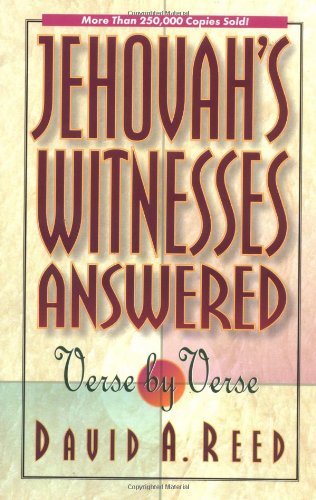
 This is the main index of my Watchtower Bible & Tract Society (Jehovah's Witnesses) errors by Bible verses.
[Right: ex-JW elder David A. Reed's, Jehovah's Witnesses Answered Verse by Verse (1987), Amazon.com. See also `tagline' quotes below all from this book (emphasis original italics, emphasis bold mine)]
As with my complementary "Watchtower Errors by Topic: A-Z,"although this index is similar in concept to Reed's book above, it will be all my own work, adding key Bible verses as I think of them.
I had originally intended that each book of the Bible would have its own page, but I am now going to have a page (or pages) for each verse. Each verse's page (or first page in the case of multiple pages) will be linked back to this main index page.
OT: Gn, Ex, Lev, Num, Dt, Jos, Jdg, Ru, 1Sam, 2Sam, 1Ki, 2Ki, 1Ch, 2Ch, Ezr, Neh, Est, Job, Ps, Pr, Ecc, SS, Isa, Jer, Lam, Eze, Dan, Hos, Joel, Am, Ob, Jnh, Mic, Nah, Hab, Zep, Hag, Zec, Mal.
NT: Mt, Mk, Lk, Jn, Ac, Rom, 1Cor, 2Cor, Gal, Eph, Php, Col, 1Th, 2Th, 1Tim, 2Tim, Tit, Phm, Heb, Jam, 1Pet, 2Pet, 1Jn, 2Jn, 3Jn, Jude, Rev. Bibliography.
Stephen E. Jones
Blogs: CreationEvolutionDesign & TheShroudofTurin
"Exodus 3:14 God said to Moses, `I AM WHO I AM.' And he said, `Say this to the people of Israel, `I AM has sent me to you:' ` (RSV) Christians universally recognize that Jesus Christ was claiming to be the Deity when he referred to himself as. the I AM: `The Jews then said to him, `You are not yet fifty years old, and have you seen Abraham?' Jesus said to them, `Truly, truly, I say to you, before Abraham was, I am' (John 8:57-58, RSV). Even Jesus' enemies recognized what he was saying. The next verse tells us that, when they heard this, `they took up stones to throw at - him...' (v. 59). The unbelieving Jews viewed Jesus' claim to be the I AM as blasphemy, a crime for which they wanted to stone him to death. Jehovah's Witnesses, however, teach that Jesus Christ is really just Michael the archangel and that Christ never claimed to be God. So, to make Scripture agree with their doctrine, they change the reading of both verses in their Bible. The Watchtower Society's translation says, `This is what you are to say to the sons of Israel, `I SHALL PROVE TO BE has sent me to you' (Exod. 3:14, NWT), and `Most truly I say to you, Before Abraham came into existence, I have been' (John 8:58, NWT). So, in the JW Bible, Jesus' words appear to have no connection with Exodus 3:14. But you do not have to be a Greek and Hebrew scholar to prove that the Watchtower Society has twisted these verses. Jehovah's Witnesses' own study Bibles prove that Jesus was claiming to be the I AM. Their 1984 large-print New World Translation of the Holy Scriptures with References has a footnote on Exodus 3:14, admitting that the Hebrew would be rendered into Greek as `Ego eimi'-I am.' And their 1985 Kingdom Interlinear Translation of the Greek Scriptures reveals that Jesus' words at John 8:58 are the same: `ego eimi' (footnote), `I am' (interlinear text) " (Reed, D.A., 1986, "Jehovah's Witnesses Answered Verse by Verse," Baker: Grand Rapids MI, Thirty-first printing, 2006, pp.26-27).
"Deuteronomy 18:20-22 `However, the prophet who presumes to speak in my name a word that I have not commanded him to speak or who speaks in the name of other gods, that prophet must die. And in case you should say in your heart: `How shall we know the word that Jehovah has not spoken?' when the prophet speaks in the name of Jehovah and the word does not occur or come true, that is the word that Jehovah did not speak. With presumptuousness the prophet spoke it. You must not get frightened at him.' (NWT). The Watchtower organization identifies itself as `The Prophet,' saying: `This "prophet" was not one man, but was a body of men and women. It was the small group of footstep followers of Jesus Christ, known at that time as International Bible Students. Today they are known as Jehovah's Christian witnesses. They are still proclaiming a warning...' (The Watchtower, 4/1/72, p. 197). The added claim is made that: `Unless we are in touch with this channel of communication that God is using, we will not progress along the road to life, no matter how much Bible reading we do' (The Watchtower, 12/1/81, p. 27)." (Reed, 1986, pp.30-31).
"Are these claims true? Is the Watchtower organization really the Prophet, the channel of communication from God? Or, is it a false prophet, fitting the description of Deuteronomy 18:20-22? The test is simple: Step #1-We know the organization `spoke in the name of Jehovah'; Step #2-We must determine whether or not the prophecies actually did occur or come true. Let's examine the facts: Throughout half of its hundred-year history, the Watchtower Society taught the belief of its founder and first president, Charles Taze Russell, that the Great Pyramid of Egypt was `inspired' of God just like the Bible (see the Watchtower's book Thy Kingdom Come, 1903 edition, p. 362). The Society's publications translated inches of pyramid measurements into calendar years, in attempts to foretell future events. Thus, they predicted that the Battle of Armageddon `will end in A.D. 1914 with the complete overthrow of earth's present rulership' (The Time Is at Hand, 1904 edition, p. 101). Obviously, this did not occur or come true. Still determined to act as a prophet, the Watchtower Society went on to predict an earthly resurrection for the year 1925: `They are to be resurrected as perfect men and constitute the princes or rulers in the earth, according to his promise.... Therefore we may confidently expect that 1925 will mark the return of Abraham, Isaac, Jacob and the faithful prophets of old' (Watchtower's book Millions Now Living Will Never Die, 1920, pp. 89-90). Did this occur or come true? No! More recently, the organization misled millions into believing that `the end' would come in 1975. They asked: `Why Are You Looking Forward to 1975?' (title of article in The Watchtower, 8/15/68, p. 494):
Are we to assume from this study that the battle of Armageddon will be all over by the autumn of 1975, and the long-looked-for thousand-year reign of Christ will begin by then? Possibly, but we wait to see how closely the seventh thousand-year period of man's existence coincides with the sabbathlike thousand-year reign of Christ. If these two periods run parallel with each other as to the calendar year, it will not be by mere chance or accident but will be according to Jehovah's loving and timely purposes... . It may involve only a difference of weeks or months, not years [p. 499].
Certainly, by now, enough weeks, months, and years have passed to prove that this prophecy concerning 1975 did not occur or come true." (Reed, 1986, pp.31-32).
"A JW may try to defend the Watchtower Society, saying that those false prophecies were all `mistakes' and that the organization has learned from these mistakes and no longer makes prophetic statements about when the end will come. In that case, ask the Witness to take out a copy of his latest Awake! magazine. Inside the front cover, on the page listing the contents of the magazine, there is a statement of purpose telling why Awake! is published. Ask the Witness to read it. As of this writing (1986), each issue still says: `Most importantly, this magazine builds confidence in the Creator's promise of a peaceful and secure New Order before the generation that saw the events of 1914 passes away.' Another prophecy! ... The facts are inescapable: The Watchtower Society spoke as a prophet, in the name of God, and what was prophesied did not come true. What does this mean for the individual Jehovah's Witness? Invite one to read what God's Word says about false prophets-and then ask what God would have him or her do. The Bible contains these warnings from Jesus Christ: `Beware of false prophets, who come to you in sheep's clothing but inwardly are ravenous wolves.' `For false Christs and false prophets will arise ... ` (Matt. 7:15, and 24:24, RSV). And the strong words quoted above from Deuteronomy 18:20-22, besides expressing God's judgment that the false prophet `must die,' also tell listeners, `You must not get frightened at him.' Rather than remain fearfully obedient to Watchtower leaders, the individual Jehovah's Witness who recognizes the organization as a false prophet should quit following it and start following the true Prophet, Jesus Christ." (Reed, 1986, pp.32-33).
"Psalm 110:1 The LORD said unto my Lord, Sit thou at my right hand, until I make thine enemies thy footstool. (KJV) Jehovah's Witnesses ... open their New World Translation and read the same verse: `The utterance of Jehovah to my Lord is... .' They go on to argue (1) that the New World Translation is a superior Bible to use, because it does not have the Lord talking to himself; and (2) that the Lord Jesus must be a mere created being, since Jehovah God is addressing a person distinct from himself. . To answer the first argument, it is only necessary to look at the text more closely. It does not say that `the Lord' was talking to `the Lord.' Most translations render the Hebrew tetragrammaton YHWH as `the LORD' (all capital letters), who is talking to the psalmist's `Lord' (both capital and small letters), the Messiah. .... Knowledgeable Christians who read this verse will grasp that God the Father is speaking to the Son. The second Witness argument-that Jesus cannot be God because `the LORD' spoke to him-is also a faulty one. The New Testament records many conversations between Jesus and the Father, but this does not disprove the deity of Christ. The Bible reveals that the Father is God (John 6:27, etc.) and that the Son is God (Isa. 9:6, John 20:28, etc.), yet there is only one God (1 Cor. 8:4)." (Reed, 1986, pp.35-36).
"In explaining to Witnesses the fact that Psalm 110 shows God, the Father in heaven, talking to the Son (also God) upon the earth, it may help to invite them to turn to Genesis 18 and 19 in their own New World Translation. There it says that `Jehovah appeared to him' [Abraham] as `three men' or angels (18:1-2). Abraham addressed the three as `Jehovah' (18:3). Two of them left Abraham and went toward the city of Sodom, but Abraham continued to address the remaining individual as `Jehovah' (18:22, 19:1). When the other two reached Sodom and spoke with Abraham's relative Lot, he addressed the two of them as `Jehovah' (19:18). And, when the city of Sodom was destroyed, the New World Translation says at Genesis 19:24: `Then Jehovah made it rain sulphur and fire from Jehovah, from the heavens... .' So, unless the Witnesses want to claim that there is more than one Jehovah, they will have to admit that God can be in more than one place at the same time, and that he can hold simultaneous conversations with different people in different places. This should make it easier for them to grasp that the Father can talk to the Son, without calling into question the deity of Christ." (Reed, 1986, pp.36-37).
"Ezekiel 18:4 Behold, all souls are mine; as the soul of the father, so also the soul of the son is mine: the soul that sinneth, it shall die. (KJV) `So,' says the Jehovah's Witness, `the soul dies. This verse proves that there is no conscious life after death.' Does it? Not at all! First, look at the context. What is the writer talking about? The Israelites were grumbling against God, quoting a proverb that said: `The fathers have eaten sour grapes, and the children's teeth are set on edge' (v. 2)-they were complaining that punishment for what a father did fell upon his offspring. Verse 4 is God's reply: The one who sins is the one who will die. .. So, the context reveals that the inspired Word was not speaking here about the condition of the dead. The word soul is used in many different senses throughout Scripture. It sometimes refers to a person's life, sometimes to the person himself ... and sometimes it refers to the inner part of man that lives on after death. Jehovah's Witnesses deny this last use of the word soul. They say that man totally ceases to exist at death, that when the body dies, there is nothing left. But there are many Scripture verses that prove them wrong. For example, ask them to turn to Luke 12:4-5. Their own New World Translation says, `. .. Do not fear those who kill the body and after this are not able to do anything more. But I will indicate to you whom to fear: Fear him who after killing has authority to throw into Gehenna. Yes, I tell you, fear this One.' Therefore, a man's body can be killed. He is dead. But something can be done to him after he is dead. He can then be thrown into Gehenna. Now if, as the Witnesses say, the man ceased to exist when his body was killed, what would be left afterwards to be thrown into Gehenna? Likewise, in 2 Corinthians 5, the apostle Paul wrote of the body as `the earthly tent we live in,' adding that he `would rather be away from the body and at home with the Lord' ... If the Jehovah's Witnesses were correct, what part of Paul could leave his body and go to be with the Lord? You might also ask the JW to read Revelation 6:9-11 in his own Bible. There it speaks of `the souls of those slaughtered,' asking God when their blood would be avenged. It adds that `a white robe was given to each of them; and they were told to rest a little while longer, until the number was filled also of their fellow slaves and their brothers who were about to be killed as they also had been.' Yes, these souls had been killed, but they are depicted as being in God's presence and engaging in conversation with him." (Reed, 1986, pp.45-46).
"Daniel 10:13, 21; 12:1 `... Michael, one of the foremost princes, came to help me. ... Michael, the prince of you people... . And during that time Michael will stand up, the great prince who is standing in behalf of the sons of your people... .' (NWT) The Watchtower Society teaches Jehovah's Witnesses that Jesus Christ was a mere angel, who was born as a human, died as a sacrifice for sins, and was raised up as an angel once again. They refer to him as `Jesus Christ, whom we understand from the Scriptures to be Michael the archangel ...' (The Watchtower, 2/15/79, p. 31). But is that really what the Bible teaches? Or is it, rather, a teaching that Watchtower leaders superimpose on Scripture? God's inspired Word mentions Michael five times-as (1) `one of the foremost princes' (Dan. 10:13, NWT); (2) `the prince of [Daniel's] people' (Dan. 10:21, NWT); (3) `the great prince who is standing in behalf of the sons of [Daniel's] people' (Dan. 12:1, NWT); (4) `the archangel' who `had a difference with the Devil and was disputing about Moses' body' but `did not dare to bring a judgment against him in abusive terms' (Jude 9, NWT); and (5) a participant in heavenly conflict when `Michael and his angels battled with the dragon' (Rev. 12:7, NWT). Which of these verses state that Michael is Jesus Christ? None of them! It is necessary to read Scripture plus a complicated Watchtower argument to reach that conclusion. The Society also turns for support to another verse that does not use the name Michael but says that `the Lord himself will descend from heaven with a commanding call, with an archangel's voice and with God's trumpet' (1 Thess. 4:16, NWT). But, if using an archangel's voice makes the Lord an archangel, then having God's trumpet makes him God-even though Watchtower leaders would have us look at only the first part of the verse. " (Reed, 1986, pp.46-47).
"Does the Bible teach elsewhere that Jesus Christ is a mere angel? To the contrary, the entire first chapter of Hebrews was written to show the superiority of the Son of God as compared to angels. Verse after verse contrasts the angels with `... His Son, whom He has appointed heir of all things, through whom also He made the worlds; who being the brightness of His glory and the express image of His person ... having become so much better than the angels, as He has by inheritance obtained a more excellent name than they. For to which of the angels did He ever say: 'You are My Son, today I have begotten you'? ... But when He again brings the firstborn into the world, He says: 'Let all the angels of God worship Him.' And of the angels He says: 'Who makes His angels spirits and His ministers a flame of fire.' But to the Son He says: 'Your throne, O God, is forever and ever... .' And: `You, LORD, in the beginning laid the foundation of the earth... .' (Heb. 1:2-8, 10, NKJV) The Son is `the reflection' of the Father's glory `and the exact representation of his very being, and he sustains all things by the word of his power'-something no angel could do-even according to the Watchtower's own translation of Hebrews 1:3 (NWT). Moreover, good angels consistently refuse to accept worship. When the apostle John fell down to worship at the feet of an angel, the angel rebuked him, saying, `Be careful! Do not do that! ... Worship God' (Rev. 22:8-9, NWT). But the Father's command concerning the Son is to `let all God's angels worship him' (Heb. 1:6, NWT, 1961 edition). In later editions, the Watchtower Society changed `worship' to `obeisance' at Hebrew 1:6. Still, regardless of how it is translated, the same Greek word proskuneo is used at both Rev. 22:8-9 and Hebrews 1:6. The proskuneo (worship or obeisance) that angels refuse to accept, but say to give only to God, is the same proskuneo (worship or obeisance) that the Father commands to be given to the Son at Hebrews 1:6. So, the Son cannot be an angel, but must be God. Persons who stop following the Watchtower organization, and start following Jesus Christ, soon come to appreciate that he is no mere angel. This realization is important, in order that they may `honor the Son just as they honor the Father' (John 5:23, NWT)." (Reed, 1986, pp.47-48).
"Matthew 6:9 `You must pray, then, this way: `Our Father in the heavens, let your name be sanctified.' ` (NWT) Jehovah's Witnesses point out that God's name must be sanctified, and thus they `prove' that we must use the name Jehovah, in order for our prayers to be heard by God. But is that what Jesus taught? Did he begin his own prayers with the expression `Jehovah God,' as the Witnesses do? Not at all! While expressing concern in the prayer that God's name be sanctified or hallowed (treated as sacred or holy), Jesus taught his disciples to pray to `our Father,' not to `Jehovah God.' He said, `You must pray, then, this way: "Our Father... ."' Many of Jesus' own personal prayers are also recorded in the Bible, and in these he sets the same example: `Father, I thank you...' (John 11:41, NWT). `Abba, Father, all things are possible to you...' (Mark 14:36, NWT). `Father, the hour has come ...' (John 17:1, NWT). Witnesses might object by saying, `Jesus had a close, special relationship with the Father. That's why he did not address him as 'Jehovah.' We might acknowledge that there is some truth to that, but Jesus' purpose was to bring all of his disciples into a close, special relationship with God, too. `No one comes to the Father except through me,' Jesus taught (John 14:6, NWT). Of Christians who come to the Father through Jesus, the Bible says: `... you have received the Spirit bf adoption by whom we cry out, `Abba, Father.' The Spirit Himself bears witness with our spirit that we are children of God' (Rom. 8:15-16, NKJV). It is obvious that Jesus' words at Matthew 6:9 definitely do not teach a need to use the name Jehovah in prayer." (Reed, 1986, pp.52-53).
"Matthew 24:34 "Assuredly, I say to you, this generation will by no means pass away till all these things are fulfilled." (NKJV) Which generation? The subject is a matter of debate among Christian Bible readers-but not among Jehovah's Witnesses, because their organization has told them specifically that `the evidence points to the 1914 generation as the generation spoken of by Jesus. Thus, "this generation will by no means pass away until all these things (including the apocalypse) occur"' (The Watchtower, 2/15/86, p. 5). For many years, each issue of their Awake! magazine has featured this statement of purpose on page 2: `Most importantly, this magazine builds confidence in the Creator's promise of a peaceful and secure New Order before the generation that saw the events of 1914 passes away.' The Awake! issue of October 8, 1968, defined the generation even more precisely by saying, `Jesus was obviously speaking about those who were old enough to witness with understanding what took place,' suggesting that these would be `youngsters 15 years of age' (p. 13, italics theirs). They said most definitely that `the `generation' logically would not apply to babies born during World War I' (The Watchtower, 10/1/78, p. 31). One need only calculate that someone fifteen years old in 1914 would be twenty-five years old in 1924, thirty-five years old in 1934-and eighty-five years old in 1984-to realize that the Watchtower's `generation that will not pass away' was almost gone by the mid-1980s. The prophecy was about to fail. But, rather than change the prophecy, JW leaders simply stretched the generation. Instead of fifteen-year-olds, who could witness `with understanding' what took place in 1914, they began to indicate instead that the generation would be made up of `those born around the time' (the very babies that they had earlier excluded!), saying: `If Jesus used `generation' in that sense and we apply it to 1914, then the babies of that generation are now 70 years old or older' (The Watchtower, 5/15/84, p. 5). ... persons who make false prophecies fall into the categories of those the Lord warned us to watch out for: `For false christs and false prophets will arise and show great signs and wonders, so as to deceive, if possible, even the elect' (Matt. 24:24, NKJV)." (Reed, 1986, pp.56-57).
"Luke 16:22-24,27-28 `Now in course of time the beggar died and he was carried off by the angels to the bosom [position] of Abraham. Also, the rich man died and was buried. And in Hades he lifted up his eyes, he existing in torments, and he saw Abraham afar off and Lazarus in the bosom [position] with him. So he called and said, "Father Abraham, have mercy on me and send Lazarus to dip the tip of his finger in water and cool my tongue, because I am in anguish in this blazing fire.... send him to the house of my father, for I have five brothers, in order that he may give them a thorough witness, that they also should not get into this place of torment.' (NWT) Jehovah's Witnesses believe their organization's teaching that hades is simply the grave and that there is no conscious existence for the dead until a future resurrection. But, since Jesus' words in the verses above do speak of such conscious existence, the Watchtower Society has to do something to negate those words. So they point out that the account is a parable, or illustration, and apply a purely symbolic meaning to everything in the story. ... Therefore, Jesus was not really talking about the condition of the dead in Luke 16, according to the Watchtower Society. ... But an examination of the Lord's other parables reveals that all of them were illustrations based on real-life situations. ... So, if the story of the rich man and Lazarus is like all the rest of Jesus' parables, it also must use a real situation to illustrate spiritual things. People must really have a conscious existence after death, and some of them must really be `in torments,' deeply regretting their past life. ... But the solution is not to be found in denying what the Bible plainly says. Although Jesus Christ was by far the most loving and compassionate person ever to walk the earth, he also had the most to say about the unpleasantness facing people after death. He said, for example:
`The Son of man will send his angels, and they will gather out of his kingdom all causes of sin and all evildoers, and throw them into the furnace of fire; there men will weep and gnash their teeth.' (Matt. 13:4142, RSV).`But he will say, " tell you, I do not know where you come from; depart from me, all you workers of iniquity!"There you will weep and gnash your teeth, when you see Abraham and Isaac and Jacob and all the prophets in the kingdom of God and you yourselves thrust out.' (Luke 13:27-28, RSV).
`So it will be at the end of the age. The angels will come out and separate the evil from the righteous, and throw them into the furnace of fire; there men will weep and gnash their teeth.' (Matt. 13:49-50, RSV).
`Then the king said to the attendants, "Bind him hand and foot, and cast him into the outer darkness; there men will weep and gnash their teeth."' (Matt. 22:13, RSV).
`The master of that servant will come on a day when he does not expect him and at an hour he is not aware of. He will cut him to pieces and assign him a place with the hypocrites, where there will be weeping and gnashing of teeth.' (Matt. 24:50-51, NIV).
`The master of that servant will come on a day when he does not expect him and at an hour he is not aware of. He will cut him to pieces and assign him a place with the unbelievers. That servant who knows his master's will and does not get ready or does not do what his master wants will be beaten with many blows. But the one who does not know and does things deserving punishment will be beaten with few blows... .' (Luke 12:46-48, NIV)."
"`And throw the good-for-nothing slave out into the darkness outside. There is where his weeping and the gnashing of his teeth will be.' (Matt. 25:30, NWT).
`... but woe to that man by whom the Son of man is betrayed! It would have been better for that man if he had not been born.' [Author's note: If he had not been born, the betrayer would have been nonexistent. But nonexistence was better than the punishment now in store for him. So, the Watchtower must be wrong in its teaching that Judas' death plunged him into eternal nonexistence.] (Matt. 26:24, RSV).
`... it is finer for you to enter one-eyed into the kingdom of God than with two eyes to be pitched into Gehenna, where their maggot does not die and the fire is not put out.' (Mark 9:47-48, NWT).
`Rejoice in that day and leap, for, look! your reward is great in heaven.... But woe to you rich persons, because you are having your consolation in full. Woe to you who are filled up now, because you will go hungry. Woe, you who are laughing now, because you will mourn and weep.' (Luke 6:23-25, NWT).
`Moreover, I say to you, my friends, Do not fear those who kill the body and after this are not able to do anything more. But I will indicate to you whom to fear: Fear him who after killing has authority to throw into Gehenna. Yes, I tell you, fear this One.' (Luke 12:4-5, NWT).
And in the revelation that Jesus gave to the aged apostle John, the Lord's angelic messenger says,
`If anyone worships the wild beast and its image, and receives a mark on his forehead or upon his hand, he will also drink of the wine of the anger of God that is poured out undiluted into the cup of his wrath, and he shall be tormented with fire and sulphur in the sight of the holy angels and in the sight of the Lamb. And the smoke of their torment ascends forever and ever, and day and night they have no rest. .. . (Rev. 14:9-11, NWT)"
Conclude by asking the Jehovah's Witness, `If someone never read any Watchtower Society publications, but only read Jesus' words, what would he believe on this subject? What did Bible readers believe for centuries before Watchtower founder `Pastor' Russell came along in the late 1800s and taught his no-hell doctrine?' The Lord used figurative language-darkness, fire, torment, exclusion-but the point is clear: Jesus taught that disobedient mankind faces some sort of unpleasantness after death, and that he came as Savior to rescue us from such a fate." (Reed, 1986, pp.63-67).
"Luke 23:43 And he said to him, `Truly, I say to you, today you will be with me in Paradise.' (RSV). The Watchtower Society's translators have moved the comma from before the word `today' to after it. This moves the adverb `today' from the second half of the sentence to the first half. So, instead of `today' identifying the time when the repentant evildoer on the cross will be with the Lord `in Paradise,' the text is changed so that `today' appears to identify simply the time when Jesus was speaking. This is another case in which JW leaders have changed the Bible to fit their doctrines. They teach that the man who turned to the Lord on the cross and said, `Jesus, remember me when you come into your kingdom' (v 42), did not go to be with Christ in Paradise that day. Rather, they claim that he was annihilated at death, has not existed anywhere at all for the past two thousand years, and will eventually get to be with the Lord in Paradise at some time during the future millennium. It was difficult for Jehovah's Witnesses to teach this doctrine in view of Jesus' words to the dying man. Therefore, when they produced their own Bible, they changed his words-or at least the punctuation, which changes the meaning of the words. ... Jesus used the expression `truly I tell you,' or `truly I say to you,' on many different occasions. ... How did the New World Bible Translation Committee punctuate the same expression in every other place where it appears? Where did all the commas go? ... of the six verses where the Lord used this same expression in the Gospel of Luke, as well as all seventy-one passages where he used it in the four Gospels. ... Luke 23:43 ... is the only verse that they punctuated differently, so as to include the time element in the first half of the sentence-obvious proof that Watchtower translators altered this verse to fit the sect's doctrines." (Reed, 1986, pp.69-70).
"Colossians 1:15 He is the image of the invisible God, the first-born of all creation. (RSV) Jehovah's Witnesses cite this verse as `proof' that Jesus Christ is not God, but rather the first angel that God created. However, does the word first-born in the Bible necessarily mean the first one who was born or created? Not at all! The term is often used in Scripture to signify priority in importance or rank, rather than actual birth order. For example, ask the Witness to turn to Psalm 89:27. This verse speaks about King David, who was the youngest, or last-born son of Jesse [1Sam 16:10-12]-as far away as he could be from being literally first-born. But note what God says about him in the psalm: `Also, I myself shall place him as firstborn ...' (NWT). Clearly, God did not reverse the order of David's birth; he was not speaking about birth order. What the psalm meant was that King David would be elevated in rank, above the others, to the preeminent position. Now, to demonstrate that the term is used in this sense when speaking about Christ at Colossians 1:15, ask the Witness to look at the context. Point out, particularly, verse 18, which identifies Christ as `the head' and `the first-born' and says that this is for the purpose `that in everything he might be pre-eminent ' (RSV). While you are right there in the Book of Colossians, clinch the point about the deity of Christ by reading chapter 2, verse 9: `For in Christ all the fullness of the Deity lives in bodily form.' (NIV)." (Reed, 1986, pp.97-98).
"Colossians 2:9 For in Christ all the fullness of the Deity lives in bodily form. (NIV) This is a text that should definitely be included when sharing with a Jehovah's Witness the abundant scriptural evidence that Jesus Christ is God. Reading it in a number of translations may prove helpful: `For in him dwelleth all the fulness of the Godhead bodily' (KJV). `For in Christ there is all of God in a human body" (LB) and `in him all the fullness of deity is resident in bodily form' (The Bible in Living English, translated by Steven T. Byington, published by the Watchtower Society, 1972). The Watchtower's New World Translation attempts to water down the message of this verse by rendering it: `because it is in him that all the fullness of the divine quality dwells bodily.' But the reference edition (footnote) and the interlinear version of their Bible both admit that the Greek word they translate as `divine quality' literally means `godship.'" (Reed, 1986, p.98).
"Revelation 1:7-8 Look! He is coming with the clouds, and every eye will see him, and those who pierced him; and all the tribes of the earth will beat themselves in grief because of him. Yes, Amen. `I am the Alpha and the Omega,' says Jehovah God, `the One who is and who was and who is coming, the Almighty.' (NWT) If Jesus Christ is shown to be `the Alpha and the Omega' and `the First and the Last,' while the JW Bible also says that Jehovah God is `the Alpha and the Omega' and `the First and the Last,' the Jehovah's Witness must either admit that Jesus Christ is the Almighty God-or else close his eyes to the Word." (Reed, 1986, pp.101-102).
"You might discuss these verses with a Witness as follows, using his own New World Translation: Revelation 1:7-8, quoted above, says that someone `is coming.' Who? Verse 7 says it is someone who was `pierced.' Who was it that was pierced when he was nailed up to die? Jesus! But verse 8 says that it is Jehovah God who `is coming.' Could it be that there are two who are coming? No! Verse 8 refers to `the One who ... is coming.' Revelation 1:8 states clearly that Jehovah God is the Alpha and the Omega. Now note what he says at Revelation 22:12-13: `'Look! I am coming quickly ... I am the Alpha and the Omega, the first and the last... .' ` So, Jehovah God is coming quickly. But notice the response when he says it again: ``'Yes; I am coming quickly. ` Amen! Come, Lord Jesus' (22:20, NWT). At this point you might mention that Alpha is the first letter of the Greek alphabet, while Omega is the last letter. Therefore, `the Alpha and the Omega' means the same thing as `the First and the Last.' Then, again referring to the New World Translation, continue like this: Who is speaking in Revelation 2:8? `These are the things that he says, `the First and the Last,' who became dead and came to life again... .' Obviously, it is Jesus. Who was Jesus identifying himself as being, when he called himself `the First and the Last'? This is how Almighty God described himself in the Old Testament. Jesus knew that the apostle John, who wrote the Revelation, and later Bible readers would all remember these verses: `"... I am the same One. I am the first. Moreover, I am the last. Moreover, my own hand laid the foundation of the earth, and my own right hand extended out the heavens ..."' (Isa. 48:12-13). And: `... I am the same One. Before me there was no God formed, and after me there continued to be none. I-I am Jehovah, and besides me there is no savior' (Isa. 43:10-11). Note, too, that the expression the first and the last is used this way to refer to the Jehovah God in Revelation 22:13: `'I am the Alpha and the Omega, the first and the last, the beginning and the end.' Yet John also records: `.... And he laid his right hand upon me and said: `Do not be fearful. I am the First and the Last, and the living one; and I became dead, but look! I am living forever and ever ...' (Rev. 1:17-18). Remind the Jehovah's Witness that he has read in his own Bible that Jehovah God is the One who is coming, the One who is coming quickly, the Alpha and the Omega, the First and the Last, and the only Savior. He has also read that our Savior Jesus Christ is the one who is coming, the One who is coming quickly, the Alpha and the Omega, the First and the Last." (Reed, 1986, Ibid., pp.102-103).
"Revelation 3:14 And unto the angel of the church of the Laodiceans write; These things saith the Amen, the faithful and true witness, the beginning of the creation of God. (KJV) This verse is one of the Jehovah's Witnesses' favorites, in their attempt to `prove' that Jesus Christ is a mere created being, the first angel that God made. `Look!' they say. `Jesus is `the beginning of the creation.' But they should be careful. They will tell you that God the Father is the speaker at Revelation 21:6 and 22:13, yet in both verses he calls himself `the beginning.' Therefore, `the beginning' must mean something else other than the first thing created. Actually, in each of these cases, the Greek text says arche, a word listed in Vine's Expository Dictionary of New Testament Words as having such varied meanings as `beginning,' `power,' `magistrate,' and `ruler.' The Watchtower Bible translates the plural of the same word as `government officials' at Luke 12:11. It is the root of our words archbishop, architect, and other words referring to someone who is chief over others. Thus, the New International Version at Revelation 3:14 says that Christ is `the ruler of God's creation.' So there is no basis for claiming that Revelation 3:14 makes Jesus Christ a created being." (Reed, 1986, pp.103-104).




 Posts
Posts


