Here is part #8, "3A. Jesus claimed to be `I AM'," the first topic in section 3. "Jesus Claimed to be Jehovah," of my series, "Jesus is Jehovah!" (by topic), which is based on my morning `quiet time'
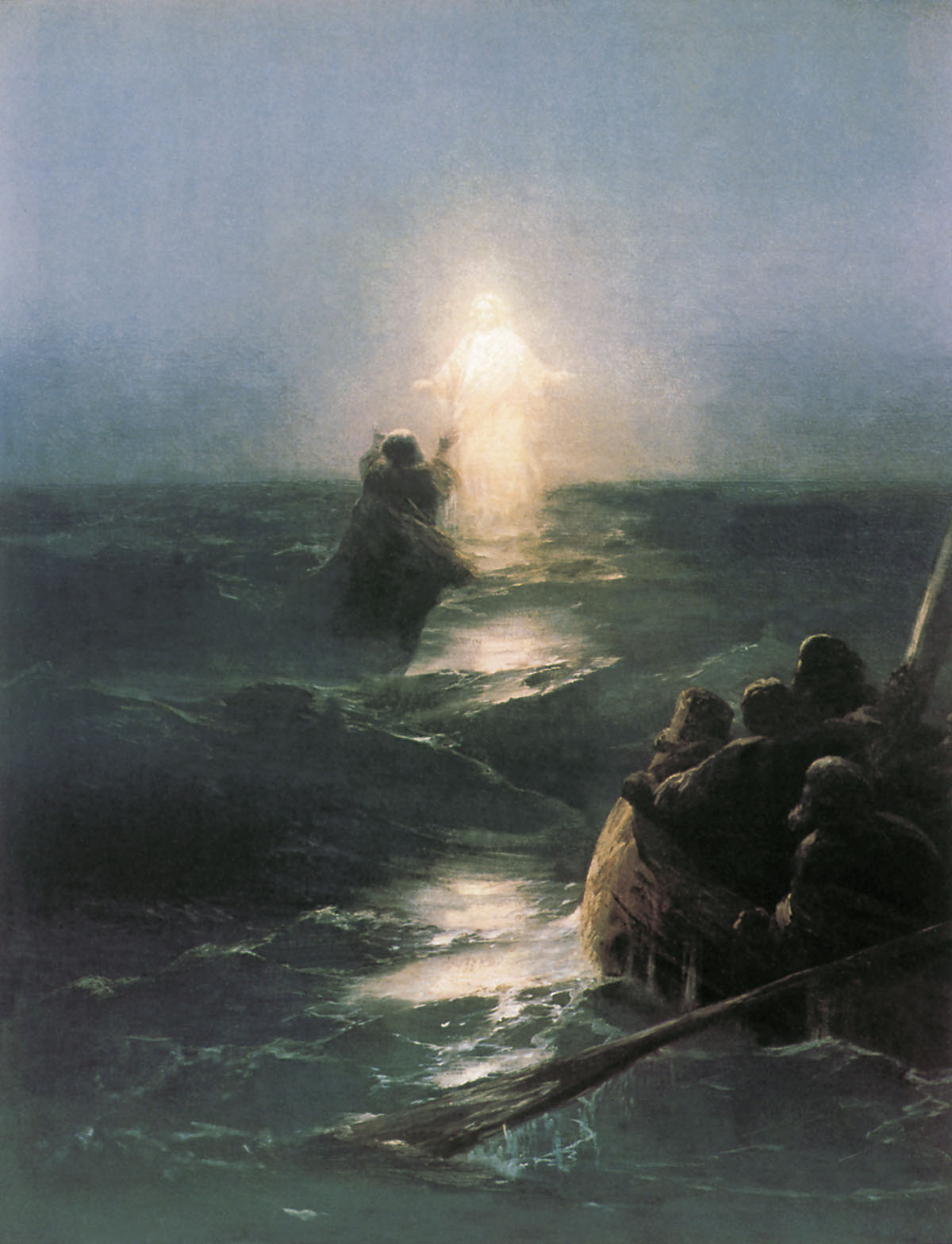
[Above (click to enlarge): "Jesus Walks on Water" (1888), by Ivan Aivazovsky (1817-1900): Wikipedia.]
Bible study. My previous post in this series was part #7, "2C. Jehovah promised that He would come to Jerusalem in Person." See part #1 the Contents page for more details of this series. I am using the English Standard Version (ESV) of the Bible, unless otherwise indicated. In this post some of the headings are from the late Jay P. Green Sr's KJ3-LITV (King James 3-Literal Translation Version), which consistently translates the Greek ego eimi in John as "I AM."
JESUS IS JEHOVAH!
© Stephen E. Jones Jesus is Jehovah!: Contents
3. JESUS CLAIMED TO BE JEHOVAH
A. Jesus claimed to be "I AM."
i. Jesus claimed to be "I AM" (Gk. ego eimi).
1) "Jesus [walking on the sea] spoke to them, saying, `Have courage, I AM!'" (Mt 14:25; Mk 6:50; Jn 6:20. LITV).
Mt 14:27. But immediately Jesus spoke to them, saying, "Take heart; it is I [ego eimi]. Do not be afraid."
Mk 6:50. for they all saw him and were terrified. But immediately he spoke to them and said, "Take heart; it is I [ego eimi]. Do not be afraid."
Jn 6:20. But he said to them, "It is I [ego eimi]; do not be afraid."
"... Jesus walking on the sea ... in this miracle account `Jesus is portrayed as filling the role ... of Yahweh ... `It is I [ego eimi]; do not be afraid' (Matt. 14:27; Mark 6:50; John 6:20). This statement echoes statements by the Lord God in Isaiah ...":
"As various scholars, both conservative and liberal, have observed, the Gospel accounts of Jesus walking on the sea [Mt 14:23-33; Mk 6:47-52; Jn 6:16-21] allude rather clearly to the account in Exodus 14-15 of the Israelites' crossing of the Red Sea. The Israelites walked in `the midst of the sea' (Exod. 14:16, 22, 27, 29 NASB) and crossed to the other side (Exod. 15:16). Likewise, the disciples' boat was `in the middle of the sea' (Mark 6:47 NASB) and they also `crossed over' the sea (Mark 6:53). A strong wind from the east blew across the Red Sea and, close to daybreak, the Egyptians found it increasingly difficult to drive their chariots as they attempted to follow the Israelites (Exod. 14:21, 24-25). Likewise, an adverse wind blew across the Sea of Galilee and, based on the geography, it also would have been blowing from the east; this wind also blew close to daybreak and made it difficult for the disciples to row their boat (Mark 6:48). According to Mark, the disciples had the same problem as the Egyptians: their hearts were hardened (Exod. 14:4, 8, 17; Mark 6:52). ... in this miracle account `Jesus is portrayed as filling the role ... of a greater Moses and of Yahweh. Jesus' response to the disciples' fear encompasses both roles. Moses had told the Israelites, `Take heart!' (tharseite, Exod. 14:13 LXX) and Jesus told the disciples the same thing: `Take heart!' (tharseite, Matt. 14:27; Mark 6:50). But then Jesus added, `It is I [ego eimi]; do not be afraid' (Matt. 14:27; Mark 6:50; John 6:20). This statement echoes statements by the Lord God in Isaiah, where he speaks of a kind of `new Exodus' when the Jews would be restored to their land: `Do not fear, for I have redeemed you; I have called you by name, you are mine. When you pass through the waters, I will be with you; and through the rivers, they shall not overwhelm you; Do not fear, for I am with you; ... so that you may know and believe me and understand that I am he [ego eimi] ... I am the LORD, your Holy One, the Creator of Israel, your King:' Thus says the LORD, who makes a way in the sea, a path in the mighty waters. (Isa. 43:1-2, 5, 10, 15- 16)." (Bowman, R.M., Jr. Komoszewski, J.E., 2007, "Putting Jesus In His Place: The Case for the Deity of Christ," Kregel: Grand Rapids MI, p.205).
"Jesus' saying `It is I' (ego eimi) draws out a reflection on the identity of Jesus ... In the Old Testament only God stills storms.":
"Jesus and Peter Walking on the Sea (Mt 14:22-33 / Mk 6:45-52; cf. Jn 6:16-21). ... As in Mark 6:48, Jesus walking on the stormy sea could only be seen as God himself coming to the distressed disciples. In the Old Testament it is only God who can save people from the sea (see ... on Mk 6:45-52). ... Peter's address to Jesus as `Lord' reflects what faith Peter does have in the one who is Lord of the destructive storm, which presumably is still raging as Peter makes his request (Mt 14:24,28, 32), for in John it is implied that only God could walk on the sea (Jn 6:19-20). And, for Matthew, Jesus' saying `It is I' (ego eimi) draws out a reflection on the identity of Jesus ... In the Old Testament only God stills storms. [Job 26:11-12; Ps 65:7; 89:6-10;107:29; Jnh 1:15] It is then thoroughly appropriate for Matthew to say that the disciples in the boat `worshiped' (proskunein) Jesus, saying, `Truly you are the Son of God' (Mt 14:33). Of all Matthew's miracle stories, it is this one that portrays the highest Christology. The story begins by drawing parallels between Moses and Jesus. In the body of the story, it is not that Jesus acts for God. Rather, in Jesus, God is seen acting to calm the storm and to rescue his people." (Twelftree, G.H., 1999, "Jesus the Miracle Worker: A Historical Theological Study," InterVarsity Press,' InterVarsity Press: Downers Grove IL, pp.130-132. Emphasis original).
"Most significantly of all ... Jesus spoke of himself as `I AM', recalling ... where God revealed himself to Moses and the people by these words (Exod. 3:14). ... by these very words Jesus identified himself with God. `Be not afraid, I AM,' ...(Mark 6:50; John 6:20 ...)":
"Most significantly of all, as we have seen, Jesus spoke of himself as `I AM', recalling the high point in the Old Testament where God revealed himself to Moses and the people by these words (Exod. 3:14). Yet by these very words Jesus identified himself with God. `Be not afraid, I AM,' he told the terrified fishermen, words that appear in independent sources (Mark 6:50; John 6:20; my tr.). Jesus refers to himself many times in the Gospel of John as `I AM', in both absolute and qualified senses (e.g. `I AM the bread of life'; John 6:35). But these I AM words also occur in the Synoptic Gospels; for example, when Jesus answered the high priest, `I AM; and you will see the Son of Man seated at the right hand of Power...' (Mark 14:62). The false prophets imitate Jesus in saying, `I AM', thereby confirming his use of these words (Mark 13:6)." (Barnett, P.W., 2009, "Messiah: Jesus - the Evidence of History," InterVarsity Press: Nottingham UK, p.122. Emphasis original).
2) "Jesus said to her [a Samaritan woman], `I AM! the One speaking to you.'" (Jn 4:26. LITV)
"Literally Jesus said, 'I am (ego eimi), the one speaking to you'":
"[Jn 4:25-26]. In response, The woman said, 'I know that Messiah' (called Christ) 'is coming. When he comes, he will explain everything to us.' It was all too difficult for her to understand. She would have to wait for the arrival of the Samaritan Messiah/Taheb to explain everything. Then Jesus declared, 'I who speak to you am he.' Literally Jesus said, 'I am (ego eimi), the one speaking to you.'" (Kruse, C.G., 2003, "The Gospel According to St. John: An Introduction and Commentary," The Tyndale New Testament Commentaries, Inter-Varsity Press: Leicester UK, p.135. Italics original).
"... Jesus' statement to the Samaritan woman: `I am he [ego eimi], the one who is speaking to you' (John 4:26). ... is almost a perfect quote from Isaiah 52:6, in which God tells his people that at some point in the future they will finally realize that he is the one speaking to them":
"According to a broad consensus of New Testament scholars, at least some of the `I am' sayings of Jesus in the Gospel of John echo these `I am' sayings of God, especially those in Isaiah.' The clearest example is a pair of such sayings in John 8, which allude strongly to a saying of God in Isaiah 43:10. Another very likely allusion is Jesus' statement to the Samaritan woman: `I am he [ego eimi], the one who is speaking to you' (John 4:26). On a prosaic level, one can read Jesus' statement as simply an affirmation that he is the Messiah about whom the woman had asked. It turns out, however, that Jesus' response is almost a perfect quote from Isaiah 52:6, in which God tells his people that at some point in the future they will finally realize that he is the one speaking to them. Other `I am' sayings of Jesus are more allusive in their relation to sayings of God in Isaiah, but in light of these clear connections, and since most of them pertain to the same passage in Isaiah 43, we should recognize these allusions as genuine as well)." (Bowman Komoszewski, 2007, p.177).
"In [Jn] 4:26 Jesus says to the woman at the well, `I am, the one speaking to you' which is strangely reminiscent of the LXX rendering of Isaiah 52:6":
"The specific phrase ego eimi occurs twenty-four times in the gospel of John. Thirteen of these times it is followed by a clear predicate (John 6:35; 6:41; 6:51; 8:12; 8:18; 10:7; 10:9; 10:11; 10:14; 11:25; 14:6; 15:1; 15:5). .... In 4:26 Jesus says to the woman at the well, `I am, the one speaking to you' which is strangely reminiscent of the LXX rendering of Isaiah 52:6. .... Given the above, we are left with seven uses that have been described as `absolute:' These would be John 8:24; 8:28; 8:58; 13:19; 18:5; 18:6; and 18:8. It is very significant that in each of these instances, the phrase comes at the end of the clause. We will note why it is important when we look at the usage of the phrase in the Septuagint." (White, J.R., 1998, "The Forgotten Trinity: Recovering the Heart of Christian Belief," Bethany House: Minneapolis MN, pp.208-209).
3) Jesus said, "For if you do not believe that I AM, you will die in your sins." (Jn 8:24. LITV)
"In each of these verses [Jn 8:24,58; 13:19; 18:5-6] a particular Greek phrase appears ... ego eimi ... `I am He.' The fact that the word `He' is italicized ... means the word itself is not found in the Greek":
"John's literary artistry was not limited to the prologue of his Gospel, nor was it confined to the direct assertion of the deity of Christ through calling Him `God' (1:1; 20:28). He found subtle ways of teaching this truth as well. One method that John presented ... is found in Jesus' use of the phrase I am. Look at these passages from the gospel of John: `Therefore I said to you that you will die in your sins; for unless you believe that I am He, you will die in your sins' (John 8:24). Jesus said to them, `Truly, truly, I say to you, before Abraham was born, I am' (John 8:58). `From now on I am telling you before it comes to pass, so that when it does occur, you may believe that I am He' (John 13:19). They answered Him, `Jesus the Nazarene.' He said to them, `I am He.' And Judas also, who was betraying Him, was standing with them. So when He said to them, `I am He,' they drew back and fell to the ground. (John 18:5-6). In each of these verses a particular Greek phrase appears ... ego eimi ... The New American Standard Bible renders this Greek phrase as `I am He.' The fact that the word `He' is italicized is very important, for this means the word itself is not found in the Greek and is being supplied by the translators in an effort to smooth out an awkward English phrase. John makes sure, through the use of context, that we do not miss the point he is making by recording these words of Jesus." (White, 1998, pp.95-96).
"`... I am' without supplying a predicate in the absolute sense as the Jews (Deut. 32:39) used the language of Jehovah (cf. Isa. 43:10 ...). ... Jesus seems to claim absolute divine being as in 8:58":
"[Jn 8:24]. For except ye believe (ean gar me pisteusete). Negative condition of third class with ean me and ingressive aorist active subjunctive of pisteuo, `For unless ye come to believe.' That I am he (hoti ego eimi). Indirect discourse, but with no word in the predicate after the copula eimi. Jesus can mean ... `that I am' without supplying a predicate in the absolute sense as the Jews (Deut. 32:39) used the language of Jehovah (cf. Isa. 43:10 where the very words occur hina pisteusete - hoti ego eimi). The phrase ego eimi occurs three times here (8:24, 28, 58) and also in 13:19. Jesus seems to claim absolute divine being as in 8:58." (Robertson, A.T., 1932, "Word Pictures in the New Testament: Volume V: The Fourth Gospel & the Epistle to the Hebrews," Broadman Press: Nashville TN, p.146. Emphasis original).
"With astonishing frequency ... Jesus is identified as the Lord (that is, YHWH) of the Old Testament ... He is ...the one who says `I am' ... (John 8:24, 28, 58):
"With astonishing frequency-far more often than even many scholars have noticed-Jesus is identified as the Lord (that is, YHWH) of the Old Testament (Rom. 10:9-13; 1 Cor. 8:6; Phil. 2:9-11; 1 Peter 3:13-15). He is the King of kings and Lord of lords (Rev. 17:14; 19:16), the divine Savior (Titus 2:13; 2 Peter 1:11), the one who says `I am' or `I am he' (John 8:24, 28, 58), the first and the last, the Alpha and the Omega, and the beginning and the end (Rev. 1:7-8, 17b-18; 2:8; 22:12-13). The New Testament repeatedly and in a variety of ways makes the name of Jesus the center of Christian faith; he has the name that is above every name (Eph. 1:21; Phil. 2:9-11; Col. 3:17)." (Bowman Komoszewski, 2007, pp.272-273).
"Thus we read in John 8:24: `... Except ye believe that I am (he), ye shall die in your sins.' ...The use of these words is reminiscent of the divine utterances occurring in the Old Testament; for instance, `I am that I am' (Ex. 3:14) ; or `See now that I, even I, am he, and there is no God with me' (Deut. 32:39)":
"We are now thinking of the manner in which Christ speaks of himself in the currently much-discussed `I am' texts. In the gospel Christ not only says in various ways what and who he is, as for instance the shepherd, the vine, the light, the way, the truth, the life and the door, but he also says of himself: I am. Thus we read in John 8:24: `... Except ye believe that I am (he), ye shall die in your sins.' In this unusual `I am' we have, says Grosheide, a self-disclosure such as had not, till now, been given us. ` [Grosheide, Comm. op Johannes, on John 8:24] I am: with these words any living man can indicate his earthly existence but the I am of Christ transcends this by far and can become an object of decisive belief. The use of these words is reminiscent of the divine utterances occurring in the Old Testament; for instance, `I am that I am' (Ex. 3:14) ; or `See now that I, even I, am he, and there is no God with me' (Deut. 32:39). For Christ, no less than for God, the I am without a predicate is valid; and upon this extraordinary reality, also here, faith is focussed. [Cf. Ps. 90:2; Isaiah 43:11, 15, 25; 44:6, 8, 24; 45:5, 18, 22] Christ repeats these words of the Father, taking them from the Old Testament, as having unique knowledge of his being, a being which places man before the decision of life and death." (Berkouwer, G.C., 1954, "The Person of Christ," Vriend, J., transl., Studies in Dogmatics, Eerdmans: Grand Rapids MI, p.168. Emphasis original).
"To those who rejected him, Jesus warned, `You will die in your sins unless you believe that I am he' (John 8:24). ... Jesus' call here ... `links Jesus with the Father as the supreme object of faith'":
"On the basis of his divine identity, Jesus made promises to his followers and expected them to place their faith unconditionally in him. While Martha's brother Lazarus lay dead, Jesus assured her, `I am the resurrection and the life. Those who believe in me, even though they die, will live, and everyone who lives and believes in me will never die' (John 11:25-26). To those who were spiritually thirsty, Jesus promised, `Whoever believes in me will never be thirsty' (John 6:35; see also 7:37-39). To those who rejected him, Jesus warned, `You will die in your sins unless you believe that I am he' (John 8:24). Moses never spoke like this! Again, belief in Jesus is not in place of belief in God. The person who accepts his teachings, Jesus said, `believes him who sent me' (John 5:24). This is what Jesus meant when he said, `Whoever believes in me believes not in me but in him who sent me' (John 12:44). Jesus made it clear that he was not inviting faith in him apart from, or in place of, faith in God. On the other hand, he made the claim-audacious for any creature to make-that he was just as trustworthy an object of faith as God himself. `Do not let your hearts be troubled. Believe in God, believe also in me' (John 14:1). Jesus' call here for the disciples to believe in him as they believed in God `links Jesus with the Father as the supreme object of faith:' [Keener, C.S., 2003, 2:931]" (Bowman Komoszewski, 2007, pp.62-63).
"... Jesus uses the term I am (Gr. Ego eimi) more than nineteen times in reference to himself in the gospel according to John. ... Often it is used to make claims about himself that would normally only be thought appropriate for God. For example ...`Unless you believe that I am ... you shall die in your sins' (8:24)":
"In all, Jesus uses the term I am (Gr. Ego eimi) more than nineteen times in reference to himself in the gospel according to John. [Jn 4:26; 6:35,41,48,51; 8:12,18,24,28,58; 10:7,9,11,14; 11:25; 13:19; 14:6; 15:1] Often it is used to make claims about himself that would normally only be thought appropriate for God. For example, `I am the bread of life, he who comes to Me shall not hunger, and he who believes in Me shall never thirst' (6:35); `I am the light of the world; he who follows Me shall not walk in the darkness, but shall have the light of life' (8:12); `Unless you believe that I am He, you shall die in your sins' (8:24); `I am the good shepherd' (10:11-14) [cf. Psalm 23:1: `The LORD is my shepherd']; `I am the resurrection, and the life; he who believes in Me shall live even if he dies' (11:25)." (McDowell, J. Wilson, B., 1988, "He Walked Among Us: Evidence for the Historical Jesus," Here's Life Publishers: San Bernardino CA, pp.313-314, 344 n40).
4) "Then Jesus said to them, When you lift up the Son of Man, then you will know that I AM ..." (Jn 8:28. LITV)
"Then, according to verse 28, Jesus told the Jews, `When you lift up the Son of Man, then you will know that I am [I AM, or ego eimi] He.' Again, the original Greek text reads, `... you will know that I AM' (there is no he). Jesus purposely used the phrase as a means of pointing to His identity as Yahweh":
"Jesus Is Yahweh ... A comparison of the Old and New Testaments provides powerful testimony to Jesus' identity as Yahweh. ... The Septuagint provides us with additional insights on Christ's identity as Yahweh. The Septuagint is a Greek translation of the Hebrew Old Testament that dates prior to the birth of Christ. It renders the Hebrew phrase for `I AM' (God's name) in Exodus 3:14 as ego eimi. On a number of occasions in the Greek New Testament, Jesus used this term as a way of identifying Himself as God. For example, in John 8:24 (NASB) Jesus declared, `Unless you believe that I am [I AM or ego eimi] He, you shall die in your sins.' The original Greek text for this verse does not have the word he. The verse is literally, `If you do not believe that I AM, you shall die in your sins.' Then, according to verse 28, Jesus told the Jews, `When you lift up the Son of Man, then you will know that I am [I AM, or ego eimi] He.' Again, the original Greek text reads, `When you lift up the Son of Man, then you will know that I AM' (there is no he). Jesus purposely used the phrase as a means of pointing to His identity as Yahweh." (Rhodes, R., 1993, "Reasoning from the Scriptures with the Jehovah's Witnesses," Harvest House: Eugene OR, Reprinted, 2006, pp.63-64. Emphasis original).
5) "Jesus said to them, `Truly, truly, I say to you, Before Abraham came to be, I AM!'" (Jn 8:58. LITV)
"In actuality the phrase I am is an assertion of absolute, timeless existence":
"[Jn 8] The reply of Jesus is strange. Literally it reads: `Before Abraham came into being, I am' (58). The same contrast of verbs is used that appears in 1:1 and 1:14. `Came into being' involves a crisis in time, a definite act. `Am,' like the other form of the same verb in 1:1, means timeless being. There never was a time when the Son was not. He could always assert, `I am.' Three times in this context I am is used in the absolute sense: in verse 24, `Except ye believe that I am he, ye shall die in your sins'; in verse 28, `When ye have lifted up the Son of man, then shall ye know that I am he'; and in verse 58, `Before Abraham was born, I am.' In no one of these passages does the third personal pronoun he follow the I am in the Greek text. The italicized form shows that it has been inserted by the translators to complete the meaning in English. In actuality the phrase I am is an assertion of absolute, timeless existence, not merely of a personal identity as the English equivalent would suggest." (Tenney, M.C., 1976, "John: The Gospel of Belief: An Analytic Study of the Text," [1948], Eerdmans: Grand Rapids MI, Second edition, pp.149-150. Emphasis original).
"... `before Abraham came into existence or was born.' I am (ego eimi). Undoubtedly here Jesus claims eternal existence with the absolute phrase used of God":
"[Jn 8:58] Before Abraham was (prin Abraam genesthai). Usual idiom with prin in positive sentence with infinitive (second aorist middle of ginomai) and the accusative of general reference, `before coming as to Abraham,' `before Abraham came into existence or was born.' I am (ego eimi). Undoubtedly here Jesus claims eternal existence with the absolute phrase used of God. The contrast between genesthai (entrance into existence of Abraham) and eimi (timeless being) is complete. See the same contrast between en in 1:1 and egeneto in 1:14. See the contrast also in Psa. 90:2 between God (ei, art) and the mountains (genethenai). See the same use of eimi in John 6:20; 9:9; 8:24, 28; 18:6." (Robertson, 1932, pp.158-159. Emphasis original).
"Perhaps the strongest claim Jesus made to be Yahweh is in John 8:58, where he says, `Before Abraham was, I am.' This statement claims not only existence before Abraham, but equality with the `I AM' of Exodus 3:14":
"Jesus Claimed to Be Yahweh. Yahweh (YHWH; sometimes appearing in English translations as `Jehovah' or in small capital letters as `LORD') is the special name given by God for himself in the Old Testament. It is the name revealed to Moses in Exodus 3:14, when God said, `I AM WHO I AM.' ... Jesus claimed to be Yahweh. He prayed, `And now, O Father, glorify thou me with thine own self with the glory which I had with thee before the world was' (John 17:5). But Yahweh of the Old Testament said, `my glory will I not give to another' (Isa. 42:8). Jesus also declared, `I am the first and the last' (Rev. 1:17)- precisely the words used by Jehovah in Isaiah 42:8. He said, `I am the good shepherd' (John 10:11), but the Old Testament said, `Yahweh is my shepherd' (Ps. 23:1). Further, Jesus claimed to be the judge of all people (Matt. 25:31f.; John 5:27f.), but Joel quotes Jehovah as saying, `for there I will sit to judge all the nations on every side' (Joel 3:12). Likewise, Jesus spoke of himself as the `bridegroom' (Matt. 25:1) while the Old Testament identifies Jehovah in this way (Isa. 62:5; Hos. 2:16). While the Psalmist declares, `The LORD is my light' (Ps. 27:1), Jesus said, `I am the light of the world' (John 8:12). Perhaps the strongest claim Jesus made to be Yahweh is in John 8:58, where he says, `Before Abraham was, I am.' This statement claims not only existence before Abraham, but equality with the `I AM' of Exodus 3:14. The Jews around him clearly understood his meaning and picked up stones to kill him for blaspheming (cf. John 8:58 and 10:31-33). The same claim is made in Mark 14:62 and John 18:5-6." (Geisler, N.L., 1999, "Baker Encyclopedia of Christian Apologetics," Baker Books: Grand Rapids MI, p.129. Emphasis original).
"Supremely significant is the I AM (Ex. 3:14; cf. Jn. 8:58; 6:35; 8:12,24; 11:25; 14:6; 18:5f.; Mk. 14:62)":
"JESUS' IDENTITY WITH YAHWEH/JEHOVAH The NT attributes to Jesus many of the perfections of Yahweh (or, Jehovah), the creator/redeemer God of the OT. There are seven main points of identity. God's name When the OT was translated into Greek in the 2nd and 3rd centuries BC (the Septuagint), the sacred name of God, YHWH, usually rendered Yahweh or Jehovah, was translated by the Greek word Kyrios (Lord); there are approaching 7,000 instances of this. This sacred and exalted title was attributed directly to Jesus (Rom. 10:9; 1 Cor. 12:3; Phil. 2:11; etc., cf. also Lord of lords, 1 Tim. 6:15; Rev. 17:14; 19:16). Indeed the confession Jesus is Lord is probably the earliest confession of faith (Rom. 10:9; 1 Cor. 12:3; 2 Cor. 4:5). On several occasions NT writers apply OT passages concerning Yahweh directly to Jesus (Acts 2:34f.; Rom. 8:34; Heb. 10:12f.; 1 Pet. 3:22 apply Ps. 110:1. Rom. 10:13 applies Joel 2:32. Phil. 2:9-11 applies Is. 45:23. Jn. 12:41 applies Is. 6:10. Eph. 4:8 applies Ps. 68:18). These passages clearly identify Jesus with Yahweh. Another link is provided by self-designations of God appropriated by Jesus or referred to him. Supremely significant is the I AM (Ex. 3:14; cf. Jn. 8:58; 6:35; 8:12,24; 11:25; 14:6; 18:5f.; Mk. 14:62). Others are bridegroom (Is. 62:5; Je. 2:2; Ezk. 16:8; cf. Mk. 2:19f.; Jn. 3:29; 2 Cor. 11:2; Rev. 19:7); shepherd (Pss. 23:1; 80:1; Is. 40:11; Ezk. 34:15; cf. Jn. 10:11-16; Heb. 13:10; 1 Pet. 2:25; 5:4); the first and the last (Is. 44:6; 48:12; cf. Rev. 2:8; 22:13)." (Milne, B., 1982, "Know the Truth: A Handbook of Christian Belief," Inter-Varsity Press: Leicester UK, Fifth printing, 1988, pp.129-130. Emphasis original).
"Jesus' `I Am' Sayings Perhaps the greatest assertion among all of his claims not only to eternal pre- existence but also to actually being the Yahweh of the Old Testament is that which is found in his `I am' saying of John 8:58: `Before Abraham was, I am' (see Ex 3:14 ...)":
"Jesus' `I Am' Sayings Perhaps the greatest assertion among all of his claims not only to eternal pre- existence but also to actually being the Yahweh of the Old Testament is that which is found in his `I am' saying of John 8:58: `Before Abraham was, I am' (see Ex 3:14: `This is what you are to say to the Israelites: `I AM [the personal name of God] has sent me to you'). Most of Jesus' `I am' sayings,' it is true, he supplied with a subjective complement of some kind ... But I agree with D. A. Carson that `two are undoubtedly absolute in both form and content...and constitute an explicit self-identification with Yahweh who had already revealed himself to men in similar terms (see especially Isa. 43:10-11).' [Carson, 1984, p.541] The two instances Carson refers to are in John 8:58 and 13:19, but there could well be other instances as well, such as Jesus' `I am' usages in John 6:20; 8:24,28; and 18:5-8. In the case of John 8:58, standing before men who already regarded him as demonic and who had told him as much, Jesus declared as we have already noted: `Before Abraham was, I am,' invoking not only the term which Yahweh in the Old Testament had chosen as his own special term of self-identification but claiming also in the process a pre-existence appropriate only to one possessed of the nature of Yahweh." (Reymond, R.L, 2003., "Jesus, Divine Messiah: The New and Old Testament Witness," [1990], Mentor: Fearn UK, pp.234-235. Emphasis original).
"The `I am' here (8:58) reminds one of the `I am' in 8:24. Basically the same thought is expressed in both passages; namely, that Jesus is God!":
"[Jn 8:58]. Jesus said to them, I most solemnly assure you, before Abraham was born, I am. The Jews had committed the error of ascribing to Jesus a merely temporal existence. They saw only the historical manifestation, not the eternal Person; only the human, not the divine. Jesus, therefore, reaffirms his eternal, timeless, absolute essence. ... Over against Abraham's fleeting span of life (see Gen. 25:7) Jesus places his own timeless present. To emphasize this eternal present he sets over against the aorist infinitive, indicating Abraham's birth in time, the present indicative, with reference to himself; hence, not I was, but I am. Hence, the thought here conveyed is not only that the second Person always existed (existed from all eternity; cf. 1:1, 2; cf. Col. 1:17), though this, too, is implied; but also, and very definitely, that his existence transcends time. He is therefore exalted infinitely above Abraham. See also on 1:18; and cf. 1:1, 2. The `I am' here (8:58) reminds one of the `I am' in 8:24. Basically the same thought is expressed in both passages; namely, that Jesus is God!" (Hendriksen, W., 1964, "A Commentary on the Gospel of John," [1954], Banner of Truth: London, Third Edition, Vol. II., pp.66-67. Emphasis original).
6) "From this time I tell you before it happens, that when it happens you may believe that I AM." (Jn 13:19. LITV)
"The meaning of the phrase in the sense of full deity is especially clear at John 13:19, where Jesus says that He has told them things before they came to pass, that when they do come to pass the disciples may believe that Ego Eimi. (I AM). ... Jesus is telling them beforehand that when it does come to pass in the future, they may know ... that He is Jehovah!":
"The real problem [for Jehovah's Witnesses] in the verse [John 8:58] is the verb Ego Eimi. Dr. Robertson, who is quoted as authoritative by the NWT (p. 775), states that eimi is `absolute.' [Robertson, A.T., "Grammar of the Greek New Testament in the Light of Historical Research," BH Publishing, 1947, p.768] This means there is no predicate expressed with it. This usage occurs four times (Jn 8:24, 58; 13:19; 18:5). In these places, the term is the same used by the Septuagint at Deuteronomy 32:39; Isaiah 43:10; and 46:4, to render the Hebrew phrase `I (am) He.' The phrase occurs only where Jehovah's Lordship is reiterated. The phrase then is a claim to full and equal deity. The incorrect and rude rendering of the NWT only serves to illustrate the difficulty of evading the meaning of the phrase and the context. The meaning of the phrase in the sense of full deity is especially clear at John 13:19, where Jesus says that He has told them things before they came to pass, that when they do come to pass the disciples may believe that Ego Eimi. (I AM). Jehovah is the only one who knows the future as a present fact. Jesus is telling them beforehand that when it does come to pass in the future, they may know that `I AM' (Ego Eimi), that He is Jehovah!" (Martin, W.R. Klann, N., 1953, "Jehovah of the Watchtower," Bethany House Publishers: Bloomington MN, Reprinted, 1981, p.53. Emphasis original).
"In the case of his `I am' in John 13:19 Jesus himself explicated its implications for his unity with the Father and in turn his own Yahwistic identity":
"In the case of his `I am' in John 13:19 Jesus himself explicated its implications for his unity with the Father and in turn his own Yahwistic identity when he declared in the following verse: `...he who receives me receives him who sent me. [Jn 13:20]' Perhaps these absolute `I am' sayings are the background to Jesus' prayer to the Father in John 17:26: `I have manifested your name to those whom you gave me out of the world.'" (Reymond, 2003, p.236).
"In Isaiah 43:10 [LXX] we read, `In order that you may know and believe Me and understand that I am He.' In John 13:19, Jesus says to the disciples, `From now on I am telling you before it comes to pass, so that when it does occur, you may believe that I am He':
"There seems to be a direct connection between the Septuagint and Jesus' usage of ego eimi. In Isaiah 43:10 we read, `In order that you may know and believe Me and understand that I am He.' In John 13:19, Jesus says to the disciples, `From now on I am telling you before it comes to pass, so that when it does occur, you may believe that I am He.' When one removes the extraneous words (such as the phrase that connects the last clause to the first) and compares these two passages, this is the result: Isaiah 43:10: hina pisteusete ... hoti ego eimi John 13:19: hina pisteusete ... hoti ego eimi Even if one were to theorize that Jesus himself did not attempt to make such an obvious connection between himself and Yahweh (which would be difficult enough to do!), one must answer the question of why John, being obviously familiar with the LXX, would so intentionally insert this kind of parallelism." (White, 1998, p.99).
"Another parallel between the usage of ego eimi in John 13:19 and its usage in Isaiah has to do with the fact that in 13:19 Jesus is telling them the future-one of the very challenges to the false gods thrown down by Yahweh in the passages from Isaiah under consideration":
"Another parallel between the usage of ego eimi in John 13:19 and its usage in Isaiah has to do with the fact that in 13:19 Jesus is telling them the future-one of the very challenges to the false gods thrown down by Yahweh in the passages from Isaiah under consideration (the so-called `trial of the false gods:') This connection is direct in Isaiah 41:4, `Who has performed and accomplished it, calling forth the generations from the beginning? `I, the LORD, am the first, and with the last. I am He.' Here the `calling forth' of the generations-time itself-is part of the usage of ani hu. The same is true in John 13:19. In the same chapter of the book of Isaiah referenced above, in verse 22 we read, `Let them bring forth and declare to us what is going to take place; as for the former events, declare what they were, that we may consider them and know their outcome. Or announce to us what is coming:' That this reference to knowledge of the future would appear in the same section that uses ani hu as the name for God, and that this would be introduced by the Lord himself in the same context in John 13:19 is significant indeed. Hence, though some would easily dismiss the ani hu/ego eimi connection, or ignore it altogether, the evidence is overwhelming that this connection is intended by John himself." (White, 1998, pp.99-100).
7) "4... Jesus said to them, Whom do you seek? 5They answered Him, Jesus the Nazarene. Jesus said to them, I AM! ... 6Then when He said to them, I AM, they departed into the rear and fell to the ground. 7Then again He asked, Whom do you seek? And they said, Jesus the Nazarene. 8Jesus answered, I told you that I AM ..." (Jn 18:4-8. LITV)
"Jesus continually affirmed His deity. When Jewish temple guards, along with Roman soldiers, came to arrest Him the night before His crucifixion, Jesus asked them, ``Whom do you seek?' They answered Him, `Jesus the Nazarene.' He said to them, `I am [ego eimi] He.' ... they drew back, and fell to the ground' (John 18:4-6)":
"Jesus ascribed this title [ego eimi "I AM"] to Himself in other instances as well. Earlier in the same chapter, Jesus declared: `... unless you believe that I am [ego eimi] He, you shall die in your sins' (John 8:24). In Greek the word He does not appear. It simply reads `... unless you believe that I am... ` He told the Jews, `When you lift up the Son of Man, then you will know that I am [ego eimi] He' (John 8:28). Again the He) is omitted in the Greek. Jesus continually affirmed His deity. When Jewish temple guards, along with Roman soldiers, came to arrest Him the night before His crucifixion, Jesus asked them, ``Whom do you seek?' They answered Him, `Jesus the Nazarene.' He said to them, `I am [ego eimi] He.'... When therefore He said to them, `I am He,' they drew back, and fell to the ground' (John 18:4-6). They were unable to stand before the force of His claim and the force of His person." (McDowell, J. Larson, B., 1975, "Jesus: A Biblical Defense of his Deity," Here's Life Publishers: San Bernardino CA, pp.22-23. Emphasis original).
"John clearly expects his readers to understand that Jesus' words `I am' on these occasions were not mere self-identification ... They were astonishing, even numinous claims to deity that were either blasphemous or true":
"The reactions of those to whom Jesus spoke when he said these things change as one moves through the Gospel. In John 8 alone their reactions run the gamut from confusion to outrage (vv. 25, 27, 59). When Jesus said, `Before Abraham was born, I am' (John 8:58 NASB), his opponents attempted to stone him to death, presumably for blasphemy (v. 59). When soldiers and officials came to arrest him and said they were looking for Jesus of Nazareth, he replied, `I am he,' and they promptly fell to the ground (18:5-6). John clearly expects his readers to understand that Jesus' words `I am' on these occasions were not mere self-identification, like `Yeah, it's me.' They were astonishing, even numinous claims to deity that were either blasphemous or true. Jesus' resurrection from the dead proves, of course, his divine self-naming to be true (John 20:27-28)." (Bowman Komoszewski, 2007, p.177).
8) "61Again the high priest questioned Him, and said to Him, `Are you the Christ, the Son of the Blessed?' 62And Jesus said, `I AM! [ego eimi] ...'" (Mk 14:61-62. LITV)
"[Mk 14:62]. ...Jesus replies with the very Name of God, I am (Ex. 3:14), thus putting Himself on an equality with God ...":
"[Mk 14:62]. It may be significant that Jesus replies with the very Name of God, I am (Ex. 3:14), thus putting Himself on an equality with God, which we know to have been a longstanding grievance on their part (2:7). In Luke, His answer is more ambiguous, though Jesus accepts the title 'Son of God' (Luke 22:70). But the phrase is reported only by Mark; even Matthew, with all his Jewish interests, does not record it [Mt 26:64]. ... although John seems to develop the same point in his gospel on another occasion (Jn. 18:6). Jesus, while accepting the title suggested by the high priest, defines it further in terms of Son of man, His special self-chosen title. This is explained by another 'creative fusion' of Psalm 110:1 with Daniel 7:13. But, if the high priest had ears to hear, there was a solemn warning in this choice of a title, for this is the Son of man vindicated and enthroned, and returning in judgment, as Stephen saw Him before his death by stoning (Acts 7:56). The priesthood stood on trial that day, although the execution of sentence was yet to come, on the terrible day in AD 70 when the priests were cut down by the Roman soldiers at the altar, as they steadily continued with their sacrifices to the last." (Cole, R.A., 1989, "The Gospel According to Mark: An Introduction and Commentary," The Tyndale New Testament commentaries, [1961], Inter-Varsity Press Leicester: UK, Second edition, pp.306-307).
"Then again at the crucial stage of His trial, Jesus being interrogated by the high priest as to His messianic claims, replied 'I am': ..' (Mark 14:62). The savage vehemence that this called forth in the high priest and the company can be explained only if it was understood by them to be a claim to personal deity, a blasphemy in their eyes of such magnitude as to be expiated only by death":
"THE `I AM' Jehovah, the incorrect but well established rendering of the Hebrew consonants YHWH, was regarded by the Jews as too sacred to be pronounced and was replaced by a variety of substitutes, such as `Lord' (Adonai), or `The Name'. We can no longer say with certainty how it was pronounced, but from Exodus 3:14 we know that it was derived from the verb `to be': `God said to Moses "I am who I am"; and He said: Say to the people of Israel "I am" has sent you.' Now on more than one occasion our Lord refers to Himself by using `I am' in a way that points unmistakably to this Old Testament title of Jehovah. In a controversy with the Jews He declared: `Before Abraham was, I am' (John 8:58). Had He been merely a pre-existent Being, then He would have had to say `Before Abraham was, I was'. That the amazing implication of His claim did not escape the Jews is clearly shown by the extreme violence of their reaction in attempting to stone Him to death for alleged blasphemy. Another occasion on which He used it was at the time of His arrest. To His question to His approaching captors `Whom seek ye?', they answered `Jesus of Nazareth', to which He replied, `I am'. The effect that this brief utterance had on them was dramatic: `They went backward and fell to the ground' (John 18:5, 6). The mere literal sense of these words could hardly have produced this extraordinary effect. Then again at the crucial stage of His trial, Jesus being interrogated by the high priest as to His messianic claims, replied 'I am': and you shall see the Son of man sitting at the right hand of power and coming with the clouds of heaven' (Mark 14:62). The savage vehemence that this called forth in the high priest and the company can be explained only if it was understood by them to be a claim to personal deity, a blasphemy in their eyes of such magnitude as to be expiated only by death." (Bruce, F.F. Martin, W.J., 1964, "The Deity of Christ," North of England Evangelical Trust: Manchester UK, pp.7-8. Emphasis original).
ii. But "I AM" is the unique self-designation of Jehovah in the Old Testament
1) "And God said to Moses, `I AM THAT I AM; and He said, You shall say this to the sons of Israel, I AM has sent me to you'" (Ex 3:14 LITV).
"The passage in Exod. 3:14 seems to furnish designedly a clue to the meaning of the word. ... I am that I am) (Heb. 'ehyeh 'asher 'ehyeh)... In both names ehyeh and Yhwh, the root idea is that of underived existence":
"The passage in Exod. 3:14 seems to furnish designedly a clue to the meaning of the word. When Moses received his commission to be the deliverer of Israel, the Almighty, who appeared in the burning bush, communicated to him the name which he should live as the credentials of his mission: `And God said unto Moses, I am that I am) (Heb. 'ehyeh 'asher 'ehyeh), and he said, Thus shalt thou say unto the children of Israel, I am hath sent me unto you.' In both names ehyeh and Yhwh, the root idea is that of underived existence. When it is said that God's name is He is, simple being is not all that is affirmed. He is in a sense in which no other being is. He is; and the cause of his being is in himself. He is because he is ..." (Unger, M.F., 1966, "Unger's Bible Dictionary," [1957], Moody Press: Chicago IL, Third edition, Fifteenth printing, 1969, p.564. Emphasis original).
"Jehovah's Witnesses' own study Bibles prove that Jesus was claiming to be the I AM. Their 1984 large-print New World Translation of the Holy Scriptures with References has a footnote on Exodus 3:14, admitting that the Hebrew would be rendered into Greek as `Ego eimi'-I am'":
"Exodus 3:14 God said to Moses, `I AM WHO I AM.' And he said, `Say this to the people of Israel, `I AM has sent me to you:' ` (RSV) Christians universally recognize that Jesus Christ was claiming to be the Deity when he referred to himself as the I AM: `The Jews then said to him, `You are not yet fifty years old, and have you seen Abraham?' Jesus said to them, `Truly, truly, I say to you, before Abraham was, I am' (John 8:57-58, RSV). Even Jesus' enemies recognized what he was saying. The next verse tells us that, when they heard this, `they took up stones to throw at - him...' (v. 59). The unbelieving Jews viewed Jesus' claim to be the I AM as blasphemy, a crime for which they wanted to stone him to death. ... Jehovah's Witnesses' own study Bibles prove that Jesus was claiming to be the I AM. Their 1984 large-print New World Translation of the Holy Scriptures with References has a footnote on Exodus 3:14, admitting that the Hebrew would be rendered into Greek as `Ego eimi'-I am.' And their 1985 Kingdom Interlinear Translation of the Greek Scriptures reveals that Jesus' words at John 8:58 are the same: `ego eimi' (footnote), `I am' (interlinear text)." (Reed, D.A., 1986, "Jehovah's Witnesses Answered Verse by Verse," Baker: Grand Rapids MI, Thirty-first printing, 2006, pp.26-27. Emphasis original).
2) "See now that I, I am He, and there is no other God with Me. I kill, and I keep alive. I wound and I heal, and there is no deliverer from My hand" (Dt 32:39 LITV).
"... God sometimes says simply, `I am he' (in Hebrew, 'ani hu, literally, `I [am] he'). The Septuagint usually translates this statement as `I am' (ego eimi). See now that I, even I, am he [Gk., `that I am,' hoti ego eimi]; there is no god besides me. (Deut. 32:39)":
"`I Am' In normal usage, both inside and outside the Bible, the phrase I am is not properly or technically classified as a name. It is, however, quite commonly part of an act of self-naming. So, for example, the Lord revealed himself to Abraham by saying, `I am God Almighty' (Gen. 17:1). He introduced the Ten Commandments by first introducing himself. `I am the LORD your God, who brought you out of the land of Egypt, out of the house of slavery' (Exod. 20:2). At times, God practically punctuates his instructions to Israel with the reminder, `I am the LORD' (for example, thirteen times in Lev. 19:10-37 alone). In addition to these straightforward uses of the words I am in the Old Testament, God sometimes says simply, `I am he' (in Hebrew, 'ani hu, literally, `I [am] he'). The Septuagint usually translates this statement as `I am' (ego eimi). See now that I, even I, am he [Gk., `that I am,' hoti ego eimi]; there is no god besides me. (Deut. 32:39) I, the LORD, am the first, and with the last. I am He. (Gk., ego eimi; Isa. 41:4 NASB)... even to your old age I am he. (Gk., ego eimi; Isa. 46:4) We may see some connections between these statements and God's declaration in Exodus 3:14, `I AM WHO I AM:' The Hebrew wording of this statement, 'ehyeh 'asher 'ehyeh, can be translated `I am who I am' or `I will be what I will be,' both of which mean much the same thing: God is the self-determining one who is always there, or who will always be there, the one on whom all creatures may and should rely. The Septuagint translates, `I am the being,' that is, `I am the one who is' (ego eimi ho on). Despite frequent criticisms of this translation, it expresses the same point reasonably well: God is the one who simply is, who depends on nothing else, and on whom all else depends.' The `I am (he)' statements in Deuteronomy and Isaiah make much the same point: from first to last, the Lord is the one and only God." (Bowman Komoszewski, 2007, pp.176-177).
3) Isaiah "I [am] he" (Heb. 'ani hu' ; LXX ego eimi) passages
To save space in this already long post, I have below grouped the "I [am] he" (Heb. 'ani hu' , LXX ego eimi) passages in Isaiah together (italics original) followed by quotes applying to them all:
"Who has planned and done it, calling forth the generations from the beginning? I Jehovah am the first and the last; I am He." (Isa 41:4 LITV).
You are My witnesses, says Jehovah; and My servant whom I have elected; that you may know and believe Me, and understand that I am He. Before Me there was no God formed; nor shall any be after Me." (Isa 43:10 LITV).
Yea, from this day I am He, and no one delivers from My hand. I will work, and who will reverse it?" (Isa 43:13 LITV).
I, even I, am He who blots out your trespasses for My sake; and I will not remember your sins." (Isa 43:25 LITV).
Even to old age I am He; and I will bear to gray hair; I made, and I will carry; and I will bear and deliver." (Isa 46:4 LITV).
Listen to Me, O Jacob, and Israel My called: I am He; I am the First; surely I am the Last." (Isa 48:12 LITV).
I, I am He comforting you. Who are you, that you should fear from man? He shall die! And from the son of man? He is given as grass." (Isa 51:12 LITV).
"... John 8:58 deliberately echoes Yahweh's `I am' statements in Isaiah 40-55. ... the Hebrew in each case reads simply ANI.HU (literally, `I [am] he'), which the LXX renders as ego eimi (Isa. 41:4; 43:10; 46:4; 52:6; compare with Deut. 32:39)... the conclusion cannot be avoided that Jesus was claiming to be Yahweh":
"Jesus as Jehovah in John 8:58 Among biblical scholars a growing consensus has formed behind the opinion that John 8:58 deliberately echoes Yahweh's `I am' statements in Isaiah 40-55. The NWT obscures the parallels in Isaiah by rendering them `I am the same One' or `I am the same'; but the Hebrew in each case reads simply ANI.HU (literally, `I [am] he'), which the LXX renders as ego eimi (Isa. 41:4; 43:10; 46:4; 52:6; compare with Deut. 32:39). There is evidence, moreover, to show that in the Judaism of Jesus day these words were sometimes used as substitutes for the divine name Yahweh itself, in particular at the Feast of Tabernacles, which from John 7:2 was apparently the occasion of Christ's `I am' sayings in John 8. This suggests that the reason for the anger of the Jews at Jesus absolute use of the expression ego eimi was that on that occasion his language was instantly recognizable as that of Yahweh. ... Considerations such as these have led most scholars to conclude that the closest Old Testament antecedent to John 8:58 is to be found in the Isaianic `I am' sayings. If this is correct, the conclusion cannot be avoided that Jesus was claiming to be Yahweh. Notable in this light is Isaiah 45:18, where God says, `I am Yahweh' (Hebrew, ANI HU YHWH), and the LXX translates simply by the predicate absolute ego eimi. " (Bowman, R.M., Jr. , 1989, "The Jehovah's Witnesses, Jesus Christ, and the Gospel of John," Baker: Grand Rapids MI, Reprinted, 1995, pp.120-121. Emphasis original).
"`I am [Ego eimi] ... In fact, in the Old Testament passages the Greek expression, and the Hebrew expressions it translates, appear to function almost like the name of God ... this use of `I am' is probably influenced by, and alludes to, Old Testament passages where God uses the same sort of self-referential language, particularly passages in Isaiah":
"`I am [Ego eimi] ... Other Johannine instances of this absolute form confirm that it functions as an important christological expression. Note the following examples: `Unless you believe that I am, you will surely die in your sins' (8:24); `When you lift up the son of man, then you will realize that I am' (8:28); `When this [what Jesus has foretold] happens, then you will believe that I am' (13:19). Clearly, in all these cases `I am' itself expresses a vital christological claim that can be perceived, and either believed or rejected, with momentous consequences. Yet, equally, to perceive the claim requires some special knowledge of the significance of this `I am' formulation, for it is as strange-sounding and mysterious in Greek as it is in literal translation. ... Indeed, this use of `I am' is probably influenced by, and alludes to, Old Testament passages where God uses the same sort of self-referential language, particularly passages in Isaiah (e.g., LXX Isa. 43:10, 25; 45:18 for uses of Ego eimi). In fact, in the Old Testament passages the Greek expression, and the Hebrew expressions it translates, appear to function almost like the name of God. So in the story of Jesus walking on the water in John 6:16-20, Jesus' use of the expression (v. 20) both identifies him (in the sense of `It is I') and also probably signals readers that this is an epiphanic scene (the same seems to be the case in the Synoptic versions of this story too, in Mark 6:50/Matt. 14:27). This latter connotation is also suggested dramatically in John 18:5-6, where the soldiers sent to arrest Jesus fall to the ground when he utters the expression. A few examples of this sonorous expression appear in the Synoptic Gospels, and they are also clearly intended to have a connotation beyond mere self-identification." (Hurtado, L.W., 2005, "Lord Jesus Christ: Devotion to Jesus in Earliest Christianity," Eerdmans: Grand Rapids MI, pp.370-371).
"The Hebrew expression most often translated into Greek as Ego eimi is 'ani hu' (`I am He,' Isa. 41:4; 43:10; 46:4), .. `I am [+ predicate]' statements abound especially in religious texts of the ancient world, but the absolute form, Ego eimi, does not occur in classical Greek literature":
"The Hebrew expression most often translated into Greek as Ego eimi is 'ani hu' (`I am He,' Isa. 41:4; 43:10; 46:4), and in one case 'ani Yhwh ('I am Yahweh,' e.g., Isa. 45:18). Other relevant biblical expressions are `I am Yahweh/the Lord' (often with further identifying phrasing; e.g., ... Isa. 44:6, 24). `I am [+ predicate]' statements abound especially in religious texts of the ancient world, but the absolute form, Ego eimi, does not occur in classical Greek literature; it is in fact very difficult to posit any assured uses of the expression in sources prior to (or not influenced by) the New Testament writings except for the uses in the Greek Old Testament such as those cited here (and others, e.g., Deut. 32:39). " (Hurtado, 2005, p.371. Emphasis original).
"The closest and most logical connection between John's usage of ego eimi and the Old Testament is to be found in the Septuagint rendering of a particular Hebrew phrase, ani hu, in the writings (primarily) of Isaiah":
"The closest and most logical connection between John's usage of ego eimi and the Old Testament is to be found in the Septuagint rendering of a particular Hebrew phrase, ani hu, in the writings (primarily) of Isaiah. The Septuagint translates the Hebrew phrase ani hu as ego eimi in Isaiah 41:4; 43:10; and 46:4. In each of these instances the phrase ani hu appears at the end of the clause, and is so rendered (or punctuated) in the LXX (just as in these seven examples in John [Jn 8:24,28,58; 13:19; 18:5,6,8]). The phrase ego eimi appears as the translation of a few other phrases in Isaiah as well that are significant to this discussion. It translates the Hebrew anoki anoki hu as ego eimi in 43:25 and 51:12. Once (52:6) ani hu is translated as ego eimi autos (basically an even more emphasized form). And once (45:18) we find ego eimi kurios for ani Yahweh! This last passage is provocative in that it is in the context of creation, an act ascribed to Jesus by John (John 1:3) and other New Testament writers (Colossians 1:16-17; Hebrews 1:2-3)." (White, 1998, pp.98-99).
"In John there are seven absolute 'I am' sayings ... It is certainly not accidental that, whereas in the Hebrew Bible there are seven occurrences of 'ani hu' ... The series of sayings thus comprehensively identifies Jesus with the God of Israel":
"The Gospel of John understandably makes a different choice when it places on the lips of Jesus during his ministry another Jesus and the God of Israel of the characteristically Deutero-Isaianic declarations of unique divine identity. The Johannine choice is the concise statement `I am he; in Hebrew 'ani hu; usually translated in the Septuagint Greek as ego eimi ('I am'), the form in which it appears in John's Gospel. This sentence occurs as a divine declaration of unique identity seven times in the Hebrew Bible: once in Deuteronomy, in one of the most important monotheistic passages of the Torah, and six times in Deutero-Isaiah. [Deut. 32:39; Isa. 41:4; 43:10, 13; 46:4; 48:12; 52:6] It serves to declare, in the most concise of forms, the uniqueness of God, equivalent to the more common 'I am YHWH'. On the lips of Jesus in the Fourth Gospel, its ambiguity, in contexts where it need not be recognized as the uniquely divine self-declaration, enables it to identify Jesus with God, not in a blatantly explicit way which, even in the Fourth Gospel, would be inappropriate before Jesus' exaltation, but in a way which becomes increasingly unambiguous through the series of seven absolute 'I am' sayings (John 4:26; 6:20; 8:24, 26, 58; 13:19; 18:5, 6, 8). It is certainly not accidental that, whereas in the Hebrew Bible there are seven occurrences of 'ani hu' and two of the emphatic variation 'anoki 'anoki hu' (Isa. 43:25; 51:12), in John there are seven absolute 'I am' sayings, with the seventh repeated twice (18:5, 6, 8) for the sake of an emphatic climax (thus seven or nine in both cases). The series of sayings thus comprehensively identifies Jesus with the God of Israel who sums up his identity in the declaration `I am he'. More than that, they identify Jesus as the eschatological revelation of the unique identity of God, predicted by Deutero-Isaiah." (Bauckham, R., 2009, "Jesus and the God of Israel: God Crucified and Other Studies on the New Testament's Christology of Divine Identity," Eerdmans: Grand Rapids MI, pp.39-40).
iii. The Jewish religious leaders understood Jesus' claim to be "I AM" [ego eimi] as His claim to be Jehovah.
"... the next verse [Jn 8:59] states that following these words they picked up stones to stone Him. Why? On the charge of blasphemy-as in the parallel case: `Because thou, being a man, makest thyself God' (John 10: 33)":
"'I AM' John 8:58 and Exodus 3:14. The theology of the Watch Tower Society must resist to the bitter end the idea that these texts speak of the same God. For if they do, then that entire theological structure crumbles beyond reconstruction. The most common rendering of John 8:58 is, `Before Abraham was born, I am.' The King James rendering of Exodus 3:14 is: `And God said unto Moses, I AM THAT I AM: and he said, Thus shalt thou say unto the children of Israel, I AM hath sent me unto you.' ... Besides, the next verse [Jn 8:59] states that following these words they picked up stones to stone Him. Why? On the charge of blasphemy-as in the parallel case: `Because thou, being a man, makest thyself God' (John 10: 33)." (Dencher, T., 1985, "Why I Left Jehovah's Witnesses," [1966], Christian Literature Crusade: Fort Washington PA, Revised, p.152. Emphasis original).
"The Jews [due to the hardness of their hearts - Jn 12:37-40] could not interpret Jesus' claim as other than blasphemy, for which stoning was the proper penalty (Lev 24:16)":
"[Jn 8:58] I am! solemnly emphatic declaration echoing God's great affirmation in Ex 3:14 (see vv. 24,28; see also note on 6:35). Jesus did not say `I was' but `I am,' expressing the eternity of his being and his oneness with the Father (see 1:1). With this climactic statement Jesus concludes his speech that began with the related claim, `I am the light of the world' (v. 12). 8:59 to stone him. The Jews could not interpret Jesus' claim as other than blasphemy, for which stoning was the proper penalty (Lev 24:16)." (Barker, K., ed., 1985, "The NIV Study Bible," Zondervan: Grand Rapids MI, p.1614).
"The immediate outraged response of the crowd - they prepare to stone him (8:59) - indicates the enormity of what the expression connotes in the narrative: it is .... (as the crowd judges) blasphemy ...":
"`I Am' Among the other important features of the Johannine presentation of Jesus is a recurrent form of expression that functions to indicate vividly his transcendent significance, `I am [Ego eimi],' used in a variety of statements. In particular, there are in GJohn [Gospel of John] a number sentences in which `I am' is itself the stated claim, and other sentences in which `I am' is followed by predicates that express Jesus' significance. In the preceding discussion of preexistence I cited John 8:58, one of several instances where Jesus applies the expression `I am' in this absolute form (i.e., without a predicate) to himself. The immediate outraged response of the crowd - they prepare to stone him (8:59) - indicates the enormity of what the expression connotes in the narrative: it is either (as the crowd judges) blasphemy or truly expresses an astonishing claim. ." (Hurtado, 2005, p.370).
"The use of ani hu by Isaiah is a euphemism for the very name of God himself. ... That it carried great weight with the Jews is seen in [Jn] 8:59 and their reaction to the Lord's usage of the phrase [of Himself]":
"The use of ani hu by Isaiah is a euphemism for the very name of God himself. Some see a connection between ani hu and Yahweh as both referring to being. That it carried great weight with the Jews is seen in [Jn] 8:59 and their reaction to the Lord's usage of the phrase. If one wishes to say that Jesus was not speaking Greek, but Aramaic, the difficulty is not removed, for the identification would have been just that much clearer!" (White, 1998, p.99).
"When the Jews heard Jesus say, `Before Abraham was born, I am,' they took the statement to mean ... an assertion of deity. To them it was blasphemy, and they picked up stones to cast at Him (Jn 8:59)":
"[Jn 8] A comparison of the use of the phrase, `I am,' with self-revelation of Jehovah in the Old Testament shows that much the same terminology was employed. God, in commissioning Moses (Ex. 3:14), said: `Thus shalt thou say unto the children of Israel, I AM hath sent me unto you.' When the Jews heard Jesus say, `Before Abraham was born, I am,' they took the statement to mean not priority to Abraham, but an assertion of deity. To them it was blasphemy, and they picked up stones to cast at Him (59)." (Tenney, 1976, p.150. Emphasis original).
"His Jewish opponents understood his meaning immediately and they `picked up stones' to stone him to death for blasphemy (see John 8:59)":
"[Jn 8:58] If there had been any uncertainty about Jesus' identity in other passages where he said, `I am' (e.g., 6:35; 9:5; 11:25), there was no confusion here because Jesus is claiming to be the one who was alive before Abraham was, that is, more than 2,000 years earlier. Jesus does not simply say, `Before Abraham was, I was,' which would simply mean that he is more than 2,000 years old. Rather, he uses the present tense `I am' in speaking of existence more than 2,000 years earlier, thus claiming a kind of transcendence over time that could only be true of God. The words `I am' in Greek use the same expression (Ego eimi) found in the Septuagint in the first half of God's self-identification in Ex. 3:14, `I AM WHO I AM.' Jesus is thus claiming not only to be eternal but also to be the God who appeared to Moses at the burning bush. His Jewish opponents understood his meaning immediately and they `picked up stones' to stone him to death for blasphemy ... (see John 8:59). ... [Jn 8:59] Stoning was the prescribed punishment for blasphemy (Lev. 24:16; cf. Deut. 13:6-11; John 10:31-33; 11:8)." (Kostenberger, A.J., 2007, "John," in "The ESV Study Bible," Crossway Bibles: Wheaton IL, p.2041).
"Thus when Jesus said to `the Jews', `before Abraham was born, I am', he was identifying himself with God. ... Jesus' opponents understood the implications of what he said, and because they did not believe in him it appeared to them as blasphemy of the worst sort":
"[Jn 8:58]. ... Jesus answered, 'before Abraham was born, I am!' ... The words 'I am' (ego eimi) are used in a number of different ways on the lips of Jesus in the Fourth Gospel ... Here they are clearly used in an absolute sense representing the divine name. Thus when Jesus said to `the Jews', `before Abraham was born, I am', he was identifying himself with God. ...[Jn 8:59]. Jesus' opponents understood the implications of what he said, and because they did not believe in him it appeared to them as blasphemy of the worst sort. The evangelist says, At this, they picked up stones to stone him. Stoning was the penalty for blasphemy prescribed in the OT (Lv. 24:14-16, 23; cf. 1 Ki. 21:13-14.). In terms of the law they would have been right to stone him, i.e. unless Jesus was who he claimed to be. Later on 'the Jews' made another attempt to stone Jesus, this time stating explicitly that they were doing so because they were convinced he was a blasphemer (10:31-33). " (Kruse, C.G., 2003, "The Gospel According to St. John: An Introduction and Commentary," The Tyndale New Testament Commentaries, Inter-Varsity Press: Leicester UK, pp.218-219. Emphasis original).
"Jesus literally said to them, `I AM Jehovah' (I AM), and it is clear that they understood Him to mean just that; for they attempted, as the next verse reveals, to stone Him ... [for] blasphemy":
"John 8:58, `Jesus said unto them ... Before Abraham was [born], I am' (KJV). In comparing this with the Septuagint translation of Exodus 3:14 and Isaiah 43:10-13, we find that the translation is identical. In Exodus 3:14, Jehovah, speaking to Moses, said, `I AM,' which is synonymous with God. Jesus literally said to them, `I AM Jehovah' (I AM), and it is clear that they understood Him to mean just that; for they attempted, as the next verse reveals, to stone Him. Hebrew law on this point states five cases in which stoning was legal, and bear in mind that the Jews were legalists. Those cases were: (1) Having a familiar spirit, Leviticus 20:27; (2) Cursing (blasphemy), Leviticus 24:10-23; (3) False prophets who lead to idolatry, Deuteronomy 13:5-10; (4) Stubborn son, Deuteronomy 21:18-21; and (5) Adultery and rape, Deuteronomy 22:21-24 and Leviticus 20:10. Now, the only legal ground the Jews had for stoning Christ (and actually they had none at all) was the second violation, namely, blasphemy." (Martin Klann, 1953, p.52).
"His [Jesus'] meaning [in Jn 8:58] was not lost on his audience, for `they took up stones to throw at him' ([Jn] 8:59). `They understood that Jesus ascribed divine existence to himself and made himself equal with God'":
"His [Jesus'] meaning was not lost on his audience, for `they took up stones to throw at him' ([Jn] 8:59). `They understood that Jesus ascribed divine existence to himself and made himself equal with God.' [Berkouwer, 1954, p.165] ... in all these declarations `the subject of the affirmation is the actual person speaking; it is of himself who stood before men and spoke to them that Our Lord makes these immense assertions, making `I am' also his own name and leading his audiences in the Gospels either to believe in him or to accuse him of blasphemy." (Reymond, 2003, p.236).
My next post in this series is part #9, "3B. Jesus claimed and accepted the titles `Lord' and `God' of Himself."
Stephen E. Jones, B.Sc., Grad. Dip. Ed.
My other blogs: CreationEvolutionDesign The Shroud of Turin
 The 9th Arbitration Appeal Court confirmed the
 The huge dam ... is located in Tak
  points out Dr Praveen Kumar of Narayana Hrudayalaya. "Firstly, there's a
  released two new judgments on January 10 protecting the right of conscientious
  Police swarmed a
 policies protected men who sexually abused children for many years.
 An estimated 1,500 Jehovah's Witnesses from Amarillo and around the region
  BROOKLYN HEIGHTS - A Brooklyn Heights multi-family building previously owned by the Watchtower Bible and Tract Society (also known as the Jehovah's Witnesses) has been sold by Massey Knakal Realty Services.
 A Jehovah's Witness jumped to his death from a Brooklyn rooftop yesterday.


 Posts
Posts

