Wednesday, June 4, 2008

Book of Mormon problems-Introduction #1

Continuing from Book of Mormon problems-Title Page with my reading through the Book of Mormon, highlighting problems that occur to me and presenting them in question format.

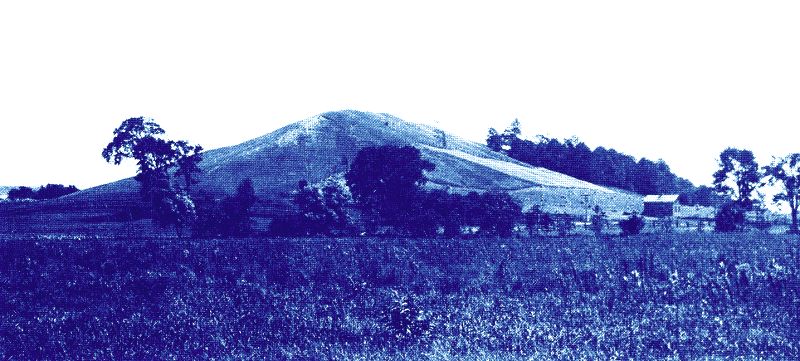
[Above: The Hill of Cumorah (color added -presumably as it was in Smith's day), from "Church History in the Fullness of Times," Church of Jesus Christ of Latter-day Saints, 1989: Sandra Tanner. Here, according to the Book of Mormon, "the Nephite and Lamanite nations ... allegedly waged large-scale wars with each other for hundreds of years, culminating in a conflict in which hundreds of thousands of people were killed in A.D. 385 ... (see Mormon 6:9-15). If all this really happened, you would think we'd find archaeological evidence to support it. But no evidence has ever surfaced." (Rhodes & Bodine, 1995, pp.125-126]

As previously explained, there are no page numbers in the introductory pages of my copy of the Book of Mormon, so page numbers "p.iv" and "p.v." are assumed. To save scanning the text, I will use the online Book of Mormon (hereafter abbreviated "BoM") , assuming it is the same as my 1981 copy. Words from the BoM are in bold. Unless otherwise indicated, Bible references are to the King James Version..

INTRODUCTION

The Book of Mormon is a volume of holy scripture comparable to the Bible. Why then is there no archaeological evidence for the Book of Mormon's "cities, persons; animals, fabrics, metals, wars and war implements, kings, palaces, or crops" but "the archaeological evidence for the Bible is so convincing that even a former skeptic such as the great archaeologist Sir William Ramsay became converted to Christian belief" (Ankerberg & Weldon, 1991, pp.38-39)? See also (Martin, 1977, pp.161-162).

It is a record of God's dealings with the ancient inhabitants of the Americas ... Why then did: 1) anthropologist Prof. Michael Coe state that "nothing, has ever shown up in any New World excavation which would suggest ... the Book of Mormon ... is a historical document," and "I have seen no archaeological evidence ... which would convince me that it [Book of Mormon] is anything but a fanciful creation" (Abanes, 2002, p.75)? 2) archaeologist Dr. Bradley Lepper a specialist in American Indian history, agree that, "There is no archaeological evidence for Old World culture in the Americas. Where the Book of Mormon makes specific claims around that, it's found wanting" (Abanes, 2002, p.75)? 3) the Smithsonian Institution issue an official statement that, `Smithsonian archeologists see no direct connection between the archeology of the New World and the subject matter of the book." (Abanes, 2002, p.75)? 4) Mormon archaeologist Dee F. Green, concede that, "The first myth we need to eliminate is that Book of Mormon archaeology exists" and "no Book of Mormon location is known with reference to modern topography" (Abanes, 2002, p.75)? 5) prominent LDS scholar, B.H. Roberts admit of features of the Book of Mormon that, "The evidence I sorrowfully submit, points to Joseph Smith as their creator" and the golden plates "were not objective but subjective with Joseph Smith" (Abanes, 2002, pp.75-76)? 6. Mormon archaeologist Thomas Stuart Ferguson admit that, "it cannot be established factually that anyone ... has put his finger on a single point of terrain that was a Book-of-Mormon geographical place ... to date there is no Book-of-Mormon geography," "Mormonism is myth-fraternity" and "'he was working on a project, a manuscript which would (according to him) expose Joseph Smith as a fraud" and "the Book of Mormon was produced through Joseph Smith's own creative genius and through his use of contemporary sources." (Abanes, 2002, pp.76-78).

... and contains, as does the Bible, the fulness of the everlasting gospel. If "the Bible" "contains" "the fulness of the everlasting gospel," then why do we need the Book of Mormon? And since the Bible teaches that salvation is by grace through faith alone (Eph 2:8-9 KJV), but Mormonism denies this teaches that salvation is by faith plus works, then why is it not "another gospel," indeed brought by "an angel from heaven," and so should be rejected as "accursed" (Gal 1:18 KJV)? (see Ankerberg & Weldon, 1991, pp.28-30; Martin, 1977, p.193; Reed & Farkas, 1992, pp.89-90; Rhodes, 2001, pp.10-11; Rhodes & Bodine, 1995, pp.49-50).

See `tagline' quotes below (emphasis italics original, emphasis bold mine). To be continued in Book of Mormon-Introduction #2.

Stephen E. Jones.
My other blogs: CreationEvolutionDesign & TheShroudofTurin


"But the most damaging strike against the BOM is the lack of any archeological evidence to support it. In 1973 distinguished anthropologist Michael Coe-Professor Emeritus of Anthropology and Curator Emeritus of Anthropology at the Peabody Museum-unequivocally stated: `The bare facts of the matter are that nothing, absolutely nothing, has ever shown up in any New World excavation which would suggest to a dispassionate observer that the Book of Mormon, as claimed by Joseph Smith, is a historical document relating to the history of early migrants to our hemisphere.' [Coe, M., "Mormons & Archeology: An Outside View," Dialogue: A Journal of Mormon Thought, Summer 1973, Vol. 8, p.46] In 1993, Coe reiterated his position, saying: `I have seen no archaeological evidence ... which would convince me that it [Book of Mormon] is anything but a fanciful creation.' [Coe, M., letter to William McKeever, Aug. 17,1993, in McKeever, W., "Yale Anthropologist's Views Remain Unchanged," Mormonism Researched, Winter, 1995, p.6] Dr. Bradley Lepper-Curator of Archaeology at the Ohio Historical Society, and Assistant Professor in the Department of Sociology and Anthropology at Denison University (Granville, Ohio)-has extensively researched American Indian history and agrees with Coe: `There is no archaeological evidence for Old World culture in the Americas. Where the Book of Mormon makes specific claims around that, it's found wanting.' [Lepper, B., in Fulton, B., "Burden of Proof," Weekly Wire, October 6, 1997] Even the Smithsonian Institution has issued an official statement refuting any claims of BOM historicity, explaining: `Smithsonian archeologists see no direct connection between the archeology of the New World and the subject matter of the book.' ["Statements Regarding the Book of Mormon," Smithsonian Institution, 1996] Some Mormon scholars, such as Dee F. Green, have conceded that there exists no such thing as BOM archeology. [Green stated: `The first myth we need to eliminate is that Book of Mormon archaeology exists... no Book of Mormon location is known with reference to modern topography. Biblical archaeology can be studied because we do know where Jerusalem and Jericho were and are, but we do not know where Zarahemla and Bountiful (nor any other location for that matter) [from the Book of Mormon] were or are. It would seem then that a concentration on geography should be the first order of business, but ... years of such an approach has left us empty-handed" Green, D.R., "Book of Mormon Archeology: the Myths and the Alternatives," Dialogue: A Journal of Mormon Thought, Summer 1969, Vol. 4, pp.72-80, p. 78] (Abanes, R., "One Nation Under Gods: A History of the Mormon Church," Four Walls Eight Windows: New York NY, 2002, pp.75, 515 n.78).

"A similar conclusion forced two of the most prominent LDS scholars, B.H. Roberts (1857-1933) and Thomas Stuart Ferguson (1915-1983), to abandon their faith in the Book of Mormon.This shocking turnabout in their perspectives still haunts LDS church officials who adamantly declare that the two icons of Mormon scholarship never repudiated their testimonies. But private letters and various other manuscripts written by Roberts and Ferguson indicate otherwise. [Tanner, J. & S., "B. H. Robert's Doubts," Salt Lake City Messenger, #84, April 1993] B.H. Roberts, described as `one of the [LDS] church's most valiant writers and speakers in defense of the Book of Mormon, ' began having doubts about the authenticity of the BOM after studying Ethan Smith's View of the Hebrews. He subsequently wrote two highly sensitive manuscripts that severely challenged the veracity of the Book of Mormon. [Walters, W.P., "An Examination of B.H. Roberts' Secret Manuscript," Utah Lighthouse Ministry: Salt Lake City UT, 1979] Both of these works were suppressed until long after his death, when they were acquired and published in 1980 by Jerald and Sandra Tanner under the title Roberts' Secret Manuscripts Revealed.The manuscripts were eventually published in 1985 by the Illinois of University Press as Studies of the Book of Mormon. In these manuscripts Roberts acknowledges that Joseph Smith could have indeed written the BOM using his own talents and creativity. [Roberts, B.H., "Studies of the Book of Mormon," Madsen, B.D. & McMurrin, S.M., eds., University of Illinois Press: Urbana IL, 1985, p.243] Roberts' writings reveal that he grew especially doubtful about the divine origins of the BOM after comparing it to the works of Josiah Priest (The Wonders of Nature, 1825) and Ethan Smith (View of the Hebrews, 1823). His final conclusion diametrically opposed his former stance as one of Mormonism's staunchest defenders: `The evidence I sorrowfully submit, points to Joseph Smith as their creator. It is difficult to believe that they are the product of history, that they come upon the scene separated by long periods of time, and among a race which was the ancestral race of the red man of America. [Roberts, 1985, p.271] Shortly before his death in 1933, Roberts told Wesley P. Lloyd that he had come to believe the Book of Mormon was a non-historical document. Lloyd wrote in his diary that Roberts said the plates `were not objective but subjective with Joseph Smith, that his exceptional imagination qualified him psychologically for the experience which he had in presenting to the world the Book of Mormon.' [Lloyd, W.P., "Private Journal of Wesley P. Lloyd," August 7, 1933] Lloyd also recorded: "These are some of the things which has made Bro. Roberts shift his base on the Book of Mormon. Instead of regarding it as the strongest evidence we have of Church Divinity, he regards it as the one which needs the most bolstering." [Ibid.] (Abanes, 2002, pp.75-76).

"Thomas Stuart Ferguson, even more than B.H. Roberts, dedicated his life to finding objective proof for the Book of Mormon. He founded the New World Archaeology Foundation at Brigham Young University, which was established specifically for the purpose of unearthing archeological evidence supporting the BOM.In One Fold and One Shepherd, he explained his hopes and dreams: `The important thing now is to continue the digging at an accelerated pace in order to find more inscriptions dating to Book-of-Mormon times. Eventually we should find decipherable inscriptions... referring to some unique person, place or event in the Book of Mormon.[Ferguson, T.S., "One Fold And One Shepherd," 1962, p.263, in Tanner, J. & S., "Ferguson's Two Faces," Salt Lake City Messenger, #69, September 1988] In 1962, Ferguson excitedly announced: `Powerful evidences sustaining the book are accumulating.' [Ibid] But by 1972, his expectations had been all but utterly destroyed, writing: `Ten years have passed... I sincerely anticipated that Book-of-Mormon cities would be positively identified within 10 years-and time has proved me wrong in my anticipation.' [Ferguson, T.S., letter to Harold Hougey, June 5, 1972, Larson, S., "The Odyssey of Thomas Stuart Ferguson," Dialogue: A Journal of Mormon Thought, Spring 1990, Vol. 23, p.76] In 1975 Ferguson finally prepared a 29-page report in response to papers written by Mormon apologists John Sorenson and Garth Norman, both of whom were claiming that archeological evidence for the BOM existed. Ferguson pulled no punches in criticizing his fellow Mormon scholars: `With all of these great efforts, it cannot be established factually that anyone, from Joseph Smith to the present day, has put his finger on a single point of terrain that was a Book-of-Mormon geographical place. And the hemisphere has been pretty well checked out by competent people... I must agree with Dee Green, who has told us that to date there is no Book-of-Mormon geography. I, for one, would be happy if Dee were wrong.' [Ferguson, T.S., "Written Symposium on Book-of-Mormon Geography: Response of Thomas S. Ferguson to the Norman & Sorenson Papers," 4, 7, 29, in Tanner, J. & S., "Ferguson's Manuscript Unveiled," Utah Lighthouse Ministry: Salt Lake City UT, 1988] Ferguson, however, explained in a February 20, 1976 letter that he had decided it to keep relatively quiet about his findings because to do otherwise could destroy the faith of others. He suggested that like minded Mormons do the same thing, noting that `Mormonism is probably the best conceived myth-fraternity to which one can belong' and that Joseph Smith `can be refuted-but why bother... It would be like wiping out placebos in medicine, and that would make no sense when they do lots of good.' [Ferguson, T.S., letter dated February 9, 1976] He further explained : `Why not say the right things and keep your membership in the great fraternity, enjoying the good things you like and discarding the ones you can't swallow (and keeping your mouth shut)? ... [W]hy try to be heroic and fight the myths-the Mormon one or any other that does more good than ill? Perhaps you and I have been spoofed by Joseph Smith. Now that we have the inside dope-why not spoof a little back and stay aboard? Please consider this letter confidential-for obvious reasons. I want to stay aboard the good ship, Mormonism... Kindly do not quote this letter and please do not cite me. [Ibid] In February 1983, Ferguson told Pierre Agrinier Bach, a longtime friend and archaeologist, that 'he was working on a project, a manuscript which would (according to him) expose Joseph Smith as a fraud.' [Bach, P.A., in Larson, S., "Quest for the Gold Plates: Thomas Stuart Ferguson's Archaeological Search for the Book of Mormon," Freethinker Press: Salt Lake City UT, 1996, p.158, in Tanner, J. & S., "Quest for the Gold Plates: Stan Larson's New Book," Salt Lake City Messenger #91, November 1996] Ferguson said that when his manuscript was completed, it would be a real `bombshell' on the Book of Mormon, `showing both positive and negative evidence from Mesoamerican archaeology, but concluding that the Book of Mormon was produced through Joseph Smith's own creative genius and through his use of contemporary sources, including Ethan Smith's View of the Hebrews.' [Ibid] Just before publishing his volatile study, Ferguson unexpectedly died in 1983-his manuscript mysteriously disappeared and has never been recovered." (Abanes, 2002, pp.76-78).

"From its inception, the Mormon Church has consistently and adamantly opposed the clear biblical teaching of justification by grace through faith alone (Ephesians 2:8,9; Philippians 3:9). In fact, few religions are more hostile to the biblical teaching of salvation by grace than Mormonism. Talmage refers to `a most pernicious doctrine-that of justification by belief alone.' [Talmage, J.E., A Study of the Articles of Faith, 1974, p.107] Joseph Fielding Smith taught that `mankind [is] damned by [the] "faith alone" doctrine.' [Smith, J.F., Doctrines of Salvation, Vol. 2, p.139] McConkie complained, `Many Protestants ...erroneously conclude that men are saved by grace alone without doing the works of righteousness.' [McConkie, B., Doctrinal New Testament Commentary, Vol. 2, p.229] Because salvation by grace is thoroughly rejected, Mormonism forcefully teaches a system of salvation by works of righteousness and personal merit. Both the Book of Mormon and Doctrine and Covenants teach `works salvation.' Further, virtually every Mormon authority of past and present has emphasized the absolute necessity of salvation by works and personal righteousness. ... But, again ... the Bible teaches only one way of salvation-by grace through faith alone. `Of Him [ Jesus], all the prophets bear witness that through His name everyone who believes in Him receives forgiveness of sins' (Acts 10:43). Jesus Himself taught that salvation was secured by faith alone. For example, `Truly, truly, I say to you, he who hears My word, and believes Him who sent Me, has eternal life, and does not come into judgment, but has passed out of death into life' (John 5:24). `Truly, truly, I say to you, he who believes has eternal life' (John 6:47). `Jesus answered and said to them, `This is the work of God, that you believe in Him whom He has sent' (John 6:29). ... As early as Genesis we read, `Abram believed the Lord, and he credited it to him as righteousness' (Genesis 15:6 NIV). The apostle Paul comments on this verse when he asserts, `What does the Scripture say? "Abraham believed God and it was credited to him as righteousness"' (Romans 4:3 NIV). ... Paul confessed that even though he was a righteous man according to the law, he counted it `but rubbish in order that I may gain Christ, and may be found in Him, not having a righteousness of my own derived from the Law, but that which is through faith in Christ, the righteousness which comes from God on the basis of faith' (Philippians 3:8-9). ... Paul repeatedly emphasized salvation was secured by grace through faith in Christ alone, as the following Scriptures prove: `For we maintain that a man is justified by faith apart from works of the Law' (Romans 3:28). `By grace you have been saved through faith; and that not of yourselves, it is the gift of God; not as a result of works, that no one should boast' (Ephesians 2:8,9). `But if it is by grace, it is no longer on the basis of works, otherwise grace is no longer grace' (Romans 11:6). `I do not nullify the grace of God; for if righteousness comes through the Law, then Christ died needlessly' (Galatians 2:21; see also Romans 4:5,6; 10:4; Galatians 3:11; Titus 3:5). Mormonism, because it teaches a religious system of salvation by good works and personal righteousness, comes under the condemnation so clearly expressed by the apostle Paul in Galatians 1:8 (NIV): `But even if we or an angel from heaven should preach a gospel other than the one we preached to you, let him be eternally condemned!'" (Ankerberg, J. & Weldon, J., "The Facts on the Mormon Church," Harvest House Publishers: Eugene OR, 1991, pp.28-30).

"Another problem for the Book of Mormon is archaeology, a major embarrassment to the Mormon Church. Mormon missionaries continue to claim that the science of archaeology substantiates the Book of Mormon, but whether we consider the alleged cities, persons; animals, fabrics, metals, wars and war implements, kings, palaces, or crops, all the evidence points to their nonexistence. ... No Book of Mormon cities have ever been located, no Book of Mormon person, place, nation, or name has been found, no Book of Mormon artifacts, no Book of Mormon scriptures, no Book of Mormon inscriptions, no Book of Mormon gold plates-nothing that demonstrates the Book of Mormon is anything other than myth or invention has ever been found. By contrast, But the archaeological evidence against Mormon claims is so devastating that prominent Mormon archaeologist Thomas Stewart Ferguson ... repudiated its prophet." (Ankerberg, J. & Weldon, J., 1991, "The Facts on the Mormon Church," Harvest: House Publishers: Eugene OR, pp.38-39).

"Archeological Evidence The Book of Mormon purports to portray the rise and development of two great civilizations. As to just how great these civilizations were, some excerpts from the book itself adequately illustrate: `The whole face of the land had become covered with buildings, and the people were as numerous almost, as it were the sand of the sea' (Mormon 1:7). ` . . fine workmanship of wood, in buildings, and in machinery, and also in iron and copper, and brass and steel, makings [sic.] all manners of tools ... ` (Jarom 1:8 and 2 Nephi 5:15). ` ... grain ... silks ... cattle ... oxen ... cows ... sheep ... swine ... goats ... horses ... asses ... elephants ... ` (See Ether 9:17-19). `... did multiply and spread ... began to cover the face of the whole earth, from the sea south to the sea north, from the sea west to the sea east' (Heleman 3:8). `... had been slain ... two millions' [Jaredites] (See Ether 15:2). ... their shipping and their building of ships, and their building of temples, and of synagogues and their sanctuaries ...' (Heleman 3:14. See also 2 Nephi 5:15, 16 and Alma 16:13). ` ... there were ten more who did fall ... with their ten thousand each...' (See Mormon 6:10-15). ... swords ... cimeters ... breastplates ... arm-shields ... shields ... head-plates ... armor' (See Alma 43:18, 19; 3:5 and Ether 15:15). `... multiplied exceedingly, and spread upon the face of the land, and became exceeding rich ...' (Jarom 1:8). See 3 Nephi 8:9, 10, 14 and 9:4, 5, 6, 8: where cities and inhabitants were sunk in the depths of the sea and earth. In addition to the foregoing statements from the Book of Mormon which indicate the tremendous spread of the culture of these races, there are some thirty-eight cities catalogued in the Book of Mormon, evidence that these were indeed mighty civilizations which should, by all the laws of archeological research into the culture of antiquity, have left vast amounts of `finds' to be evaluated. But such is not the case as we shall show. The Mormons have yet to explain the fact that leading archeological researchers not only have repudiated the claims of the Book of Mormon as to the existence of these civilizations, but have adduced considerable evidence to show the impossibility of the accounts given in the Mormon Bible." (Martin, W.R., 1977, "The Kingdom of the Cults: An Analysis of the Major Cult Systems in the Present Christian Era," Bethany Fellowship: Minneapolis MN, pp.161-162).

"The Christ of the Mormons cannot save, for he is as the Apostle Paul describes him, `another Jesus,' the subject of `another gospel,' and the originator of a `different spirit,' whose forerunner (the angelic messenger, Moroni) was anticipated by the Apostle (Galatians 1:8 and 9) and who along with the entire revelation is to be considered `anathema' or more literally from the Greek, `cursed' by God. It may be difficult for some to grasp what is in fact an incredible concept, but Mormonism fits perfectly into the descriptions given by the Word of God. The greatest of the apostles, in his second letter to the Corinthian church, after mentioning a counterfeit Jesus, gospel and spirit, goes on to state that such occurrences should not come as a surprise to the Christian church: `For such are false apostles, deceitful workmen, transforming themselves into apostles of Christ, and it is not surprising, for Satan himself transforms himself into an angel of light. It is therefore no great marvel if his servants also transform themselves as servants of righteousness whose end will be according to-their works' (II Corinthians 11:13-15, Greek). This is harsh language indeed, but it is the language of God's choosing and it cannot be ignored by anyone who takes seriously the revelations of Scripture and apostolic authority. Mormonism, with the apostles, priesthood, temples, secret signs, symbols, hand shakes and mysteries, quite literally masquerades as `the church of the restoration'; but at its heart, in its doctrine of the Messiah, it is found to be contrary to every major Biblical pronouncement." (Martin, W.R., "The Kingdom of the Cults: An Analysis of the Major Cult Systems in the Present Christian Era," Bethany Fellowship: Minneapolis MN, 1977, p.193).

" Galatians 1:8 But though we, or an angel from heaven, preach any other gospel unto you than that which we have preached unto you, let him be accursed. Although this verse is more often used by Christians to challenge Mormonism, Mormons themselves will sometimes quote it in connection with their claim that the church set up on earth by Jesus Christ soon became apostate, teaching `another gospel,' and so needed to be restored. The Protestant Reformation of the sixteenth century did not accomplish this, they assert, because the church was beyond reform. A total restoration was required, and this took place in 1830 when Joseph Smith founded the LDS Church. It is true that another gospel was introduced early in the history of Christianity; that is what the apostle Paul wrote the Galatians about and warned them against (Gal. 1:6). From the rest of Paul's letter it appears that the other gospel being taught in Galatia had to do with salvation through works (compare Gal. 3:1, 2). Actually, there were a number of `other' gospels taught by persons who sought to `pervert the gospel of Christ' (Gal. 1:7). Some of these are mentioned specifically in the Bible: `the doctrine of Balaam,' `the doctrine of the Nicolaitans,' and the `doctrine' of `that woman Jezebel, which calleth herself a prophetess' (Rev. 2:14, 15, 20-24). The epistles of Paul, Peter, James, Jude, and John are full of warnings against false teachers and false teachings working their way into the church. But, did those other gospels succeed in penetrating the church to the point that the true gospel of Jesus Christ was lost and forgotten? No. In combating the counterfeit gospels, these Bible writers left us their inspired epistles outlining and defending the true gospel. Thousands of early manuscripts have survived to this day, preserving what they wrote. Controversies continued to disturb the church in the centuries that followed, but those disputes, too, are well documented with writings pro and con surviving for our examination. With church history so well preserved, it is possible for us today to trace the development of doctrines and practices over the years. ... Yet, in the mountains of manuscripts dating back nearly two thousand years, nowhere do we find evidence that the church originally taught anything resembling the `restored gospel' of Mormonism. If it were true that the church founded by Jesus Christ originally taught such LDS doctrines as the plurality of Gods, men becoming Gods, celestial marriage, and God the Father having once been a man, and if it were true that those doctrines were later set aside in favor of what is now considered orthodox Christianity, there would certainly be some record of this. There would be very ancient Bible manuscripts containing those teachings that could be compared with later manuscripts leaving them out. And there would be writings pro and con debating those teachings, dating to the time when they were allegedly repressed. But no such evidence is available. ... But, instead of ancient manuscripts, Mormons rely on the writings of Joseph Smith, who claimed to have received his information by direct revelation. The evidence actually points to Mormonism being the `other gospel' and orthodox Christianity being the historically verifiable original gospel of Christ. Regardless of whether Joseph Smith received his information from an angel or from other sources, it still differs from what is recorded in the Bible. So the Scripture applies: `But though we, or an angel from heaven, preach any other gospel unto you than that which we have preached unto you, let him be accursed."' (Reed, D.A. & Farkas, J.R., "Mormons Answered Verse by Verse," Baker: Grand Rapids MI, 1992, pp.89-90).

"The Bible does not prophesy a total apostasy in the early church. ... Galatians 1:6-8 `I am astonished that you are so quickly deserting the one who called you by the grace of Christ and are turning to a different gospel-which is really no gospel at all. Evidently some people are throwing you into confusion and are trying to pervert the gospel of Christ. But even if we or an angel from heaven should preach a gospel other than the one we preached to you, let him be eternally condemned!' This passage records the apostle Paul's warning against believing a different gospel. Notice that there is no indication that there would be a total apostasy of the entire church throughout the world. The local church in Galatia was the focus of these statements by the apostle Paul. The Galatians had apparently succumbed to a gospel that added works to faith. Certain Jewish Christians, unhappy with the way Paul freely invited Gentiles to come to God, had begun to visit the churches he had established. Their purpose was to `Judaize' these Gentile believers-to persuade them that after believing in Christ they needed to take the additional step of getting circumcised.' This effectively added `law' to the `grace' Paul had been preaching. Galatians 3:1,3 says, `You foolish Galatians!...After beginning with the Spirit, are you now trying to attain your goal by human effort?' Paul responded by emphasizing that any gospel that contradicted the gospel of grace already authoritatively handed down to them is to be rejected. He even held himself accountable to this standard (see Galatians 1:8; 1 Corinthians 15:3). A Counterfeit Gospel The gospel of Mormonism is one of works, which contradicts the gospel of grace taught by Paul (Ephesians 2:8,9). The Mormon gospel falls into the category of `a different gospel' (Galatians 1:8)." (Rhodes, R., "The 10 Most Important Things You Can Say to a Mormon," Harvest House: Eugene OR, 2001, pp.10-11).

"Another Gospel ... In Galatians 1:6-8 we read, `I marvel that ye are so soon removed from him that called you into the grace of Christ unto another gospel; which is not another; but there be some that trouble you, and would pervert the gospel of Christ. But though we, or an angel from heaven, preach any other gospel unto you than that which we have preached unto you, let him be accursed.' The Mormons often cite this verse in their attempt to prove that the early church became completely apostate (believing `another gospel') and was thus in need of restoration. This restoration allegedly came through the Mormon prophet Joseph Smith. ... First you will want to make clear what Galatians 1:8 does not say. The text does not even remotely hint that there would be a total apostasy of the entire church. Mormons are reading something into the text that is not there. By allowing Galatians 1 to speak for itself, a person would never come to the conclusion that it is referring to a complete apostasy of the entire church. You will then want to clarify the nature of the false gospel the Galatians had bought into: It was a gospel of legalism, which added works to faith. This was not the same gospel Paul had preached and by which the Galatians had been saved. Apparently false teachers had been at work confusing the Galatians (see Acts 15:24; 20:29-30). ... This, in effect, added law to the grace Paul had been preaching. It is clear, then, that the `other gospel' being taught in Galatia had to do with salvation through works (see Galatians 3:1-2). There are numerous other so-called `gospels' that pervert the true gospel of Christ (Galatians 1:7). These include the `doctrine of Balaam,' the `doctrine of the Nicolaitans,' and the `doctrine' of `that woman Jezebel; which calleth herself a prophetess' (Revelation 2:14,15,20-24). No matter what kind of gospel it is and no matter who it comes from (even an angel), if it goes against the authoritative gospel already handed down, it is to be rejected and is accursed by God. ... Measuring the `gospel' of Mormonism against that expressed in Galatians and the rest of the New Testament (a gospel of grace, not works), it becomes abundantly clear that the LDS works-gospel is in fact `another' gospel that must be pronounced anathema-accursed by God, and deadly to people seeking to enter His kingdom." (Rhodes, R. & Bodine, M., "Reasoning from the Scriptures with the Mormons," Harvest House Publishers: Eugene OR, 1995, pp.49-50).

"Archaeology and the Book of Mormon Down through the years, Mormons have claimed that archaeological finds have proven the veracity and reliability of the Book of Mormon. But is there support for such claims? We must keep in mind that according to the Mormon Scriptures, the Nephite and Lamanite nations had huge populations that lived in large, fortified cities. They allegedly waged large-scale wars with each other for hundreds of years, culminating in a conflict in which hundreds of thousands of people were killed in A.D. 385 near Hill Cumorah in present-day New York State (see Mormon 6:9-15). If all this really happened, you would think we'd find archaeological evidence to support it. But no evidence has ever surfaced. While there is massive archaeological evidence to support the people and places mentioned in the Bible, such evidence is completely missing in regard to the Book of Mormon and other Mormon Scriptures. [Tanner, J. & S., "Major Problems of Mormonism," Utah Lighthouse Ministry: Salt Lake City UT, 1989, pp.162-165]" (Rhodes, R. & Bodine, M., 1995, "Reasoning from the Scriptures With the Mormons," Harvest House Publishers: Eugene OR, pp.125-126).

Saturday, May 24, 2008

Book of Mormon problems-Title Page

I have decided to broaden the scope of this blog to include not only "Jehovah's Witness" but also Mormonism "related matters."

[Left: Book of Mormon, Amazon.com]

I am aware that Mormons, unlike Jehovah's Witnesses, agree that Jesus of the New Testament is Jehovah of the Old Testament, although what they mean by that vwrbal agreement, will be found to be, like their `agreement' with other Christian doctrines, radically different from what Christianity means by it.

That is because Mormonism is based on the first vision in 1820 of its founder, Joseph Smith (1805–1844), then a 14-year old boy, in which he claimed that God the Father and His Son appeared to him and told him that of the Christian churches of his day, "all their creeds were an abomination in his sight" ("Joseph Smith-History," 1:17-19. My emphasis). But one of those creeds is the Apostles' Creed, which states in part:

"I believe in God, the Father Almighty, the Creator of heaven and earth, and in Jesus Christ, His only Son, our Lord: Who was conceived of the Holy Spirit, born of the Virgin Mary ... was crucified, died, and was buried. ... The third day He arose again from the dead. He ascended into heaven and sits at the right hand of God the Father Almighty, whence He shall come to judge the living and the dead."

So Mormonism today must either: 1) maintain that the doctrines of the Apostles' Creed, including the above, are "an abomination" in God's sight; or 2) admit that Joseph Smith's first vision upon which Mormonism is based was wrong (i.e. either a lie or delusion). There is no third option.

The reason I have now decided to also critique here Mormonism in general and the Book of Mormon in particular, is that some months ago I was stopped in the street by two Mormon missionaries, and in the course of our discussion they asked me if I had read the Book of Mormon. This would almost always be a winning point for Mormons because very few non-Mormons would had taken the time and effort to read the Book of Mormon. I had to admit that I had only read the first few chapters of it many years ago. But I pointed out, and they agreed, that one does not have to first read the sacred books of every other religion before one can rationally believe that one's own religion is true. I then went on the offensive with a question (based on what I had read in books about Mormonism, and had years before asked of two Mormon missionaries who knocked on my door):

"How, if the Book of Mormon is based on a 19th century translation by Joseph Smith of Egyptian texts written between 600 BC and AD 400, it contains extensive quotations from the 17th century AD King James Version of the Bible, including its translation errors"?

They had no answer but the older one claimed he had seen an answer to it. I replied that: 1) they had no answer now; and 2) it could not be an adequate answer, because it is impossible that a text could be written in Egyptian, such that when translated into English it would reproduce ~27,000 words of an already existing English text, let alone its errors (See Ankerberg & Weldon, 1991, pp.35-36 below). Nevertheless, I recognised that Mormons would always have at least one winning point in our encounters until I had myself personally read the Book of Mormon from cover to cover.

The issue came up again on Shazoolo's YouTube channel where I began responding to Mormons' comments. And having since re-read my existing books, and bought and read new books, on Mormonism, I asked them the same and other questions relating to the evidence for the Book of Mormon being a plagiarism of the King James Bible.

About a week ago, while waiting for my wife, I read the first five chapters of the Book of Mormon (1Nephi 1-5), and posted some questions that occurred to me, under one of Shazoolo's videos, "Re: answering anti-mormon claim about the book of galatians." Then, a few days ago, I bought a copy of the Book of Mormon (1981) and posted some more question about problems in its introductory pages. Only yesterday I bought some secondhand books about Mormonism and was given a combined "The Book of Mormon, The Doctrine and Covenants and The Pearl of Great Price" (1981).

So I have now decided to begin reading right through the Book of Mormon (and probably then The Doctrine and Covenants and The Pearl of Great Price), posting problems I find in it to this my "Jesus is Jehovah" blog. Throughout this series, I reserve the right to add to these questions retrospectively if further problems occur to me. There are no page numbers in the introduction pages, so the page numbers "p.i.," etc, are assumed. Text from the Book of Mormon (hereafter abbreviated "BoM") is in bold. Unless otherwise indicated, Bible references are to the King James Version, which I understand is the only Bible version that Mormon's accept. So here, after this long preamble, are my questions based on problems I found in the Title Page(s) of the Book of Mormon:

p.i. Another Testament of Jesus Christ Why another testament of Jesus Christ? The Old Testament (i.e. Old Covenant) predicts there will be "a new covenant" (Jer 31:31). And the New Testament claims that Jesus established that "new covenant" (Heb 8:13; 12:24) or "new testament" (Mt 26:28; Mk 14:24; Lk 22:20; 1Cor 11:25; 2Cor 3:6; Heb 9:15), as a fulfillement of that Old Testament prophecy (Heb 8:8). But there is no prophecy in the New Testament that there will be yet another testament or covenant. Rather, the New Testament states that the new covenant, was based on Jesus' "once for all" sacrifice of Himself (Heb 9:12; 26; 10:1-2,10 NIV). See also Hoekema, 1963, pp.30-31 below.

p.iii. An account written by the hand of Mormon upon plates The Introduction says these were "gold plates." Where did Mormon get the gold from? Is there any evidence that Native Americans knew how to mine and manufacture gold plates?

p.iii. Mormon, Nephi, Laman and Moroni These Jewish names do not appear in the KJV. Have those exact names been found in Jewish literature? If not, were they made up by Joseph Smith (or Solomon Spalding)?

p.iii. the people of Jared They appear in Gn 5:15-20 and so were presumably wiped out by the Flood in Gn 6-8. Neither are they mentioned in the Table of Nations in Gn 10. So how were they existing "when the Lord confounded the tongues at the Tower of Babel" in Gn 11:1-9?

p.iii. remnant of the House of Israel If this is the American Indians, how is it reconciled with DNA evidence the latter are more closely related to Asians than Jews? See Martin, 1977, p.163 below.

p.iii convincing of the Jew and Gentile that Jesus is the Christ Since the Christian church has been doing this from ~AD 30, why would God need the Book of Mormon to do it from ~AD 1830? And why, after nearly 180 years, has the Mormonism only "two congregations in Israel"? And what does Mormonism mean by "Jesus is the Christ," since Mormonism must either: 1) regard as "an abomination in" God's "sight" the "Jesus Christ" of the Apostles' Creed (see above), i.e. God's "only Son, our Lord ... conceived of the Holy Spirit, born of the Virgin Mary ... was crucified, died, and was buried" and "The third day ... arose again from the dead" and "ascended into heaven and sits at the right hand of God the Father Almighty, whence He shall come to judge the living and the dead"; or 2) admit that Joseph Smith's first vision, upon which Mormonism is based was a lie or a delusion.

p.iii Translated by Joseph Smith, Jun. Why should anyone believe that Joseph Smith translated the Book of Mormon (Introduction) from Egyptian (Mormon 9:32), given that: 1) there are at least five different versions of Smith's crucial first vision of 1820 in his own handwriting which all conflict with each other in important details (see Ankerberg & Weldon, 1991, pp.35-36 below; and 2) Smith, in addition to being a convicted "impostor," falsely claimed to have translated The Book of Abraham (which is part of The Pearl of Great Price), from what turned out to be an Egyptian funerary text which has nothing to do with Abraham?

To be continued in Book of Mormon-Introduction.

Stephen E. Jones.
My other blogs: CreationEvolutionDesign & TheShroudofTurin


"Is the `first vision' account forming the foundation of the Mormon Church really credible? Joseph Smith's `first vision' forms the essence of Mormonism's claim to uniqueness: that God Himself had rejected all other churches as false and was now restoring the `true' church through this 15-year-old boy.' This is why Mormons have agreed that the `first vision' account is absolutely crucial to the credibility and authority of both Smith and the Church. Second in importance only to Christ's `deity,' the `first vision' is the `foundation of the church'; the Mormon Church stands or falls on the authenticity of this event, and the `truth and validity' of all of Joseph Smith's subsequent work rests upon its genuineness. The following facts prove, by Mormonism's own assertions, that their church is based on falsehood. The official account of the event was written by Smith around 1838 and published in Times and Seasons in 1842, two decades after `the event' took place. [Tanner, J. & S., "The Changing World of Mormonism," Moody Press, 1981, p. 148] What most Mormons have never been told is that at least five earlier drafts of the `first vision' exist. These conflicting accounts have been ignored or repressed by Mormon leaders because they disagree with what has come to be the preferred or official version. Of all versions, the official composition, Smith's final draft, is the least credible. [Ibid., pp.10,149-155] The earliest known account was written by Smith in 1832. It varies in important details with the official version. There are discrepancies in Smith's age, the presence of an evil power, Smith's reason for seeking the Lord, the existence of a revival, and the number of divine personages in the vision. For example, the revival Smith claimed happened in 1820 (he clearly gives his age as 15) actually took place in 1824-1825. [Walters, W.P., "New Light on Mormon Origins from the Palmyra [New York] Revival," 1967] There was no revival in 1820, and, therefore, Smith had no reason to seek God's counsel over his own religious confusion. Another account by Smith was written between 1835-1836. [Tanner, ibid., pp.155-156] In this different and contradictory version, there is no mention of God or Christ, but only of many spirits and `angels' who testified of Jesus. Leading authorities on Mormonism Jerald and Sandra Tanner conclude: `We have now examined three different handwritten manuscripts of the first vision. They were all written by Joseph Smith or his scribes and yet every one of them is different. The first account says there was only one personage. The second account says there were many, and the third says there were two. The church, of course, accepts the version which accepts two personages .... At any rate... it becomes very difficult to believe that Joseph Smith ever had a vision in the grove.' [Ibid., p.156] The crucial `first vision' account is simply not credible. Mormons who accept it must ignore and deny strong evidence to the contrary." (Ankerberg, J. & Weldon, J., "The Facts on the Mormon Church," Harvest House Publishers: Eugene OR, 1991, pp.35-36).

"But the content of the Book of Mormon presents further difficulties. For example, there are many clearly demonstrated plagiarisms. Material has been taken from ... the King James Bible. Some 27,000 words from the King James Bible are found in the Book of Mormon. [Hoekema, A.A., "The Four Major Cults," Eerdmans: Grand Rapids MI, 1977, p.85] But if the Book of Mormon was first written between 600 B.C. and A.D. 421, how could it possibly contain such extensive quotations from the King James Bible, not to be written for another 1,200 to 2,000 years? The Tanners have listed, one by one, 400 verses and portions of verses quoted from the New Testament in the Book of Mormon in their book The Case Against Mormonism. [Tanner, J. & S., "The Case Against Mormonism," Vol. 2, Modern Microfilm Co: Salt Lake City UT, 1968, pp.87-102] The Book of Mormon even contains King James Bible translation errors. For example, in 2 Nephi 14:5 (Isaiah 4:5) the correct translation of the Hebrew chupaah is `canopy,' not `defense.' In 2 Nephi 15:25 (Isaiah 5:25) the correct translation of the Hebrew suchah is `refuse,' not `torn.'" (Ankerberg & Weldon, 1991, pp.38-39).

"We must at this point assert, in the strongest possible terms, that Mormonism does not deserve to be called a Christian religion. It is basically anti-Christian and anti-Biblical. The Mormon contention that `after the book [the Bible] hath gone forth through the hands of the great and abominable church ... there are many plain and precious things taken away from the book...' (1 Nephi 13:28), is completely contrary to fact. The many copies of Old Testament manuscripts which we now possess do vary in minor matters - the spelling of words, the omission of a phrase here and there - but there is no evidence whatsoever that any major sections of Old Testament books have been lost. The manuscripts found among the Dead Sea Scrolls, generally dated from about 200 to 50 B.C., include portions of every Old Testament book except Esther'; studies have revealed that these documents - older by a thousand years than previously discovered Old Testament manuscripts - are substantially identical to the text of the Old Testament which had been previously handed down. As far as New Testament manuscripts are concerned, the oldest of which go back to the second century A.D., the situation is substantially the same. The variations that are found in these manuscripts -- all copies of the originals or of copies made from the originals - are of a relatively minor nature. There is no indication whatever that any large sections of material found in the originals have been lost. Most of the manuscript variations concern matters of spelling, word order, tense, and the like; no single doctrine is affected by them in any way. There is, further, not a shred of evidence to show that any translations of the Bible, including the fourth-century Vulgate, which became the official medieval Roman Catholic version, omitted any portions of these manuscripts or failed to reproduce any major sections of the Bible. The Bible itself, moreover, clearly indicates that it is the final revelation of God to man, and that it does not need to be supplemented by additional revelation. We have already noted Christ's reference to Moses and the prophets as giving sufficient revelation for man's salvation (Lk. 16:19-31 ...). When the risen Christ appeared to the disciples from Emmaus, He did not find it necessary to give them additional revelations, but `beginning from Moses and from all the prophets, he interpreted to them in all the Scriptures the things concerning himself (Lk. 24:27). The finality of the revelation that came through Jesus Christ is strikingly expressed in Hebrews 1:1 and 2: `God, having of old times spoken unto the fathers in the prophets, by divers portions and in divers manners, hath at the end of these days spoken unto us in his Son... .' God's revelation through Christ is here described as climactic and definitive -- the claim that further revelations would have to be given to the church 1800 years later by Joseph Smith clearly contradicts the thrust of this passage!" (Hoekema, A.A., 1963, "The Four Major Cults: Christian Science, Jehovah's Witnesses, Mormonism, Seventh-day Adventism", Paternoster: Exeter UK, Reprinted, 1969, pp.30-31).

"The Mongoloid Factor It is one of the main contentions of Mormon theology that the American Indians are the descendants of the Lamanites and that they were of the Semitic race, in fact of Jewish origin. As we have seen, this claim is extensive in Mormon literature; and if evidence could be adduced to show that the American Indian could not possibly be of Semitic extraction, the entire story of Nephi and his trip to America in 600 B.C. would be proven false. It is, therefore, of considerable value to learn that in the findings compiled by anthropologists and those who specialize in genetics, the various physical factors of the Mediterranean races from which the Jewish or Semitic race spring bear little or no resemblance to those of the American Indian! Genotypically, there is therefore little if any correlation, and phenotypically speaking the American Indians are considered to be Mongoloid in extraction, not Mediterranean Caucasoids. Now, if the Lamanites, as the Book of Mormon tells it, were the descendants of Nephi, who was a Jew of the Mediterranean Caucasoid type, then their descendants, the American Indians, would by necessity have the same blood factor genotypically; and phenotypic, or apparent characteristics, would be the same. But this is not at all the case. Instead, the American Indian, so say anthropologists, is not of Semitic extraction and has the definite phenotypical characteristic of a Mongoloid." (Martin, W.R., 1977, "The Kingdom of the Cults: An Analysis of the Major Cult Systems in the Present Christian Era," Bethany Fellowship: Minneapolis MN, p.163. Emphasis original).

Thursday, May 22, 2008

Was Jesus executed on a cross or a stake? #3B: Historical (9th-5th Century BC)

[See also Introduction #1; Linguistic #2A, #2B, #2C; Historical #3A, #3C, #3D]

Continuing from #3A: Historical, in this series, Was Jesus executed on a cross or a stake?

[Above: Papyrus Bodmer II (P66), Earlham School of Religion, Richmond, Indiana. "Papyrus 66 ... is a near complete codex of the Gospel of John .... It is one of the oldest New Testament manuscripts known to exist, with its writing dated to the middle of the 2nd century CE" (Wikipedia), i.e. ~AD150. At its page 137 (not shown), "The beginning of line 3 contains that section of Jn 19:16 where it is stated that Pilate delivered Jesus `to be crucified.' Here the verb staurothe is abbreviated s tau-rho the. ... Line 6 contains the mention of Golgotha in Jn 19:17, and continues with the opening words of Jn 19:18, `where they crucified him... .' Here the verb estaurosan abbreviated es tau-rho an ... . Line 10 contains a portion of Jn 19:19 where Pilate wrote a title `and put it on the cross.' ... the noun staurou is abbreviated s tau-rho ou." (Finegan, 1992, pp.381-382. My transliteration). That is, from ~AD 150, if not earlier, New Testament manuscript copyists were substituting for stauros a staurogram,

[Left: Staurograms combining the Greek letters, from left to right, Tau and Rho, the Chi-Rho monogram formed by the first two letters of `Christ' in Greek, and the Iota-Chi monogram composed of the initials for `Jesus Christ' in Greek." (David J. Ross)]

a combinination of the Greek letters tau and rho to make a tiny pictorial representation of a human body affixed to a Latin Cross (crux immissa). So this is further archaeological evidence that Jesus was crucified on a traditional two-beamed Latin cross and not on a single-beamed stake.]

As previously, my method is to quote in bold from Appendix 3C of "The Kingdom Interlinear Translation," 1985, pp.1149-1151) and then comment on that quote.

In the writings of Livy, a Roman historian of the first century B.C.E., crux means a mere stake."Cross" is only a later meaning of crux. ... Evidence is, therefore, completely lacking that Jesus Christ was crucified on two pieces of timber placed at right angles.

We have seen in part #3A that in the writings of Livy (59 BC-AD 17) the word crux meant not a single-beamed stake, but a two-beamed cross! So the Watchtower Society's historical argument that Jesus was executed on a stake, because the Romans did not start crucifying on two-beamed cross until "later," i.e. later than "the first century B.C.E," or at least later than the death of Jesus in either AD 30 or 33.

But as we shall see, far from the "Evidence" being "completely lacking that Jesus Christ was crucified on two pieces of timber placed at right angles," there is overwhelming and irrefutable historical evidence that the Romans were crucifying on two-beamed crosses from as far back as the third century BC. We will examine that evidence, quoting from the writings of the ancient Greeks, Romans and Jews, in chronological order from the oldest through to the first century AD.

Again, I am indebted to Leolaia's references in her, "The facts on crucifixion, stauros, and the `torture stake'," but my quotes here were scanned by me from either photocopied library books or books I own (my emphasis below). Each quote is hyperlinked to a fuller version in the `tagline' at the end of this post.

9th Century BC

Homer. Ancient Greek epic poet, Homer (c. 9th century BC) describes building a pig-pen with "stakes [staurous] ":

"Without he had driven stakes [staurous] the whole length, this way and that, huge stakes, set close together, which he had made by splitting an oak to the black core. " (Homer, "The Odyssey," 14.11).

So the Watchtower Society's claim that the only meaning of staurous was a single pole or stake until after the execution of Jesus, means that the word staurous would have had to remain only its original meaning for at least 900 years!

7th Century BC

Livy. Roman historian Titus Livius, better known as Livy (59 BC-AD 17), writing between 35 BC-AD 10 his history of Rome, described the ancient Roman punishment, dating at least from 672-640 BC, which involved the victim being bound beneath a fork of a tree and flogged to death:

"The dread formula of the law [BC 672-640] ran thus: `Let the duumvirs pronounce him guilty of treason; if he shall appeal from the duumvirs, let the appeal he tried; if the duumvirs win, let the lictor veil his head; let him bind him with a rope to a barren tree [infelici arbori]; let him scourge him either within or without the pomerium. ... `... can you bear ... to see him bound beneath a fork [furca] and scourged and tortured?''" (Livy, "History of Rome," 1.26.6,10).

But being attached to a fork of a tree, which presumably was by outstretched arms, is effectively a two-beamed cross in the 7th century BC! It is clearly a precursor to later (but as we shall see well before the time of Christ) Roman crucifixion consisting of scourging, crossbeam-bearing through the town to the site of execution outside the own and then having both outstretched hands nailed to the crossbeam, and the crossbeam bearing the victim then attached to an upright tree-trunk set in the ground.

6th Century BC

Ezra 6:11. The Bible in Ezra 6:11 (NIV) describes what may be a Persian live crucifixion in ~520 BC:

"Furthermore, I decree that if anyone changes this edict, a beam is to be pulled from his house and he is to be lifted up and impaled on it."

but the text is not specific enough to be certain. The Aramaic (Ezr 4:7-6:18 is in Aramaic, not Hebrew) literally is: "and lifted up [zeqaph "hanged"] he shall be smitten [mecha' "to strike"] upon it" (Kidner, 1979, pp.57-58), which may not even be execution but flogging.

5th Century BC

Herodotus. The Greek historian Herodotus (c. 484-425 BC), writing in c.440 BC, describes what may include instances of crucifixion by the Persians in the Greco-Persian Wars (499-479 BC). Where he used terms based on the root Greek word "skolops ... a `pointed stake'" (Kittel & Friedrich, 1985, p.1047), its primary meaning seems to be "impaled" on a stake, in the sense of having a pointed stake driven through his body:

"Astyages ... took the Magians who interpreted dreams and had persuaded him to let Cyrus go free, and impaled [aneskolopise] them" (Herodotus, "Histories," 1.128).

"When the Egyptian chirurgeons ... were about to be impaled [aneskolopieisthai] for being less skilful than a Greek" (Herodotus, 3.132)

"Darius ... impaled [aneskolopise] about three thousand men that were chief among them." (Herodotus, 3.159).

".... Sataspes ... was to be impaled [aneskolopieisthai] ... But Xerxes did not believe that Sataspes spoke truth, and ... impaled [aneskolopise] him ..." (Herodotus, 4.43).

But Herodotus used also used terms based on the stauros, presumably to indicate something different from impalement as above, which could in crucifixion in the sense of being affixed to a two-beamed cross. The first two instances are of affixing an already dead body to a stake:

"Polycrates ... sailed to meet Oroetes .... But ... Having killed him ... Oroetes then crucified [anestaurose] him ..." (Herodotus, 3.125).

"Harpagus who had taken Histiaeus, impaled [anestaurosan] his body on the spot, and sent his head embalmed to king Darius at Susa ..." (Herodotus, 6.30).

But the next two example are of live crucifixion:

"Sandoces had been taken and crucified [anestaurose] by Darius because he had given unjust judgment for a bribe. But Sandoces having been hung on the cross [anakremasthentos] ... Darius perceived that he had acted with more haste than wisdom, and so set Sandoces free." (Herodotus, 7.194).

"So they carried Artayctes away to the headland where Xerxes had bridged the strait ... and there nailed him to boards and hanged [anekremasan] him aloft; and as for his son, they stoned him to death before his father's eyes. ..." (Herodotus, 9.120-122).

The first of the above two live crucifixions may have been on a two-beamed cross. This is supported by the Penguin edition of Herodotus which also translates it to mean "crucified" on "cross":

"Sandoces ... while he was actually on the cross, Darius ... realizing ... that he had acted with more promptitude than wisdom, caused him to be taken down." (Herodotus, 7.194).

However, the second example of live crucifixion, with its mention of "boards" was probably, "the `tympanum' ... a flat board made up of planks (sanides) on which criminals were fastened for public display, torture or execution.." (Hengel, 1977, pp.69-70).

So from the 7th to the 5th century BC we have examples of Persian impalement on a single-beamed stake, Roman fastening to the fork of a tree, presumably by the victim's outstretched arms, and an example of what may be a Persian live crucifixion on a two-beamed cross. And as we shall see in future posts in this series, from the 5th century through to the 1st century BC, i.e. well before the time of Jesus, there are clearer examples in the writings of ancient historians of what can only be live crucifixion on a two-beamed cross.

Continued in Part #3C: Historical.

See `tagline' quotes below (original emphasis italics, my emphasis bold).

Stephen E. Jones.
My other blogs: CreationEvolutionDesign & TheShroudofTurin


"PAPYRUS BODMER II (P66) is a manuscript in codex form with numbered pages which contains most of the Gospel according to John, Chapters 1-14, and fragments of the rest of the Gospel through Chapter 21. It was probably written about A. D. 200 if not even earlier. In the manuscript at most of the places where the noun stauros, `cross,' and the verb stauroo, `crucify,' occur an abbreviation of the word is employed in which the tau and the rho are written together to make the sign-tau-rho ... . The present photograph shows the extant fragments of page 137 (PAZ) in the codex. The beginning of line 3 contains that section of Jn 19:16 where it is stated that Pilate delivered Jesus `to be crucified.' Here the verb staurothe is abbreviated s tau-rho the. The initial sigma is badly preserved but the remaining letters are plainly legible together with the line over them which marks the abbreviation. Line 6 contains the mention of Golgotha in Jn 19:17, and continues with the opening words of Jn 19:18, `where they crucified him... .' Here the verb estaurosan abbreviated es tau-rho an the initial epsilon being lifted above the level of the other letters as shown. Line 10 contains a portion of Jn 19:19 where Pilate wrote a title `and put it on the cross.' Here, although it is more difficult to make out because of the break in the papyrus, the noun staurou is abbreviated s tau-rho ou." (Finegan, J., "The Archeology of the New Testament: The Life of Jesus and the Beginning of the Early Church," [1969], Princeton University Press: Princeton NJ, Revised edition, 1992, pp.381-382. Emphasis original. My transliteration).

"Herodotus further shows that even the Athenians could crucify a hated enemy ... the phrase `nail to planks', which appears only here, suggests that a real cross was not used in this case, but the `tympanum', which was familiar from their own penal law. This was a flat board made up of planks (sanides) on which criminals were fastened for public display, torture or execution. The seventeen victims discovered in the well-known find of the tomb at Phaleron from the seventh century BC were fastened with a ring round their necks and hooks round their hands and feet. This could be seen as an aggravated form of apotymanismos, which would come very near to crucifixion if the victim were nailed down instead of being bound or fastened with curved nails." (Hengel, M., "Crucifixion: In the Ancient World and the Folly of the Message of the Cross," Bowden, J., transl., Fortress Press: Philadelphia PA, 1977, Third printing 1982, pp.69-70)

"Thus the Median army was foully scattered. Astyages, hearing this, sent a threatening message to Cyrus, `that even so he should not go unpunished'; and with that he took the Magians who interpreted dreams and had persuaded him to let Cyrus go free, and impaled [aneskolopise] them; then he armed the Medes who were left in the city, the youths and old men. Leading these out, and encountering the Persians, he was worsted: Astyages himself was taken prisoner, and lost the Median army which he led." (Herodotus, "History," 1.128, Godley, A.D., transl., Loeb Classical Library, Heinemann: London, 1920, Reprinted, 1946, Vol. I., p.169).

"But Polycrates would listen to no counsel. He sailed to meet Oroetes, with a great retinue of followers, among whom was Democedes, son of Calliphon, a man of Crotona and the most skilful physician of his time. But no sooner had Polycrates come to Magnesia than he was foully murdered, making an end which ill beseemed himself and his pride; for, saving only the despots of Syracuse, there is no despot of Greek race to be compared with Polycrates for magnificence. Having killed him (in some way not fit to be told) Oroetes then crucified [anestaurose] him; as for the Samians in his retinue he let them go, bidding them thank Oroetes for their freedom; those who were not Samians, or, were servants of Polycrates' followers, he kept for slaves. So Polycrates was hanged aloft, and thereby his daughter's dream came true; for he was washed by Zeus when it rained, and the moisture from his body was his anointment by the sun." (Herodotus, 3.125).

"So now for having healed Darius at Susa Dernocedes had a very great house and ate at the king's table; all was his, except only permission to return to his Greek home. When the Egyptian chirurgeons who had till now attended on the king were about to be impaled [aneskolopieisthai] for being less skilful than a Greek, Democedes begged their lives of the king and saved them; and he saved besides an Elean diviner, who had been of Polycrates' retinue and was left neglected among the slaves. Mightily in favour with the king was Democedes." (Herodotus, 3.132).

"Having mastered the Babylonians, Darius destroyed their walls and reft away all their gates, neither of which things Cyrus had done at the first taking of Babylon; moreover he impaled [aneskolopise] about three thousand men that were chief among them; as for the rest, he gave them back their city to dwell in. Further, as the Babylonians, fearing for their food, had strangled their own women, as I have shown above, Darius provided that they should have wives to bear them children, by appointing that each of the neighbouring nations should send a certain tale of women to Babylon; the whole sum of the women thus collected was fifty thousand: these were the mothers of those who now inhabit the city." (Herodotus, 3.159).

"The next story is that of the Carchedonians: for as for Sataspes son of Teaspes, an Achaemenid, he did not sail round Libya, though he was sent for that end; but he feared the length and the loneliness of the voyage and so returned back without accomplishing the task. laid upon him by his mother. For he had raped the virgin daughter of Zopyrus son of Megabyzus; and when on this charge he was to be impaled [aneskolopieisthai] by King Xerxes, Sataspes' mother, who was Darius' sister, begged for his life, saying that she would lay a heavier punishment on him than did Xerxes; for he should be compelled to sail round Libya, till he completed his voyage and came to the Arabian Gulf. Xerxes agreeing to this, Sataspes went to Egypt, where he received a ship and a crew from the Egyptians, and sailed past the Pillars of Heracles. Having sailed out beyond them, and rounded the Libyan promontory called Solois, he sailed southward; but when he had been many months sailing far over the sea, and ever there was more before him, he turned back and made sail for Egypt. Thence coming to Xerxes, he told in his story how when he was farthest distant he sailed by a country of little men, who wore palm-leaf raiment; these, whenever he and his men put in to land with their ship, would ever leave their towns and flee to the hills; he and his men did no wrong when they landed, and took naught from the people but what they needed for eating. As to his not sailing wholly round Libya, the reason (he said) was that the ship could move no farther, but was stayed. But Xerxes did not believe that Sataspes spoke truth, and as the task appointed was unfulfilled he impaled [aneskolopise] him, punishing him on the charge first brought against him." (Herodotus, 4.43).

"But those near the Pangaean mountains and the country of the Doberes and the Agrianes and the Odomanti and the Prasiad lake itself were never subdued at all by Megabazus; albeit he tried to take the lake-dwellers, whose dwellings were such as I shall show :-There is set in the midst of the lake a platform made fast on tall piles [stauron], whereto one bridge gives a narrow passage from the land. The piles [staurous] which support the platform were set there in old times by all the people working together, but by a later custom this is the manner of their setting: the piles [staurous] are brought from a mountain called Orbelus, and every man plants three for each woman that he weds; and each has many wives. " (Herodotus, 5.16).

"Now had he been taken prisoner and brought on his way to king Darius, no harm had been done him (to my thinking) and the king had forgiven his guilt; but as it was, Histiaeus being brought to Sardis, there both by reason of what he had done, and for fear that he might escape and again win lower at the court, Artaphrenes, viceroy of Sardis, and Harpagus who had taken Histiaeus, impaled [anestaurosan] his body on the spot, and sent his head embalmed to king Darius at Susa. When Darius learnt of this he blamed those who had so done, because they had not brought Histiaeus before him alive; for the head, he gave command that it should be washed and buried with full observance, as the head of one that had done great good to Darius himself and to Persia." (Herodotus, 6.30).

"Fifteen of those ships had put to sea a long time after all the rest, and it chanced that they sighted the Greek ships off Artemisium. Supposing these to be their own fleet, the foreigners held on their course into the midst of their enemies. Their captain was the viceroy from Cyme in Aeolia, Sandoces son of Thumasius; he had once before this, being then one of the king's judges, been taken and crucified [anestaurose] by Darius because he had given unjust judgment for a bribe. But Sandoces having been hung on the cross [anakremasthentos], Darius found on a reckoning that his good services to the royal house were more than his offences; whereat the king perceived that he had acted with more haste than wisdom, and so set Sandoces free." (Herodotus, 7.194).

"Sandoces, who was one of the royal judges, had been arrested by Darius some time before and crucified, on a charge of perverting justice for money. But while he was actually on the cross, Darius came to the conclusion that his services to the royal house outweighed his offences, and realizing in consequence that he had acted with more promptitude than wisdom, caused him to be taken down." (Herodotus, "The Histories," 7.194, de Selincourt, A., transl., Penguin: London, 1954, Revised 1996, p.437).

"But Xanthippus the general was unmoved by this promise; for the people of Elaeus entreated that Artayetes should he put to death in justice to Protesilaus, and the general himself likewise was so minded. So they carried Artayctes away to the headland where Xerxes had bridged the strait (or, by another story, to the hill above the town of Madytus), and there nailed him to boards and hanged [anekremasan] him aloft; and as for his son, they stoned him to death before his father's eyes. ... This Artayctes who was crucified [anakremasthentos] was grandson to that Artembares who instructed the Persians in a design which they took from him and laid before Cyrus ..." (Herodotus, 9.120,122).

"He found him sitting in the fore-hall of his house, where his court was built high in a place of wide outlook, a great and goodly court with an open space around it. This the swineherd had himself built for the swine of his master, that was gone, without the knowledge of his mistress and the old man Laertes. With huge stones had he built it, and set on it a coping of thorn. Without he had driven stakes [staurous] the whole length, this way and that, huge stakes, set close together, which he had made by splitting an oak to the black core; and within the court he had made twelve sties close by one another, as beds for the swine, and in each one were penned fifty wallowing swine, females for breeding; but the boars slept without." (Homer, "The Odyssey," 14.11, Murray, A.T., transl., Loeb classical library, Heinemann: London, 1919, Reprinted, 1953, p.35).

"[Ezr 6:]11. One who alters the edict would probably have included anyone who violated it (cf. Ryle). There was poetic justice intended in making a man's own house his instrument of execution for tampering with the house of God. The form of punishment may or may not have been impalement (RSV; cf. GNB's elaboration of the theme); certainly this hideous practice was no novelty, as Assyrian monuments show. But the Aramaic reads literally `and lifted up he shall be smitten upon it', which NEB takes to mean `fastened erect to it and flogged', while BDB understands it as some form of crucifixion,' and 1 Esdras 6:32 as hanging. The common ground between such punishments was the public spectacle they afforded for disgrace and warning. It is a relief to know that Israelite law put two crucial restraints on such a practice: the victim was executed before this, not by means of it (Dt. 21:22; note the sequence), and the display of his corpse must not be prolonged (Dt. 21:23)." (Kidner, D., "Ezra and Nehemiah: An Introduction and Commentary," Tyndale Press: London, 1979, pp.57-58).

"skolops [pointed stake, thorn] 1. This rare term denotes a `pointed stake,' such as is used in pits or palisades. Being fastened to such a stake is a form of execution; the reference is to crucifixion on a T - shaped cross, or to impaling and exposure on a stake. Corpses are also impaled on stakes as a sign of disgrace. 2. Another meaning in the LXX is a `thorn' or `splinter' on the foot, finger, etc., which doctors remove by plasters or ointments. Spines of palms are used in magic, and demons supposedly put prickles on women's temples. In the OT God blocks the way of Israel with thickets in Hos. 2:8, and oppressors are splinters in the eyes of Israel in Num. 33:55 or thorns in Ezek. 28:24. 3. In 2 Cor. 12:7 Paul is speaking about bodily afflictions, and among these he mentions a skolops that God sends, that acts as a messenger of Satan, and that is obviously painful. The idea is not that of a stake to which the apostle is impaled, nor of a barb of depression, e.g., at his failure to win the Jews to Christ, or in reaction from ecstasy. Physical ill-treatment or a physical disability seems to be in view, but there can be no saying what it is. Although it hampers his work, God uses it to keep him from arrogance and to point him to his true strength. 4. Only rarely do Christians use the group with reference to Jesus' execution (cf. Origen Against Celsus 2.55.68-69). It lies outside the usage that soon develops in relation to the cross (cf. the paucity of anastauroun)." (Kittel, G. & Friedrich, G., eds., "Theological Dictionary of the New Testament: Abridged in one Volume," [1985], Bromiley, G.W., transl., Eerdmans: Grand Rapids MI, Reprinted, 1988, p.1047. Emphasis original).

"The dread formula of the law [BC 672-640] ran thus: `Let the duumvirs pronounce him guilty of treason; if he shall appeal from the duumvirs, let the appeal he tried; if the duumvirs win, let the lictor veil his head; let him bind him with a rope to a barren tree [infelici arbori]; let him scourge him either within or without the pomerium.'" (Livy, "History of Rome," 1.26.6, Foster, B.O., transl., Loeb Classical Library, Heinemann: London, Vol. I, 1919, Reprinted, 1957, p.93).

Friday, April 25, 2008

Was Jesus executed on a cross or a stake? #3A: Historical (Introduction)

[See also Introduction #1; Linguistic #2A, #2B, #2C; #3B, #3C, #3D]

Continuing from Part #2C: Linguistic, in this series, Was Jesus executed on a cross or a stake? As before, my method will be to

[Above: The Alexamenos Graffito, "The graffito shown below is from first century (AD) Rome. ... It obviously mocks a Christian ... The human figure with the ass head on the cross is presumably Jesus ...," Rodney J. Decker.]

quote in bold from Appendix 3C of the Watchtower Bible & Tract Society's, "The Kingdom Interlinear Translation," 1985, pp.1149-1151, and then comment on that quote.

In the writings of Livy, a Roman historian of the first century B.C.E., crux means a mere stake. The Watchtower Society has been making this claim since at least 1950:

"Even in the writings of Livy, a Roman historian of the first century B.C., crux means a mere stake." (NWT, 1950, pp.769-770. See also KIT, 1969, p.1155 & NWT, 1984, p.1577).

As Leolaia pointed out in her "The facts on crucifixion, stauros, and the `torture stake'," the "word crux ... appeared six times in Livy's writings":

"... the word crux in its various inflected forms appeared six times in Livy's writings ... Each and every one of these references to crucifixion are laconic and devoid of detail as to the manner of the execution; none of the six excerpts reveal any information indicating what the nature of the crux was like. When Livy did refer to the crux simplex, he used the word palus ... The Society's claim must therefore be dismissed as false." (Leolaia, 2005).

I am indebted to Leolaia's references in her post above, and I agree that, "none of the six ... reveal any information indicating what the nature of the crux was like." However, when they are combined with the at least two instances where Livy referred to being bound to a palum or "stake" i.e. crux simplex, then that becomes evidence that by crux (or cruci) Livy meant something other than a single-beamed "stake," i.e. a two-beamed cross (see below).

Consistent with my policy of quoting from the primary sources where possible, here are quotes of those six references to crux and two to palus in Livy's writings, which I obtained from a library and scanned (my emphasis bold):

"Whereupon he scourged the guide, and, to terrify the others, crucified [crucem sublato] him ... [B.C. 217]" (Livy, "History of Rome," 22.13).

"... five and twenty slaves were crucified [crucem acti], on the charge of having conspired in the Campus Martius. [B.C. 217] " (Livy, 22.33).

"He thereupon enticed their sufetes-the highest magistrates among the Phoenicians-together with the treasurer to a conference and ordered them to be scourged and crucified [cruci adfigi]. [B.C. 206]" (Livy, 28.37).

"The deserters were more severely treated than the runaway slaves, Latin citizens being beheaded, Romans crucified [crucem sublati]. [B.C. 201]" (Livy, 30.43).

"... some, who had been the instigators of the revolt, he scourged and crucified [crucibus adfixit], others he turned over to their masters. [B.C. 196]" (Livy, 33.36).

"...even if I were pleading ... before the Carthaginian senate, where commanders are said to be crucified [crucem tolli] if they have conducted a campaign with successful result but defective policy ... [B.C. 187] " (Livy, 38.48).

"When Livy did refer to the crux simplex, he used the word palus." (Leolaia, 2005):

"Bound to a stake [Deligati ad palum] they were scourged and beheaded ... [B.C. 206] " (Livy, 28.29).

"... bound to a stake [ad palum deligatus], with my back mangled by rods... [B.C. 211] " (Livy, 26.13).

From the above it can be seen that Livy (59BC-AD17), made a distinction between being crucified (crucem) on a cruci and being bound to a stake (ad palum deligatus). That is, between being affixed (adfigi, adfixit = ad "to" + figo "to fix, fasten, attach, to drive in, pierce" - "Collins Latin Dictionary," 1995) to a cruci and being tied to a palum.

`Cross' is only a later meaning of crux. A single stake for impalement of a criminal was called in Latin crux simplex. And since the Watchtower admits that crux originally meant "a single stake" and then "later" became a two-beamed cross, if "In the writings of Livy" cruci or crux meant something other than "a single stake," it must have by at least the time Livy was writing about, the third century BC, come to mean a two-beamed cross.

Therefore, the Society's claim that "In the writings of Livy ... crux means a mere stake," is false. In the writings of Livy, from the third century BC, the word crux meant not a single-beamed stake, but a two-beamed cross!

To be continued in Part #3B Historical, where we will see that the historical evidence is overwhelming and irrefutable that crux and therefore also its Greek equivalent stauros, had come to mean a two-beamed cross, by at least the third century BC.

[...]

See `tagline' quotes below (original emphasis italics, my emphasis bold).

Stephen E. Jones.
My other blogs: CreationEvolutionDesign & TheShroudofTurin


"actio, -onis f action, doing; official duties, negotiations; (law) action, suit, indictment, pleading, case, trial; (RHET) delivery; (drama) plot; ... ad prep (with acc) to, towards, against; near, at; until; (num) about; with regard to, according to; for the purpose of, for; compared with; besides; ... adfigo, -gere, -xi, -xum vt to fasten, attach; to impress (on the mind). ... adfixus ppp of adfigo. ... figo, -gere, -xi, -xum vt to fix, fasten, attach, to drive in, pierce ... " (Kidd, D.A., 1995, "Collins Paperback Latin Dictionary," HarperCollins: London, pp.4-5. Emphasis original).

"[22.13] But the difficulty experienced by Carthaginians [B.C. 217] in pronouncing Latin names caused the guide to understand Casilinum instead of Casinum; and quitting the proper road he led him down through the districts of Allifae, Caiatia and Cales into the Plain of Stella. There Hannibal, looking round on the mountains and rivers that enclosed the plain, called up the guide and asked him where in the world he was. And only when the guide had answered that he should lodge that night in Casilinum, did he perceive at last how the man had blundered, and that Casinum lay far off in another direction. Whereupon he scourged the guide, and, to terrify the others, crucified [crucem sublato] him, and going into camp behind entrenchments, dispatched Maharbal with the cavalry to ravage the Falernian country side." (Livy, 1929, "History of Rome," Vol. V, Foster, B.O., transl., Loeb Classical Library, Heinemann: London, Reprinted, 1957, p.245).

"[22.33] At about this time a Carthaginian spy [B.C. 217] who for two years had eluded capture was caught in Rome, and after his hands had been cut off, was allowed to go; and five and twenty slaves were crucified [crucem acti], on the charge of having conspired in the Campus Martius."(Livy, 1929, pp.309,311).

"[26.13] I shall not see Appius Claudius and Quintus Fulvius, emboldened by their insolent victory, nor [B.C. 211] shall I be dragged in chains through the city of Rome as a spectacle in a triumph, so that I may then breathe my last in the prison, or else, bound to a stake [ad palum deligatus], with my back mangled by rods, may submit my neck to the Roman axe." (Livy, 1943, "History of Rome," Vol. VII, Moore, F.G., transl., Loeb Classical Library, Heinemann: London, Reprinted, 1958, pp.51,53).

"[28.29] The herald's voice was heard, calling out the: names of [B.C. 206] those condemned in the war-council. They were being dragged out into the centre stripped, and at the same time everything requisite for punishment was being brought out. Bound to a stake [Deligati ad palum] they were scourged and beheaded, while the spectators were so paralysed by fear that not only was no fierce protest against the severity of the punishment heard, but not even a groan." (Livy, 1949, "History of Rome," Vol. VIII, Moore, F.G., transl., Loeb Classical Library, Heinemann: London, Reprinted, 1955, p.123).

"[28.37] Mago, upon his return to Gades finding [B.C. 206] himself shut out of the city, put in with his fleet [B.C. 206] to Cimbii, a place not far from Gades. He sent emissaries and complained because the gates had been closed against him, an ally and friend. The Gaditani tried to excuse themselves, saying it was done by a mob enraged on account of some looting committed by the soldiers as they were embarking. He thereupon enticed their sufetes-the highest magistrates among the Phoenicians-together with the treasurer to a conference and ordered them to be scourged and crucified [cruci adfigi]." (Livy, 1949, p.149).

"[30.43]The ships Scipio ordered to be put to sea and to he burned. Some historians relate that [B.C. 201] there were five hundred of them - every type of vessel propelled by oars; and that when the Carthaginians suddenly caught sight of the fire it was as doleful for them as if Carthage itself were in flames. The deserters were more severely treated than the runaway slaves, Latin citizens being beheaded, Romans crucified [crucem sublati]." (Livy, 1949, p.533).

"[33.36] While these events were taking place in Greece, Macedonia, and Asia, a slave [B.C. 196] insurrection rendered Etruria almost a battle-field. Manius Acilius Glabrio, the praetor exercising jurisdiction in cases between citizens and aliens, was sent with one of the two city legions to investigate and suppress it, and destroyed part of them, cutting them off in detail, part of them by encountering them in a body; many of them were killed and many captured; some, who had been the instigators of the revolt, he scourged and crucified [crucibus adfixit], others he turned over to their masters." (Livy, 1935, "History of Rome," Vol. IX, Sage, E.T., transl., Loeb Classical Library, Heinemann: London, Reprinted, 1953, p.373).

"[38.48] Now, since I have answered the charge that I [B.C. 187] initiated the war, I must render account for its conduct. In this I for my part should trust my own cause even if I were pleading, not before the Roman, but before the Carthaginian senate, where commanders are said to be crucified [crucem tolli] if they have conducted a campaign with successful result but defective policy ..." (Livy, 1936, "History of Rome," Vol. XI, Sage, E.T., transl., Loeb Classical Library, Heinemann: London, Reprinted, 1958, p.169).

"The fact that stau•ros' is translated crux in the Latin versions furnishes no argument against this. Any authoritative Latin dictionary will inform the examiner that the basic meaning of crux is a `tree, frame, or other wooden instrument of execution' on which criminals were impaled or hanged. (Lewis-Short) A cross is only a later meaning of crux. Even in the writings of Livy, a Roman historian of the first century B.C., crux means a mere stake." WB&TS, 1950, "New World Translation of the Christian Greek Scriptures," Watchtower Bible & Tract Society of New York: Brooklyn NY, pp.769-770).

"The fact that stau ros' is translated crux in the Latin versions furnishes no argument against this. Any authoritative Latin dictionary will inform the examiner that the basic meaning of crux is a `tree, frame, or other wooden instrument of execution" on which criminals were impaled or hanged. (Lewis Short) A cross is only a later meaning of crux. Even in the writings of Livy, a Roman historian of the first century B.C., crux means a mere stake." (WB&TS, 1969, "The Kingdom Interlinear Translation of the Greek Scriptures," Watchtower Bible & Tract Society: Brooklyn NY, Second printing, p.1155).

"The Latin dictionary by Lewis and Short gives as the basic meaning of crux `a tree, frame, or other wooden instruments of execution, on which criminals were impaled or hanged.' In the writings of Livy, a Roman historian of the first century B.C.E., crux means a mere stake. `Cross' is only a later meaning of crux. A single stake for impalement of a criminal was called in Latin crux sim'plex." (WB&TS, 1984, "New World Translation of the Holy Scriptures: With References," [1961], Watchtower Bible & Tract Society of New York: Brooklyn NY, p.1577).

"The Society also falsely claims that crux meant only `stake' in the days of the Roman historian Livy (59 B.C.-A.D. 17). We read in the 1950 New World Translation appendix: `The fact that stauros is translated crux in the Latin versions furnishes no argument against [the `torture stake' doctrine]... .A cross is only a later meaning of crux. Even in the writings of Livy, a Roman historian of the first century B.C.E., crux means a mere stake' (p. 770). The 22 June 1984 Awake! likewise remarked: `The Latin word used for the instrument on which Christ died was crux which, according to Livy, a famous Roman historian of the first century C.E., means a mere stake' (p. 17). Finally, the version of the New World Translation published in the same year stated: `In the writings of Livy, a Roman historian of the first century B.C.E., crux means a mere stake. `Cross' is only a later meaning of crux' (p. 1577). But this claim does not stand up to critical scrutiny. Notice that the Society never backs up its claim with references to Livy's writings. A careful examination of Livy's writings shows the historian never used crux the way the Society says he did, i.e. with specific reference to a crux simplex. According to Packard's Concordance to Livy, the word crux in its various inflected forms appeared six times in Livy's writings (p. 1011). These are quoted below with their contexts: `Whereupon he scourged the guide, and, to terrify others, crucified ( crucem sublato ) him, and going into the camp behind the entrenchments, dispatched Maharbal with the cavalry' (22.13.9). `Five and twenty slaves were crucified ( crucem acti ), on the charge of having conspired in the Campus Martius' (22.33.2). `He thereupon ... ordered them [high-ranking officials] to be scourged and crucified ( cruci adfigi ). Then he crossed over to his ships to the island of Pityusa' (28.37.3). (4) `The deserters were severely treated than the runaway slaves, Latin citizens being beheaded, Romans crucified (crucem sublati)' (30.43.13). `Some, who had been the instigators of the revolt, he scourged and crucified (crucibus adfixit), others he turned over to their masters' (33.36.3). `In this I for my part should trust my own cause even if I were pleading, not before the Roman, but before the Carthaginian senate, where commanders are said to be crucified (crucem tolli) if they have conducted a campaign with successful but defective policy' (38.48.13). Each and every one of these references to crucifixion are laconic and devoid of detail as to the manner of the execution; none of the six excerpts reveal any information indicating what the nature of the crux was like. When Livy did refer to the crux simplex, he used the word palus: `Bound to a stake (deligati ad palum) they were scourged and beheaded' (28.29.11; cf. also 26.13.15). The Society's claim must therefore be dismissed as false." (Leolaia, 2005, "The facts on crucifixion, stauros, and the `torture stake,'" Jehovah's Witnesses Discussion Forum, 11 June).