Friday, October 1, 2010

Questions for Jehovah's Witnesses A-Z

Here is a list of questions for Jehovah's Witnesses in alphabetic order, with

[Right: Ian Brown's "60 Questions Every Jehovah's Witness Should Be Asked." While I may refer to this book and other compilations of Christian questions to ask JWs, this list of questions is my own work.]

supporting quotes from Watchtower Bible & Tract Society sources. As I expand this list, I will add new pages, and change the headings to A-M, N-Z, and eventually to A, B, C, etc.


[Bible] [Cross] [God] [Jehovah] [Jehovah's Witnesses] [Jesus] [Michael] [Name] [NWT] [Russell] [Rutherford] [Trinity]

BIBLE
o Why did the Watchtower Bible & Tract Society warn that if JWs read the Bible exclusively, they would come to believe what Christianity teaches?

"From time to time, there have arisen from among the ranks of Jehovah's people those who ... say that it is sufficient to read the Bible exclusively, either alone or in small groups at home. But, strangely, through such 'Bible reading,' they have reverted right back to the apostate doctrines that commentaries by Christendom's clergy were teaching 100 years ago ..." (Watchtower, Aug 15, 1981, p.29).

CROSS
o If Jesus was nailed to a stake, not a cross, with his arms above his head, affixed by one nail (singular) as consistently depicted in Watchtower publications, why does the Bible say Jesus had nails (plural) in his hands?

Jn 20:24-25 NWT. But Thomas, one of the twelve, who was called The Twin, was not with them when Jesus came. Consequently the other disciples would say to him: "We have seen the Lord!" But he said to them: "Unless I see in his hands the print of the nails and stick my finger into the print of the nails and stick my hand into his side, I will certainly not believe."

o Why then would the Bible say that the charge was posted above Jesus' head, when according to Watchtower depictions, it would be above Jesus' hands?

Mt 27:37 NWT. Also, they posted above his head the charge against him, in writing: "This is Jesus the King of the Jews."

GOD
o If Jesus is only "a god" (Jn 1:1 NWT) and not "God" (Jn 1:1 KJV, etc) then are not JWs polytheists, believing in more than one god?

"poly-the-ism ... n. The worship of or belief in more than one god." (The American Heritage Dictionary of the English Language, Fourth Edition, 2009).

"poly-the-ism noun ... belief in or worship of more than one god" (Merriam-Webster Dictionary, 2010).

"polytheism ...-noun the doctrine of or belief in more than one god or in many gods." (Random House Dictionary, 2010).

JEHOVAH
o Why does the Greek equivalent of the name "Jehovah" not appear in any manuscript of the Greek New Testament?

"In view of this evidence, it seems most unusual to find that the extant manuscript copies of the original text of the Christian Greek Scriptures do not contain the divine name in its full form. The name therefore is also absent from most translations of the so-called `New Testament.' Yet the name does appear in these sources in its abbreviated form at Revelation 19:1, 3, 4, 6, in the expression `Alleluia' or `Hallelujah' ..." ("Aid to Bible Understanding," Watchtower Bible & Tract Society: Brooklyn NY, Second edition, 1971, p.886).

"God's Name and the `New Testament' THE position of God's name is unshakable in the Hebrew Scriptures, the `Old Testament.' ... With the Christian Greek Scriptures, the `New Testament,' the situation is different. Manuscripts of the book of Revelation (the last book of the Bible) have God's name in its abbreviated form, `Jah,' (in the word `Hallelujah'). But apart from that, no ancient Greek manuscript that we possess today of the books from Matthew to Revelation contains God's name in full." ("The Divine Name That Will Endure Forever," Watchtower Bible & Tract Society of New York: Brooklyn NY 1984, p.23).

o If use of the name "Jehovah" is so important, why is it missing from seven books of the New World Translation's New Testament?

"Even supposing that one felt inclined to accept the argument of the Watch Tower Society in justifying its insertion of the name `Jehovah' in the ... New Testament ... even in the Watch Tower's own translation, with its distinctive insertions, there are entire letters written by apostles in which the name `Jehovah' is completely absent, namely, Philippians, First Timothy, Titus, Philemon and the three letters of John. ... it would be completely unthinkable for any prominent individual in the Witness organization to write on a spiritual matter without employing the name `Jehovah' with frequency. To write letters of the length and content of Paul's letter to the Philippians, or his first pastoral letter to Timothy and that to Titus, or to write three separate letters of admonition and exhortation on crucial issues like those dealt with by the apostle John-to write these and not make repeated use of the name `Jehovah' would lay one open to suspicion of apostasy among Jehovah's Witnesses. Yet in their own New World Translation the name does not appear in any of these seven apostolic letters and their discussion of vital spiritual issues. ... in writing these letters the apostles Paul and John clearly did not conform to the norm predominating within the Watch Tower organization.." (Franz, R., 2007, "In Search of Christian Freedom," Commentary Press: Atlanta GA, Second edition, p.504).

o Why use the name "Jehovah" when it is not the correct translation but was coined by a 13th century Roman Catholic monk?

"By combining the vowel signs of 'Adhonay' and 'Elohim' with the four consonants of the Tetragrammaton the pronunciations Yehowah' and Yehowih' were formed. The first of these provided the basis for the Latinized form `Jehova(h);' The first recorded use of this form dates from the thirteenth century C.E. Raymundus Martini, a Spanish monk of the Dominican Order, used it in his book Pugeo Fidei of the year 1270." ("Aid to Bible Understanding," p.884).

JEHOVAH'S WITNESSES
o Why use the name "Jehovah's Witnesses" when the New Testament says we are to be Jesus' witnesses?

Acts 1:8 NWT. but YOU will receive power when the holy spirit arrives upon YOU, and YOU will be witnesses of me both in Jerusalem and in all Ju•de´a and Sa•mar´i•a and to the most distant part of the earth."

o Why does the New Testament nowhere say that we are to be "Jehovah's Witnesses"?

o Why are there "Christians" in the New Testament (Acts 11:26; 26:28; 1Pet 4:16 NWT) but no "Jehovah's Witnesses"?

JESUS
o If Jesus is not God then why does the New Testament call Him God?

Mt 1:23. "The virgin will be with child and will give birth to a son, and they will call him Immanuel"-which means, "God with us."

Jn 1:1. In the beginning was the Word, and the Word was with God, and the Word was God.

Jn 20:28. Thomas said to him, "My Lord and my God!"

Acts 20:28. Keep watch over yourselves and all the flock of which the Holy Spirit has made you overseers. Be shepherds of the church of God, which he bought with his own blood.

Rom 9:5. Theirs are the patriarchs, and from them is traced the human ancestry of Christ, who is God over all, forever praised! Amen.

Php 2:5-6. Your attitude should be the same as that of Christ Jesus: Who, being in very nature God, did not consider equality with God something to be grasped, Col 2:9. For in Christ all the fullness of the Deity lives in bodily form,

Titus 2:13. while we wait for the blessed hope-the glorious appearing of our great God and Savior, Jesus Christ,

Heb 1:8. But about the Son he says, "Your throne, O God, will last for ever and ever, and righteousness will be the scepter of your kingdom."

2Pet 1:1. Simon Peter, a servant and apostle of Jesus Christ, To those who through the righteousness of our God and Savior Jesus Christ have received a faith as precious as ours:

1Jn 5:20. We know also that the Son of God has come and has given us understanding, so that we may know him who is true. And we are in him who is true-even in his Son Jesus Christ. He is the true God and eternal life.

o Why does the name "Jesus" occur 912 times in the New World Translation but the name "Jehovah" only 237 times?

"Secondly, even if we were to accept the numerous insertions made by the translators ... of the New World Translation of the name `Jehovah' in the Christian Scriptures, we are still faced with the fact that the original writers of those Christian Scriptures referred to the name of God's Son with far greater frequency. The name `Jesus' appears 912 times, hence far outnumbering the 237 insertions of the name `Jehovah.' This too is strikingly different from the practice found within Watch Tower publications, where the ratio is at times just the reverse." (Franz, 2007, pp.504-505).

MICHAEL THE ARCHANGEL
o If Jesus is Michael the Archangel, as the Watchtower teaches, would not such an important truth be clearly taught in the New Testament, especially in the Gospels and the letters of Paul?

"Who Is Michael the Archangel? THE spirit creature called Michael is not mentioned often in the Bible. However, when he is referred to, he is in action. In the book of Daniel, Michael is battling wicked angels [Dn 10:13; 10:21; 12:1]; in the letter of Jude, he is disputing with Satan [Jude 9]; and in Revelation, he is waging war with the Devil and his demons [Rev 12:7]. By defending Jehovah's rulership and fighting God's enemies, Michael lives up to the meaning of his name-'Who Is Like God?' But who is Michael? ... the Bible indicates that Michael is another name for Jesus Christ, before and after his life on earth." ("What Does the Bible Really Teach?," Watchtower Bible & Tract Society of New York: Brooklyn NY, 2005, p.218).

o If Michael is the only archangel, as the Watchtower claims, why is he called "one of the foremost princes"?

"Archangel. God's Word refers to Michael `the archangel.' (Jude 9) This term means `chief angel.' Notice that Michael is called the archangel. This suggests that there is only one such angel.." ("What Does the Bible Really Teach?," pp.218-219).

Dn 10:13 NWT. But the prince of the royal realm of Persia was standing in opposition to me for twenty-one days, and, look! Mi´cha-el, one of the foremost princes, came to help me; and I, for my part, remained there beside the kings of Persia.

o And if Michael is the only archangel why did Paul say "an archangel's voice"?

1Th 4:16 NWT. because the Lord himself will descend from heaven with a commanding call, with an archangel's voice and with God's trumpet

o If Jesus was an angel, why does the New Testament contrast him with "the angels"?

Heb 1:4 NWT. So he [the Son] has become better than the angels, to the extent that he has inherited a name more excellent than theirs.

Heb 1:5 NWT. For example, to which one of the angels did he ever say: "You are my son; I, today, I have become your father"?

Heb 1:6 NWT. But when he again brings his Firstborn into the inhabited earth, he says: "And let all God's angels do obeisance to him."

NAME
o Colossians 3:17 NWT says, "whatever it is that YOU do in word or in work, do everything in the name of the Lord Jesus..." (my emphasis). Do Jehovah's Witnesses do EVERYTHING in the name of JESUS?

"Col 3:17 NWT. And whatever it is that YOU do in word or in work, do everything in the name of the Lord Jesus, thanking God the Father through him.

NEW WORLD TRANSLATION
o Why has the Watchtower Bible & Tract Society never published the names of the translators of its New World Translation? Is it because, as former Governing Body member Ray Franz revealed, no member of the translation committee was qualified in Biblical Hebrew, Aramaic or Greek?

"The New World Translation bears no translator's name and is presented as the anonymous work of the `New World Translation Committee.' Other members of that committee were Nathan Knorr, Albert Schroeder and George Gangas. Fred Franz, however, was the only one with sufficient knowledge of the Bible languages to attempt translation of this kind. He had studied [non-Biblical] Greek for two years at the University of Cincinnati but was only self-taught in Hebrew." (Franz, R., "Crisis of Conscience," Commentary Press: Atlanta GA, Fourth edition, 2002, p.56).

RUSSELL, CHARLES TAZE
o Was not Charles Taze Russell (1852-1916), the founder and first President of the Watchtower Bible & Tract Society, a false prophet?

"True, there have been those in times past who predicted an `end to the world,' even announcing a specific date. The `end' did not come. They were guilty of false prophesying." ("A Time to `Lift Up Your Head' in Confident Hope," Awake! , October 8, 1968, p.23).

"In this chapter we present the Bible evidence proving that the full end of the times of the Gentiles, i. e., the full end of their lease of dominion, will be reached in A. D. 1914; and that that date will be the farthest limit of the rule of imperfect men. ... at that date the Kingdom of God ... will obtain full, universal control, and that it will then be `set up,' or firmly established, in the earth, on the ruins of present institutions. ... from that time forward Jerusalem shall no longer be trodden down of the Gentiles, but shall arise from the dust of divine disfavor ... the great `time of trouble such as never was since there was a nation,' will reach its culmination in a world-wide reign of anarchy ... the Lord's Anointed and his rightful and righteous authority will first be recognized by a company of God's children while passing through the great tribulation ... before that date God's Kingdom, organized in power, will be in the earth and then smite and crush the Gentile image (Dan. 2:34)-and fully consume the power of these kings. Its own power and dominion will be established as ... it crushes and scatters the `powers that be'-civil and ecclesiastical- iron and clay." (Russell, C.T., 1889, "Studies in the Scriptures, Series II: The Time is at Hand," Watch Tower Bible & Tract Society: Brooklyn NY, pp.77-78. Italics original).

"True it is expecting great things to claim, as we do, that within the coming twenty-six years all present governments will be overthrown and dissolved; but we are living in a special and peculiar time, the `Day of Jehovah,' in which matters culminate quickly ... In view of this strong Bible evidence concerning the Times of the Gentiles, we consider it an established truth that the final end of the kingdoms of this world, and the full establishment of the Kingdom of God, will be accomplished at the end of A. D. 1914. Then the prayer of the Church, ever since her Lord took his departure `Thy Kingdom come'-will be answered ; and under that wise and just administration, the whole earth will be filled with the glory of the Lord-with knowledge, and righteousness, and peace (Psa. 72:19 ; Isa. 6:3 ; Hab. 2:14) ; and the will of God shall be done `on earth, as it is done in heaven.'" (Russell, 1889, pp.98-99).

"But let no one hastily infer a peaceable conversion of the nations to be here symbolized; for many scriptures, Such as Rev. 11:17, 18; Dan. 12:1; 1 Thes. 2:8; Psalms 149 and 47, teach the very opposite. Be not surprised, then, when in subsequent chapters we present proofs that the setting up of the Kingdom of God is already begun, that it is pointed out in prophecy as due to begin the exercise of power in A. D. 1878, and that the `battle of the great day of God Almighty' (Rev. 16:14.), which will end in A. D. 1914 with the complete overthrow of earth's present rulership, is already commenced. The gathering of the armies is plainly visible from the standpoint of God's Word. If our vision be unobstructed by prejudice, when we get the telescope of God's Word rightly adjusted we may see with clearness the character of many of the events due to take place in the `Day of the Lord' -that we are in the very midst of those events, and that `the Great Day of His Wrath is come.'" (Russell, 1889, p.101. Italics original).

RUTHERFORD, `JUDGE' JOSEPH
o Was not `Judge' Joseph Rutherford (1869–1942), the second President of the Watchtower Bible & Tract Society, also a false prophet?

"The chief thing to be restored is the human race to life; and since other Scriptures definitely fix the fact that there will be a resurrection of Abraham, Isaac, Jacob and other faithful ones of old, and that these will have the first favor, we may expect 1925 to witness the return of these faithful men of Israel from the condition of death, being resurrected and fully restored to perfect humanity and made the visible, legal representatives of the new order of things on earth." (Rutherford, J.F., 1920, "Millions Now Living Will Never Die," International Bible Students Association: Brooklyn NY, p.88).

"As we have heretofore stated, the great jubilee cycle is due to begin in 1925. At that time the earthly phase of the kingdom shall be recognized. The Apostle Paul in the eleventh chapter of Hebrews names a long list of faithful men who died before the crucifixion of the Lord and before the beginning of the selection of the church. These can never be a part of the heavenly class; they had no heavenly hopes; but God has in store something good for them. They are to be resurrected as perfect men and constitute the princes or rulers in the earth, according to his promise. (Psalm 45:1.6; Isaiah 32:1; Matthew 8: 11.) Therefore we may confidently expect that 1925 will mark the return of Abraham, Isaac,. Jacob and the faithful prophets of old, particularly those named by the Apostle in Hebrews chapter eleven, to the condition of human perfection." (Rutherford, 1920, p.89).

"Based upon the argument heretofore set forth, then, that the old order of things, the old world, is ending and is therefore passing away, and that the new order is coming in, and that 1925 shall mark the resurrection of the faithful worthies of old and the beginning of reconstruction, it is reasonable to conclude that millions of people now on the earth will be still on the earth in 1925. Then, based upon the promises set forth in the divine Word, we must reach the positive and indisputable conclusion that millions now living will never die." (Rutherford, 1920, p.97).

TRINITY
o If the Trinity (one God in three Persons: Father, Son and Holy Spirit) is a false doctrine, why does Jesus command that all nations be baptized "in the name [singular] of the Father and of the Son and of the Holy Spirit" (Mt 28:19)?

o Why is the Father, Son and Holy Spirit mentioned together in so many passages of the New Testament (Mt 28:19; 2Cor 13:14; 1Pet 1:2. Mt 3:16-17; Lk 1:35; 3:22; Jn 3:34; 14:26; 15:26; Ac 2:33,38; Rom 15:16,30; 1Cor 12:4-6; Eph 1:13-14; 2:18; 3:14-17; 4:4-6; 2Th 2:13; Heb 9:14; Jude 1:20-21)?

o Why does God in the Old Testament speak of Himself as plural (Gn 1:26-27; 11:6-8; Isa 6:8)?

Gn 1:26 NWT. And God went on to say: "Let us make man in our image, according to our likeness, and let them have in subjection the fish of the sea and the flying creatures of the heavens and the domestic animals and all the earth and every moving animal that is moving upon the earth."

Gn 11:6-7 NWT. After that Jehovah said: "Look! They are one people and there is one language for them all, and this is what they start to do. Why, now there is nothing that they may have in mind to do that will be unattainable for them. Come now! Let us go down and there confuse their language that they may not listen to one another's language."

Gn 3:22 NWT. And Jehovah God went on to say: "Here the man has become like one of us in knowing good and bad, and now in order that he may not put his hand out and actually take [fruit] also from the tree of life and eat and live to time indefinite,-"

Isa 6:8 NWT. And I began to hear the voice of Jehovah saying: "Whom shall I send, and who will go for us?" And I proceeded to say: "Here I am! Send me."

Stephen E. Jones.
My other blogs: CreationEvolutionDesign & The Shroud of Turin

Thursday, May 20, 2010

Jesus is Jehovah in Philemon

Jesus is Jehovah in the New Testament: Index

1. INTRODUCTION
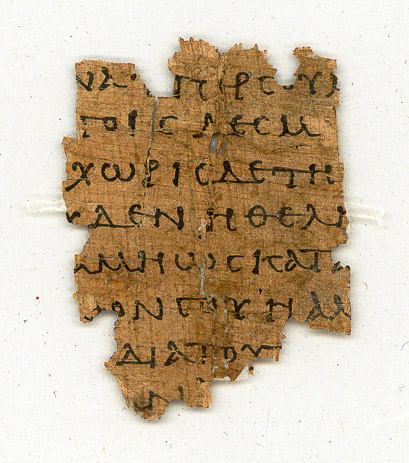
Continuing from Jesus is Jehovah in James with this my Jesus is

[Above: Papyrus 87 (Gregory-Aland), fragment of the Apostle Paul's Epistle to Philemon: Wikipedia]

Jehovah in Philemon, being part #10 of my series, "Jesus is Jehovah in the New Testament," which is based on my morning `quiet time' study. See the first in this series, Jesus is Jehovah in Matthew, for further details about this series.

Because Philemon is such a short letter, it does not have the full range of evidence that Jesus of the New Testament is Jehovah (Heb. Yahweh) of the Old Testament, come in the flesh. Nevertheless, it does contain some evidence that Jesus is Jehovah and also for completeness I am including it in this series. Quote extracts are linked to fuller quotes towards the end of this post.

2. JESUS HAS NAMES AND TITLES OF JEHOVAH
Lord. Jesus is "the Lord Jesus Christ" (Phm 1:3) and "our Lord Jesus Christ" (Phm 1:25). He is "the Lord Jesus" (Phm 1:5); "the Lord" (Phm 1:16,20). And again, "Lord" (Gk. kurios) is the word used nearly 7,000 times in the Greek Old Testament (The Septuagint or LXX) to translate Heb. YHWH (Yahweh):

"JESUS' IDENTITY WITH YAHWEH/JEHOVAH The NT attributes to Jesus many of the perfections of Yahweh (or, Jehovah), the creator/redeemer God of the OT. There are seven main points of identity. God's name When the OT was translated into Greek in the 2nd and 3rd centuries BC (the Septuagint), the sacred name of God, YHWH, usually rendered Yahweh or Jehovah, was translated by the Greek word Kyrios (Lord); there are approaching 7,000 instances of this. This sacred and exalted title was attributed directly to Jesus (Rom. 10:9; 1 Cor. 12:3; Phil. 2:11; etc., cf. also Lord of lords, 1 Tim. 6:15; Rev. 17:14; 19:16). Indeed the confession Jesus is Lord is probably the earliest confession of faith (Rom. 10:9; 1 Cor. 12:3; 2 Cor. 4:5). On several occasions NT writers apply OT passages concerning Yahweh directly to Jesus (Acts 2:34f.; Rom. 8:34; Heb. 10:12f.; 1 Pet. 3:22 apply Ps. 110:1. Rom. 10:13 applies Joel 2:32. Phil. 2:9-11 applies Is. 45:23. Jn. 12:41 applies Is. 6:10. Eph. 4:8 applies Ps. 68:18). These passages clearly identify Jesus with Yahweh. Another link is provided by self-designations of God appropriated by Jesus or referred to him. Supremely significant is the I AM (Ex. 3:14; cf. Jn. 8:58; 6:35; 8:12,24; 11:25; 14:6; 18:5f.; Mk. 14:62). Others are bridegroom (Is. 62:5; Je. 2:2; Ezk. 16:8; cf. Mk. 2:19f.; Jn. 3:29; 2 Cor. 11:2; Rev. 19:7); shepherd (Pss. 23:1; 80:1; Is. 40:11; Ezk. 34:15; cf. Jn. 10:11-16; Heb. 13:10; 1 Pet. 2:25; 5:4); the first and the last (Is. 44:6; 48:12; cf. Rev. 2:8; 22:13). (Milne, B., 1982, "Know the Truth: A Handbook of Christian Belief," Inter-Varsity Press: Leicester UK, Fifth printing, 1988, pp.129-130. Emphasis original).

So when Paul and the other New Testament writers called Jesus, "the Lord," or "the Lord Jesus Christ," they meant "Jehovah" or "Jehovah Jesus Christ":

"But there was a far stronger reason for the application of the Greek term `Lord' to Jesus ... The word `Lord' is used by the Septuagint to translate the `Jahwe' of the Hebrew test. .... And the fact is of capital importance. For it was among the readers of the Septuagint that Christianity first made its way. The Septuagint was the Bible of the Jewish synagogues, and in the synagogues the reading of it was heard not only by Jews but also by hosts of Gentiles, the `God-fearers' of the Book of Acts. It was with the `God-fearers' that the Gentile mission began. ... Thus when the Christian missionaries used the word `Lord' of Jesus, their hearers knew at once what they meant. They knew at once that Jesus occupied a place which is occupied only by God. For the word `Lord' is used countless times in the Greek scriptures as the holiest name of the covenant God of Israel, and these passages were applied freely to Jesus." (Machen, J.G., 1925, "The Origin of Paul's Religion," pp.307-308).

3. OLD TESTAMENT PASSAGES ABOUT JEHOVAH ARE APPLIED TO JESUS
There are no Old Testament passages quoted in Philemon.

4. JESUS HAS ATTRIBUTES OF JEHOVAH
There are no direct statements of Jesus' attributes in Philemon.

5. JESUS DOES WORKS OF JEHOVAH
Grace and peace. Jesus together with the Father is the giver of grace and peace:"Grace to you and peace from God our Father and the Lord Jesus Christ."(Phm 1:3; Rom 1:7; 1Cor 1:3; 2Cor 1:2; Eph 1:2; Php 1:2. See also 2Th 1:2; Eph 6:23; 1Th 1:1; 2Th 1:1):

"The phrase `God the Father and the Lord Jesus Christ,' present in Paul's salutations, thanksgivings, and other doxological passages, indicates a functional identity between the Father and the Lord. They are jointly the source of grace and peace" (Capes, D.B., 1992, "Old Testament Yahweh Texts in Paul's Christology," pp.62-64, 68).

"[Gal 1:3] This grace and peace come from God the Father and our Lord Jesus Christ ... the main theological point is the close association of Christ with God. Indeed, the use of the word Kyrios, 'Lord', as a title of Christ would in itself be sufficient to assure this. Much study has been devoted to this Greek word, the one chosen by the early translators into Greek of the Hebrew Bible to stand for the divine name YHWH.... Kyrios varied in meaning ... to the full sense of 'Lord', in confession of the deity of Christ. When the early Christians used the phrase, 'Jesus is Lord' [Rom 10:9; 1Cor 12:3] ...they cannot have meant less than this." (Cole, R.A., 1989, "The Letter of Paul to the Galatians:," p.70. Emphasis original).

6. JESUS RECEIVES HONOUR AND WORSHIP DUE TO JEHOVAH
Equal with the Father. That Jesus is mentioned in the same breath as the Father, "Grace to you and peace from God our Father and the Lord Jesus Christ." (Phm 1:3; Rom 1:7; 1Cor 1:3; 2Cor 1:2; Eph 1:2; Php 1:2; 2Th 1:2; Eph 6:23; 1Th 1:1; 2Th 1:1), is evidence of His equal status with the Father:

"[1Th 1:1] God the Father and the Lord Jesus Christ. The combination of both terms (a. God the Father, b. the Lord Jesus Christ) after one preposition (in; that is grounded in) would seem to indicate that the two are entirely co-ordinate, that is, that the reference is to the first and to the second person of the Holy Trinity. ... In referring to the second person the full name is used here: the Lord Jesus Christ. In the LXX the name Lord (kurios) translates Jehovah, the God of Israel. It is more often the rendering of Jehovah than of anything else. ... Now the Jews were strict monotheists. Yet Paul, though himself a Jew, again and again gives to Jesus the title Lord. This shows that, in the thinking of the apostle, Jesus is just as fully divine as is God the Father: one and the same essence is possessed by the Father and by the Son (also by the Spirit, II Cor. 13:14)." (Hendriksen, W., 1955, "1 & 2 Thessalonians," pp.40-41. Emphasis original).

"[1Th 1:1] ... in God the Father and the Lord Jesus Christ ... It is striking (a) that he speaks of the Father and the Lord in one breath (no-one else could be linked with the Father in this way), (b) that he joins the two under one preposition in, and (c) that he expresses the closeness of the tie linking the Thessalonians with their God in terms of Christ as well as the Father. 'The association could hardly be closer' ... This high view of Jesus is continued with the use of Lord and Christ. Lord was used in LXX as the translation of the divine name and it was commonly used of deity in other religions ... From very early times Jesus was seen to have the highest place." (Morris, L.L., 1984, "The Epistles of Paul to the Thessalonians," p.41).

"[1Th 1:1] In God the Father and the Lord Jesus Christ ... Paul ... dares also to apply kurios (Lord) to `Jesus Christ,' the word appropriated by Claudius (Dominus, Kurios) and other emperors in the emperor-worship, and also common in the Septuagint for God as in Psa. 32:1f. (quoted by Paul in Rom. 4:8). Paul uses Kurios of God (I Cor. 3:5) or of Jesus Christ as here. ... And here he places `the Lord Jesus Christ' in the same category and on the same plane with `God the father.'" (Robertson, A.T., 1931, "Word Pictures in the New Testament: Volume IV: The Epistles of Paul," p.6. Emphasis original).

"[2Th 1:2] From God the Father and the Lord Jesus Christ ... Note absence of article both after en and apo, though both God and Lord Jesus Christ are definite. In both cases Jesus Christ is put on a par with God, though not identical." (Robertson, 1931, p.41. Emphasis original).

7. OBJECTIONS TO JESUS BEING JEHOVAH
I am not aware of any verses in Philemon that are, or even could be, cited as objections to Jesus being Jehovah, especially when it is borne in mind:

"That the Lord Jesus Christ is revealed in the New Testament as being Jehovah (Heb. Yahweh) of the Old Testament come in the flesh, does not preclude the other two Persons of the Holy Trinity (Mt 28:19; 2Cor 13:14; 1Pet 1:2): the Father (Dt 32:6; Isa 63:16; 64:8; Mal 1:6) and the Holy Spirit (Lk 4:18 = Isa 61:1; Acts 5:3-4,9; 2Cor 3:17), also being, as revealed in the New Testament, Jehovah: the one Triune God." (Jones, S.E., "Jesus is Jehovah in the New Testament: Index," January 11, 2009).

8. CONCLUSION
Since there are in Philemon no known objections to Jesus being Jehovah, and there is evidence (see above) that Jesus is Jehovah, then Jesus is Jehovah in Philemon!

The quotes below are hyperlinked from references above. The previous (ninth) post in this series was "Jesus is Jehovah in James" and the next (eleventh) post is "Jesus is Jehovah in Colossians."

Stephen E. Jones.
My other blogs: CreationEvolutionDesign & The Shroud of Turin

"God, the Father, and the Lord. Jesus Christ Paul's letters generally followed the literary patterns of that day. ... Paul followed contemporary epistolary practice by including certain stereotyped forms in his introductory formulae, thanksgivings, and farewells. In these sections he often utilized the formula, `God the Father of our Lord Jesus Christ,' or a variation of it. ... Thus, his typical salutation read: `Grace to you and peace from God our Father and the Lord Jesus Christ' ... Paul designated both God the Father and the Lord Jesus as dispensers of grace and peace to the Church. ... God the Father and the Lord Jesus Christ bring these blessings into men's lives by faith. They are unified in function. Such a connection is possible only if God and the Lord reside at the same level in Paul's thought ... One final factor needs to be mentioned. The phrase `God the Father and the Lord Jesus Christ,' present in Paul's salutations, thanksgivings, and other doxological passages, indicates a functional identity between the Father and the Lord. They are jointly the source of grace and peace. Praise, thanksgiving, and blessing belong to them." (Capes, D.B., 1992, "Old Testament Yahweh Texts in Paul's Christology," J.C.B. Mohr: Tübingen, Germany, pp.62-64, 68).

"[Gal 1:3] This grace and peace come from God the Father and our Lord Jesus Christ. It is probable that by the common construction known as chiasmus (which could be translated as an 'x-shaped' construction), the source of grace is seen as Christ, and the source of peace as God the Father. Again, however, the main theological point is the close association of Christ with God. Indeed, the use of the word Kyrios, 'Lord', as a title of Christ would in itself be sufficient to assure this. Much study has been devoted to this Greek word, the one chosen by the early translators into Greek of the Hebrew Bible to stand for the divine name YHWH, which might not be pronounced by the pious Jew, and for which the Hebrew adonai, 'my Lord', had already been substituted. Kyrios varied in meaning from the polite 'sir', used in formal address to a stranger, to the full sense of 'Lord', in confession of the deity of Christ. When the early Christians used the phrase, 'Jesus is Lord' [Rom 10:9; 1Cor 12:3], as a baptismal confession, they cannot have meant less than this." (Cole, R.A., 1989, "The Letter of Paul to the Galatians: An Introduction and Commentary," The Tyndale New Testament commentaries, [1965], Inter-Varsity Press Leicester: UK, Second edition, p.70).

"[1Th 1:1] God the Father and the Lord Jesus Christ. The combination of both terms (a. God the Father, b. the Lord Jesus Christ) after one preposition (in; that is grounded in) would seem to indicate that the two are entirely co-ordinate, that is, that the reference is to the first and to the second person of the Holy Trinity. Note also the trinitarian character of verses 3-5. Hence, the third person (Holy Spirit), mentioned in verse 5, is implied already in verse 1. Paul often mentions the three together in series of closely connected passages (II Thess. 2:13, 14; I Cor. 12:4-6; II Cor. 13:14; Eph. 2:18; 3:2-5; 3:14-17; 4:4-6; 5:18-20). In referring to the second person the full name is used here: the Lord Jesus Christ. In the LXX the name Lord (kurios) translates Jehovah, the God of Israel. It is more often the rendering of Jehovah than of anything else. (At times it is the equivalent of Adon, Adonai, Baal, etc.) Now the Jews were strict monotheists. Yet Paul, though himself a Jew, again and again gives to Jesus the title Lord. This shows that, in the thinking of the apostle, Jesus is just as fully divine as is God the Father: one and the same essence is possessed by the Father and by the Son (also by the Spirit, II Cor. 13:14)." (Hendriksen, W., 1955, "1 & 2 Thessalonians," New Testament Commentary, Banner of Truth: Edinburgh UK, British edition, 1972, pp.40-41. Emphasis original).

"But there was a far stronger reason for the application of the Greek term `Lord' to Jesus than that which was found in its general currency among Greek-speaking peoples. The religious use of the term was not limited to the pagan cults, but appears also, and if anything even more firmly established, in the Greek Old Testament. The word `Lord' is used by the Septuagint to translate the `Jahwe' of the Hebrew test. It would be quite irrelevant to discuss the reasons which governed the translators in their choice of this particular word. No doubt some word for `Lord' was required by the associations which had already clustered around the Hebrew word. And various reasons may be suggested for the choice of `kyrios' rather than some other Greek word meaning `lord' [As, for example, despotes] Possibly the root meaning of `kyrios' better expressed the idea which was intended; perhaps, also, a religious meaning had already been attached to `kyrios,' which the other words did not possess. At any rate, whatever may have been the reason, `kyrios' was the word which was chosen. And the fact is of capital importance. For it was among the readers of the Septuagint that Christianity first made its way. The Septuagint was the Bible of the Jewish synagogues, and in the synagogues the reading of it was heard not only by Jews but also by hosts of Gentiles, the `God-fearers' of the Book of Acts. It was with the `God-fearers' that the Gentile mission began. And even where there were Gentile converts who had not passed at all through the school of the synagogue in the very earliest period perhaps such converts were few-even then the Septuagint was at once used in their instruction. Thus when the Christian missionaries used the word `Lord' of Jesus, their hearers knew at once what they meant. They knew at once that Jesus occupied a place which is occupied only by God. For the word `Lord' is used countless times in the Greek scriptures as the holiest name of the covenant God of Israel, and these passages were applied freely to Jesus." (Machen, J.G., 1925, "The Origin of Paul's Religion: The James Sprunt Lectures Delivered at Union Theological Seminary in Virginia," Eerdmans: Grand Rapids MI, Reprinted, 1965, pp.307-308).

"[1Th 1:1] Also peculiar to these Epistles is the phrase in God the Father and the Lord Jesus Christ (Paul usually says 'in Christ'). It is striking (a) that he speaks of the Father and the Lord in one breath (no-one else could be linked with the Father in this way), (b) that he joins the two under one preposition in, and (c) that he expresses the closeness of the tie linking the Thessalonians with their God in terms of Christ as well as the Father. 'The association could hardly be closer' (Ward). This high view of Jesus is continued with the use of Lord and Christ. Lord was used in LXX as the translation of the divine name and it was commonly used of deity in other religions (as well as having less significant uses). It points to a very high place. Christ means 'anointed' and is equivalent to 'Messiah'. And all this in a letter written only about twenty years after the crucifixion. From very early times Jesus was seen to have the highest place." (Morris, L.L., 1984, "The Epistles of Paul to the Thessalonians: An Introduction and Commentary," Tyndale New Testament Commentaries, [1956], Inter-Varsity Press: Leicester UK, Second Edition, p.41).

"[1Th 1:1] In God the Father and the Lord Jesus Christ (en theoi patri kai kurioi Jesou Christoi). This church is grounded in (en, with the locative case) and exists in the sphere and power of God the Father and the Lord Jesus Christ. No article in the Greek, for both theoi patri and kurioi Jesou Christoi are treated as proper names. In the very beginning of this first Epistle of Paul we meet his Christology. He at once uses the full title, `Lord Jesus Christ,' with all the theological content of each word. The name `Jesus' (Saviour, Matt. 1:21) he knew, as the `Jesus of history,' the personal name of the Man of Galilee, whom he had once persecuted (Acts 9:5), but whom he at once, after his conversion, proclaimed to be `the Messiah,' (ho Christos, Acts 9:22). This position Paul never changed. In the great sermon at Antioch in Pisidia which Luke has preserved (Acts 13:23) Paul proved that God fulfilled his promise to Israel by raising up `Jesus as Saviour' (sotera Iesoun). Now Paul follows the Christian custom by adding Christos (verbal from chrio, to anoint) as a proper name to Jesus (Jesus Christ) as later he will often say `Christ Jesus' (Col. 1:1). And he dares also to apply kurios (Lord) to `Jesus Christ,' the word appropriated by Claudius (Dominus, Kurios) and other emperors in the emperor-worship, and also common in the Septuagint for God as in Psa. 32:1f. (quoted by Paul in Rom. 4:8). Paul uses Kurios of God (I Cor. 3:5) or of Jesus Christ as here. In fact, he more frequently applies it to Christ when not quoting the Old Testament as in Rom. 4:8. And here he places `the Lord Jesus Christ' in the same category and on the same plane with `God the father.' There will be growth in Paul's Christology and he will never attain all the knowledge of Christ for which he longs (Phil. 3:10-12), but it is patent that here in his first Epistle there is no `reduced Christ' for Paul. He took Jesus as `Lord' when he surrendered to Jesus on the Damascus Road: `And I said, What shall I do, Lord? And the Lord said to me' (Acts 22:10). It is impossible to understand Paul without seeing clearly this first and final stand for the Lord Jesus Christ. Paul did not get this view of Jesus from current views of Mithra or of Isis or any other alien faith. The Risen Christ became at once for Paul the Lord of his life." (Robertson, A.T., 1931, "Word Pictures in the New Testament: Volume IV: The Epistles of Paul," Broadman Press: Nashville TN, p.6. Emphasis original).

"[2Th 1:2] From God the Father and the Lord Jesus Christ (apo theou patros kai Kuriou lesou Christou). ... Note absence of article both after en and apo, though both God and Lord Jesus Christ are definite. In both cases Jesus Christ is put on a par with God, though not identical. See on I Thess. 1:1 for discussion of words, but note difference between en, in the sphere of, by the power of, and apo, from, as the fountain head and source of grace and peace." (Robertson, 1931, p.41. Emphasis original).

Tuesday, April 27, 2010

Re: Who is this "Lord" mentioned in Psalm 110:1?

AN

Thanks for your message. As is my stated policy when I get a private message on a topic that is relevant to one of my blogs,

[Above: "... and is seated at the right hand of the Father": Godzdogz:

"The key Scriptural text is Psalm 110:1 - `The Lord says to my lord: "Sit at my right hand, till I make your enemies your footstool"' - which the Church sings in her liturgy every Sunday. Inspired by this, we find nascent expressions of belief in Christ seated at the Father's right in the New Testament letters attributed to St Paul (e.g. Ephesians 1:20; Colossians 3:1). This psalm verse is the most cited Old Testament text in the New Testament and it also has the distinction of being the only one commented upon by Jesus in the Synoptic gospels (Mt 22:41-46; Mk 12:35-37; Lk 20:41-44). Here, the point being made is that Jesus, the Messiah, is both greater than David and is Lord. As we have seen earlier in this series of posts, to call Jesus `Lord' indicates his divinity."

in this case my JesusisJehovah! blog, I respond publicly via that blog after removing the sender's (your) personal identifying details. Your words are bold to distinguish them from mine. Brief quotes are hyperlinked to fuller quotes towards the end of this post.

----- Original Message -----
From: AN
To: Stephen E. Jones
Sent: Wednesday, April 14, 2010 2:54 PM
Subject: jesusisyhwh.blogspot.com

>Greetings respectful sir,

You don't say what your position is, but I assume you are a Jehovah's Witness. Even if you are not, I have responded as though you are, because my posts on this my Jesus is Jehovah! blog are primarily intended for the benefit of Jehovah's Witnesses (existing, former or would-be).

>Can you please explain Psalms 110:1
>
>American Standard Version
Jehovah saith unto my Lord, Sit thou at my right hand, Until I make thine enemies thy footstol

>
>World English Bible
Yahweh says to my Lord, "Sit at my right hand, until I make your enemies your footstool for your feet."

>
>Darby Bible Translation
{Psalm of David.} Jehovah said unto my Lord, Sit at my right hand, until I put thine enemies as footstool of thy feet.

>
>Who is this "Lord" mentioned on the above texts?

As I presume you already know, the "Lord" (Heb. adoni) of Ps 110:1 (ASV):

Jehovah saith unto my Lord [Heb. adoni], Sit thou at my right hand, Until I make thine enemies thy footstool.

is identified by Jesus, and the New Testament writers, as "Christ," "Jesus" and "the Son":

Mt 22:41-46. While the Pharisees were gathered together, Jesus asked them, "What do you think about the Christ? Whose son is he?" "The son of David," they replied. He said to them, "How is it then that David, speaking by the Spirit, calls him 'Lord'? For he says, "'The Lord said to my Lord: "Sit at my right hand until I put your enemies under your feet." ' If then David calls him 'Lord,' how can he be his son?" No one could say a word in reply, and from that day on no one dared to ask him any more questions.

Mk 12:35-37. While Jesus was teaching in the temple courts, he asked, "How is it that the teachers of the law say that the Christ is the son of David? David himself, speaking by the Holy Spirit, declared: " 'The Lord said to my Lord: "Sit at my right hand until I put your enemies under your feet." ' David himself calls him 'Lord.' How then can he be his son?" The large crowd listened to him with delight.

Lk 20:41-44. Then Jesus said to them, "How is it that they say the Christ is the Son of David? David himself declares in the Book of Psalms: " 'The Lord said to my Lord: "Sit at my right hand until I make your enemies a footstool for your feet." ' David calls him 'Lord.' How then can he be his son?"

Acts 2:32-35. God has raised this Jesus to life, and we are all witnesses of the fact. Exalted to the right hand of God, he has received from the Father the promised Holy Spirit and has poured out what you now see and hear. For David did not ascend to heaven, and yet he said, " 'The Lord said to my Lord: "Sit at my right hand until I make your enemies a footstool for your feet." '

Heb 1:13.To which of the angels did God ever say, "Sit at my right hand until I make your enemies a footstool for your feet"?

Note that the last of these, Heb 1:13, even in the NWT, distinguishes Christ ("the Son" - v.8) from "the angels":

Heb 1:8,13 NWT. But with reference to the Son ... to which one of the angels has he ever said: "Sit at my right hand, until I place your enemies as a stool for your feet"?

Which proves that Jesus is not Michael the archangel, as the Watchtower Bible & Tract Society claims:

"Likewise, the Bible indicates that Michael is another name for Jesus Christ, before and after his life on earth." (WB&TS, 2005, "What Does the Bible Really Teach?," Watchtower Bible & Tract Society of New York: Brooklyn NY, p.218).

As do other verses in Hebrews 1 prove that Jesus is not Michael the archangel, "... the author of Hebrews not only separates Jesus from angels [Heb 1:5], he even commands the angels to worship him" [Heb. 1:6] (my emphasis):

"Perhaps the most peculiar Watchtower doctrine is the idea that Jesus is really Michael the archangel. ... The clearest contradiction of such an idea can be found in the book of Hebrews ... where the sacred author asks, `For to what angel did God ever say, "Thou art my Son"' (1:5, citing Ps. 2:7) and `When he brings the first-born into the world, he says, "Let all God's angels worship him"' (1:6, citing Deut. 32:43). ... Here the author of Hebrews not only separates Jesus from angels, he even commands the angels to worship him (Heb. 1:6; cf. Rev. 5:13-14, 14:7)." (Evert, J., 2001, "Answering Jehovah's Witnesses," pp.72-73).

The writer of Hebrews in Heb. 1:13 quotes Ps 110:1 to prove that Jesus is "greater than the angels" (my emphasis) which includes Michael the archangel:

"[Ps 110:1] ... Now follows God's oracle to David's lord. Sit at my right hand. The authority and power conferred by such an address will be illustrated in the remaining verses of the psalm; but it will take the New Testament to do it justice. a. He is not only greater than David (Acts 2:34., `for David did not ascend into the heavens') but greater than the angels (Heb. 1:13, `to what angel has he ever said, "Sit at my right hand..."?'" (Kidner, D., 1975, "Psalms 73-150," p.393. Emphasis original).

That is because, "In the religious and cultural milieu of Jesus' day, to claim to sit at God's right hand was tantamount to claiming equality with God" (my emphasis):

"Psalm 110:1, in which David says, The LORD [YHWH] says to my Lord ['adoni]: `Sit at my right hand, until I make your enemies your footstool.' (ESV) ... Jesus ... is pointing out that ... the Messiah ...would not be a mere Davidic king but would be a universal sovereign, sitting at God's right hand, honored as Lord even by his ancestor David. A careful examination of Psalm 110:1, and Jesus' application of it ... to himself, reveals how remarkable Jesus' claim was and why it seemed to the Sanhedrin to be blasphemous. It was one thing to enter God's presence and yet another to sit in it. But to sit at God's right side was another matter altogether. In the religious and cultural milieu of Jesus' day, to claim to sit at God's right hand was tantamount to claiming equality with God. ... For Jesus to claim that he would sit at God's right hand was akin to claiming ... that he would be entitled to have his head as high as that of the king. Jesus, then, was claiming the right to go directly into God's `throne room' and sit at his side. The temerity of such a claim for any mere human would be astonishing to the Jews of Jesus' day ... The Holy of Holies could be entered only on a specific day in specific ways by one specific person. ... If entrance requirements to the earthly Holy of Holies were so strict, we can imagine what the Sanhedrin priests would have thought about Jesus claiming to have the right to enter God's heavenly presence. After all, the earthly temple was ... a model of the heavenly one ... Jesus was claiming that he was going to enter permanently into the heavenly Holies of Holies and sit down." (Bowman, R.M. & Komoszewski, J.E., 2007, "Putting Jesus In His Place," pp.243-245. Emphasis original).

Moreover, one of the clearest example's of the New Testament's teaching that Jesus is Jehovah, is a few verses earlier in Heb 1:8,10-11:

But about the Son ... He also says, "In the beginning, O Lord, you laid the foundations of the earth, and the heavens are the work of your hands. They will perish, but you remain; they will all wear out like a garment. You will roll them up like a robe; like a garment they will be changed. But you remain the same, and your years will never end." .

where an Old Testament passage about Jehovah, Ps 102:24-27:

So I said: "Do not take me away, O my God, in the midst of my days; your years go on through all generations. In the beginning you laid the foundations of the earth, and the heavens are the work of your hands. They will perish, but you remain; they will all wear out like a garment. Like clothing you will change them and they will be discarded. But you remain the same, and your years will never end.

is applied to Jesus "the Son."

This is clear even in the Watchtower Society's own New World Translation, that Heb 1:8,10-11 NWT:

But with reference to the Son: ... "You at [the] beginning, O Lord, laid the foundations of the earth itself, and the heavens are [the] works of your hands. They themselves will perish, but you yourself are to remain continually; and just like an outer garment they will all grow old, and you will wrap them up just as a cloak, as an outer garment; and they will be changed, but you are the same, and your years will never run out."

is a quote of Ps 102:24-27 NWT:

I proceeded to say: "O my God, Do not take me off at the half of my days; Your years are throughout all generations. Long ago you laid the foundations of the earth itself, And the heavens are the work of your hands. They themselves will perish, but you yourself will keep standing; And just like a garment they will all of them wear out. Just like clothing you will replace them, and they will finish their turn. But you are the same, and your own years will not be completed.

in which the Psalmist is addressing "Jehovah":

Ps 102:1 NWT. A prayer of the afflicted in case he grows feeble and pours out his concern before Jehovah himself. O Jehovah, do hear my prayer; And to you may my own cry for help come.

That is, the "words in this psalm [Ps 102:25-27] are addressed to Yahweh (God), but are directly applied to Jesus Christ in Hebrews 1:10-12, thus indicating Christ's full deity" (my emphasis):

"Hebrews 1:10-12 is actually a quotation from Psalm 102:25-27. It is highly revealing that the words in this psalm are addressed to Yahweh (God), but are directly applied to Jesus Christ in Hebrews 1:10-12, thus indicating Christ's full deity. ... Psalm 102:25 says of Yahweh: `In the beginning you laid the foundations of the earth, and the heavens are the work of your hands.' ... the writer of Hebrews directly applies this verse to Jesus Christ (Heb. 1:10)." (Rhodes, R., 1992, "Christ Before the Manger," pp.44,63).

So "What could be said of Yahweh, could be said of Christ" (my emphasis):

"The writer of Hebrews, likewise, used the words of Psalm 102:25-27, which celebrated Yahweh as Creator, equally of Christ (Heb. 1:10-12). .... What could be said of Yahweh, could be said of Christ. If the gospel was God's, then it was also Christ's. If the Kingdom was God's, then it was also Christ's. To have faith is, indiscriminately, to have faith either in God or in Christ, and God and Christ were alike to be praised, thanked, and worshiped." (Wells, D.F., 1992, "The Person of Christ," p.76).

Indeed, "This single passage in Hebrews suffices to prove that Jesus is God-Jehovah-since an Old Testament reference to God is now applied to him" (my emphasis):

"God the Creator (Hebrews 1:10) Psalm 102:24-25 [NWT] reads, `O my God... Your years are throughout all generations. Long ago you laid the foundations of the earth itself. And the heavens are the work of your hands.' Ask any Witness, `Who are these verses talking about?' Witnesses unanimously assert that they are speaking of Jehovah. And they are right. Verses 1, 12, 15, 16, 18, 19, 21, and 22 all make it clear - by using the divine name - that the God in question is indeed Jehovah. However, the author of Hebrews takes the Psalmist's words and applies them to Jesus: `But with reference to the Son... `You at [the] beginning O Lord, laid the foundations of the earth itself, and the heavens are [the] works of your hands' (1:8, 10). This single passage in Hebrews suffices to prove that Jesus is God- Jehovah-since an Old Testament reference to God is now applied to him." (Evert, 2001, p.79. Emphasis original).

For "If the Son was not Jehovah, then it was illegitimate for the writer of Hebrews to quote these words about Jehovah and apply them to Jesus" and "what these verses say about Jesus can only be true of Jehovah" (my emphasis):

"In any case, the next quotation from the Psalms leaves no room for doubt. Continuing to speak about the Son, the writer of Hebrews quotes these words (Heb. 1:10-12 NWT):
You [at] the beginning, O Lord, laid the foundations of the earth itself, and the heavens are [the] works of your hands. They themselves will perish, but you yourself are to remain continually; and just like an outer garment they will all grow old, and you will wrap them up just as a cloak, as an outer garment; and they will be changed, but you are the same, and your years will never run out.
In the context of Psalm 102:25-27 from which this is quoted, these words are spoken of Jehovah. If the Son was not Jehovah, then it was illegitimate for the writer of Hebrews to quote these words about Jehovah and apply them to Jesus to try to prove that he was greater than the angels. Moreover, what these verses say about Jesus can only be true of Jehovah-namely, that he created the heavens and the earth (cf. Isa. 44:24) and is unchanging and eternal by nature." (Bowman, R.M., 1989, "Why You Should Believe in the Trinity: An Answer to Jehovah's Witnesses," Baker: Grand Rapids MI, Third printing, 1990, pp.107-108. Emphasis original).

Again (see my "I sincerely believe that Jesus is not Jehovah, but that he is Jehovah God's Son #2", "Main reasons why Jehovah's Witnessism is false" and "Re: `So, Who sent Jesus? if he is Jehovah, did he send himself to earth?', etc" on Isa 45:23 about Jehovah quoted of Jesus in Php 2:9-11) if the Watchtower was consistent in translating Gk. kyrios in the New Testament as "Jehovah" where it is a quote from the Old Testament that refers to Jehovah (Heb. Yahweh) or God:

"How is a modern translator to know or determine when to render the Greek words κυριοσ [kyrios] and Θεοσ [theos] into the divine name in his version? By determining where the inspired Christian writers have quoted from the Hebrew Scriptures. Then he must refer back to the original to locate whether the divine name appears there. This way he can determine the identity to give to Ky'ri-os and the-os' and he can then clothe them with personality. Realizing that this is the time and place for it, we have followed this course in rendering our version of the Christian Greek Scriptures." (WB&TS, 1969, "The Kingdom Interlinear Translation of the Greek Scriptures," Watchtower Bible & Tract Society: Brooklyn NY, p.18).

then it would translate Heb 1:8,10 NWT as (my emphasis):

But with reference to the SON: ... And: "You at [the] beginning, O JEHOVAH, laid the foundations of the earth itself, and the heavens are [the] works of your hands

>If you had already explained that on your posts please send me the link so I can check it, thanks

I had already explained that in my posts, " Re: Jesus is not Jehovah ... such a thing is unthinkable" (2008) and " Re: Is Jesus Jehovah? Please answer the following #3" (2009). But as it was in conjunction with other issues, I have here expanded on my explanation of Ps 110:1.

The Watchtower claims that, because "Jesus explained that he himself was David's `Lord,' referred to in this psalm. So Jesus is not Jehovah but is the one to whom Jehovah's words were here directed" :

"Is Jehovah in the `Old Testament' Jesus Christ in the `New Testament'? ... Ps. 110:1: `The utterance of Jehovah to my [David's] Lord is: `Sit at my right hand until I place your enemies as a stool for your feet.' (At Matthew 22:41-45, Jesus explained that he himself was David's `Lord,' referred to in this psalm. So Jesus is not Jehovah but is the one to whom Jehovah's words were here directed.)" (WB&TS, 1989, "Reasoning from the Scriptures," pp.197-198).

But this is fallacious. Who was David's "Lord" (Heb. 'adon) but Jehovah?:

Ps 16:1-2. Michtam of David ... O my soul, thou hast said unto Jehovah, Thou art my Lord ...

Ps 35:1,22-23. A Psalm of David. Strive thou, O Jehovah, with them that strive with me ... my God and my Lord.

Ps 38:1,15,22. A Psalm of David ... O Jehovah, rebuke me not in thy wrath ... For in thee, O Jehovah, do I hope: Thou wilt answer, O Lord my God. ... Make haste to help me, O Lord, my salvation.

Ps 51:1,15. ... A Psalm of David ... Have mercy upon me, O God ... O Lord ... my mouth shall show forth thy praise.

Ps 55:1,9 ... Maschil of David. Give ear to my prayer, O God ... Destroy, O Lord, and divide their tongue ...

Ps 59:1,11. ... A Psalm of David. ... Deliver me from mine enemies, O my God ... bring them down, O Lord our shield.

Ps 62:1,12 .... A Psalm of David. My soul waiteth in silence for God only ... unto thee, O Lord, belongeth lovingkindness ...

Ps 69:1,6,8 .... A Psalm of David. Save me, O God ... Let not them that wait for thee be put to shame through me, O Lord Jehovah of hosts ... There is none like unto thee among the gods, O Lord ...

Ps 86:1,3,4,8-9,12,15. A Prayer of David. Bow down thine ear, O Jehovah, and answer me ... Be merciful unto me, O Lord ... For unto thee, O Lord, do I lift up my soul ... There is none like unto thee among the gods, O Lord ... All nations whom thou hast made shall come and worship before thee, O Lord ... I will praise thee, O Lord my God ... But thou, O Lord, art a God merciful and gracious ...

That is why Psalm 110:1 was such an unsolvable puzzle to the Jews with their un-Biblical unitarian view of God. They could not understand how Jehovah could be talking to Jehovah. And that is why it is still a puzzle to Jehovah's Witnesses, who also have an un-Biblical unitarian view of God.

The New Testament clearly teaches that Jesus is Jehovah come in the flesh (see above on Ps 102:25-27 about Jehovah quoted of Jesus in Heb 1:8,10-12) and also see my post "Jesus is Jehovah! and my series "Jesus is Jehovah in the New Testament."

Therefore the right approach is not the Watchtower's method of playing Bible verses off against each other (`wresting the Scripture to their own destruction' - 2Pet 3:16), but the Christian approach of trying to see how both can be true: 1. Jesus is Jehovah; and 2. Jehovah was speaking to David's Lord who is Jesus.

The problem is solved within a Christian Biblical trinitarian view of God, where "YHWH is a compound unity ... the Father ... the Son ... and ... the Holy Spirit ..." as Messianic Jews also acknowledge:

"YHWH [the LORD] is our Elohim. He is echad [One]. He alone is YHWH. Deuteronomy 6:4. .... The nature of YHWH is a compound unity expressed in the aspects of Abba [God, the Father], Yeshua [Salvation, Jesus, the Son, Messiah] and the Ruach HaKodesh [the Holy Spirit/Breath] in this age. Matthew 28:19." ("Torah Observant Followers of Yeshua - Statement of Beliefs," December 28, 2006).

That is, Father, the Son and the Holy Spirit, are "Jehovah: the one Triune God":

"That the Lord Jesus Christ is revealed in the New Testament as being Jehovah (Heb. Yahweh) of the Old Testament come in the flesh, does not preclude the other two Persons of the Holy Trinity (Mt 28:19; 2Cor 13:14; 1Pet 1:2): the Father (Dt 32:6; Isa 63:16; 64:8; Mal 1:6) and the Holy Spirit (Lk 4:18 = Isa 61:1; Acts 5:3-4,9; 2Cor 3:17), also being, as revealed in the New Testament, Jehovah: the one Triune God." (Jones, S.E., "Jesus is Jehovah in the New Testament: Index," January 11, 2009).

So to answer your first question, "Can you please explain Psalms 110:1?" Yes, it is Jehovah God the Father speaking to Jehovah God the Son:

"Psalm 110:1... Jehovah's Witnesses ... argue ... that the Lord Jesus must be a mere created being, since Jehovah God is addressing a person distinct from himself. ... Knowledgeable Christians who read this verse will grasp that God the Father is speaking to the Son. " (Reed, D.A., 1986, "Jehovah's Witnesses Answered Verse by Verse," pp.35-36. My emphasis).

"... Psalm 110 shows God, the Father in heaven, talking to the Son (also God) upon the earth." (Reed, 1986, pp.36-37. My emphasis).

"Psalm 110:1-Jehovah and `My Lord'. ... This verse makes perfect sense within the scope of trinitarian theology. .... Scripture not only teaches that the Messiah would be the Son of David in terms of His humanity, it also teaches that He is God ... Here we have the first person of the Trinity speaking to the second person of the Trinity." (Rhodes, 1993, pp.161-162. My emphasis).

"Psalm 110:1 records a conversation between the Father and the Son ... [who is] God" (Geisler, N.L., 1999, "Baker Encyclopedia of Christian Apologetics," p.130).

>Regards,
>
>AN

My regards to you too. If you are a Jehovah's Witness, I hope you can now see that the Watchtower Society is wrong in its claim that Jesus is Michael the archangel, and that Jesus actually is Jehovah, come in the flesh!

Stephen E. Jones.
My other blogs: CreationEvolutionDesign & The Shroud of Turin


"Sitting in the Big Chair (Psalm 110:1) ... Psalm 110:1, in which David says, The LORD [YHWH] says to my Lord ['adoni]: `Sit at my right hand, until I make your enemies your footstool.' (ESV) The Hebrew makes it clear that by `the LORD' and `my Lord' two different persons are in view. Jesus identified the second person ('my Lord') as the Messiah when he applied the text to himself. Earlier in Mark, Jesus points out something peculiar about this statement. The Jews typically expected the Messiah simply to be a descendant of David who would prove to be the ultimate human warrior-king. Yet David calls the future Messiah his `Lord:' How, Jesus asks, could the Messiah be David's son and also be his Lord (Mark 12:35-37)? Some modern readers of the Bible have suggested that Jesus was here denying that the Messiah would be a descendant of David, but this really misses the point. Jesus is not denying that the Messiah would be a descendant of David but is pointing out that somehow the Messiah would be much more than that. The Messiah would not be a mere Davidic king but would be a universal sovereign, sitting at God's right hand, honored as Lord even by his ancestor David. A careful examination of Psalm 110:1, and Jesus' application of it (in conjunction with Daniel 7:13) to himself, reveals how remarkable Jesus' claim was and why it seemed to the Sanhedrin to be blasphemous. It was one thing to enter God's presence and yet another to sit in it. But to sit at God's right side was another matter altogether. In the religious and cultural milieu of Jesus' day, to claim to sit at God's right hand was tantamount to claiming equality with God. ... For Jesus to claim that he would sit at God's right hand was akin to claiming, in an `Oriental' cultural context, that he would be entitled to have his head as high as that of the king. Jesus, then, was claiming the right to go directly into God's `throne room' and sit at his side. The temerity of such a claim for any mere human would be astonishing to the Jews of Jesus' day. The priests of the Sanhedrin, to whom Jesus made this claim, could not, as a rule, even go into the inner sanctum of the temple, known as the Holy of Holies. Many of them probably had never been inside it. The Holy of Holies could be entered only on a specific day in specific ways by one specific person. Failure to follow the instructions exactly resulted in death. On the Day of Atonement, the high priest entered the Holy of Holies, carrying. the blood of a bull as offering for personal purification and the blood of a ram as offering for atonement for the people. This was followed by a change of garments and ritual washings (Lev. 16). In other words, one entered into God's presence in the temple cautiously. If entrance requirements to the earthly Holy of Holies were so strict, we can imagine what the Sanhedrin priests would have thought about Jesus claiming to have the right to enter God's heavenly presence. After all, the earthly temple was, according to Josephus, viewed as a model of the heavenly one [Josephus Antiquities 3.181-87]. Worse still, though, Jesus was claiming that he was going to enter permanently into the heavenly Holies of Holies and sit down. Jesus might as well have claimed that he owned the place! Indeed, that is what his statement amounted to. As Darrell Bock has put it, Jesus' claim `would be worse, in the leadership's view, than claiming the right to be able to walk into the Holy of Holies in the temple and live there!' [Bock, D.L., "Jesus According to Scripture: Restoring the Portrait from the Gospels," Baker: Grand Rapids, 2002, p.375]" (Bowman, R.M., Jr. & Komoszewski, J.E., 2007, "Putting Jesus In His Place: The Case for the Deity of Christ," Kregel: Grand Rapids MI, pp.243-245).

"Perhaps the most peculiar Watchtower doctrine is the idea that Jesus is really Michael the archangel. This teaching is not typically mentioned when introducing the faith to a new recruit, as can be seen in the official overview of beliefs published by the Watchtower. If Witnesses have difficulty explaining any particular doctrine, it is this one. ... The clearest contradiction of such an idea can be found in the book of Hebrews (RSV:CE), where the sacred author asks, `For to what angel did God ever say, "Thou art my Son"' (1:5, citing Ps. 2:7) and `When he brings the first-born into the world, he says, "Let all God's angels worship him"' (1:6, citing Deut. 32:43). `Of the angels he says, "Who makes his angels winds, and his servants flames of fire." But of the Son he says, "Thy throne, O God, is for ever and ever ..." and, "Thou, Lord, didst found the earth in the beginning, and the heavens are the work of thy hands"' (1:7-8, citing Ps. 104:4, 45:6, and 102:25). Here the author of Hebrews not only separates Jesus from angels, he even commands the angels to worship him (Heb. 1:6; cf. Rev. 5:13-14, 14:7). The first issue of Zion's Watch Tower magazine agreed: `"Let all the angels of God worship him" [that must include Michael] and "Thy throne, O God, is forever and ever."' [Zion's Watch Tower, July 1879, p.9. Brackets and italics original]" (Evert, J., 2001, "Answering Jehovah's Witnesses," Catholic Answers: El Cajon CA, pp.72-73).

"Jesus Claimed to Be Messiah-God. ... But the Old Testament teaches that the coming Messiah would be God himself. So when Jesus claimed to be that Messiah, he was also claiming to be God. For example, the prophet Isaiah (in 9:6) calls the Messiah, `Mighty God.' The psalmist wrote of Messiah, `Your throne, O God, will last for ever and ever' (Ps. 45:6; cf. Heb. 1:8). Psalm 110:1 records a conversation between the Father and the Son: `The LORD (Yahweh) says to my Lord (Adonai): 'Sit at my right hand.' Jesus applied this passage to himself in Matthew 22:43-44. In the great messianic prophecy of Daniel 7, the Son of Man is called the `Ancient of Days' (vs. 22), a phrase used twice in the same passage of God the Father (vss. 9, 13). Jesus also said he was the Messiah at his trial before the high priest. When asked, `Are you the Christ [Greek for `Messiah'], the Son of the Blessed One?' Jesus responded, `I am.... And you will see the Son of Man sitting at the right hand of the Mighty One and coming on the clouds of heaven.' At this, the high priest tore his robe and said, `Why do we need any more witnesses? ...You have heard the blasphemy!' (Mark 14:61-64). There was no doubt that in claiming to be Messiah, Jesus also claimed to be God (see also Matt. 26:54; Luke 24:27)." (Geisler, N.L., 1999, "Baker Encyclopedia of Christian Apologetics," Baker Books: Grand Rapids MI, pp.129-130).

"[Ps 110:1] The first line, after the title, runs literally, `The oracle of Yahweh to my lord'. It is an opening which stamps the next words as God's direct message to His King, on which verses 2 and 3 provide the inspired comment. ... The startling fact that David spoke of a king as my lord (cf. Knox, freely, `the Master I serve') was pointed out, as we have seen, by Christ, who left His hearers to think out its implications, and His apostles to spell them out. ... David here (so to speak) falls down and worships the Man who stands before him (cf. Jos. 5:14). Now follows God's oracle to David's lord. Sit at my right hand. The authority and power conferred by such an address will be illustrated in the remaining verses of the psalm; but it will take the New Testament to do it justice. a. He is not only greater than David (Acts 2:34., `for David did not ascend into the heavens') but greater than the angels (Heb. 1:13, `to what angel has he ever said, "Sit at my right hand..." ?'); b. God exalted Him as emphatically as man rejected Him (Acts 5:30f., `Jesus whom you killed ... God exalted ... at his right hand') c. It is as Saviour and Intercessor that He reigns (Acts 5:31 ; Rom. 8:34., `Christ ... who is at the right hand of God ... intercedes for us') d. ('Sit...') : In token of a finished task, He is seated (Heb. 10:11f., `every priest stands daily ..., offering repeatedly .... But ... Christ ... sat down at the right hand of God') e. (`till ...'): He awaits the last surrender (Heb. 10:13, `to wait until his enemies should be made a stool for his feet'; cf. also 1 Cor. 15:25f.). So this single verse displays the divine Person of Christ, His power and the prospect before Him. Together with verse 4 it underlies most of the New Testament teaching on His glory as Priest-King." (Kidner, D., 1975, "Psalms 73-150: An Introduction and Commentary on Books III - IV of the Psalms," Tyndale Press: London, Reprinted, 2004, p.393. Emphasis and ellipses original).

"Psalm 110:1 The LORD said unto my Lord, Sit thou at my right hand, until I make thine enemies thy footstool. (KJV) Jehovah's Witnesses ... open their New World Translation and read the same verse: `The utterance of Jehovah to my Lord is... .' They go on to argue (1) that the New World Translation is a superior Bible to use, because it does not have the Lord talking to himself; and (2) that the Lord Jesus must be a mere created being, since Jehovah God is addressing a person distinct from himself. To answer the first argument, it is only necessary to look at the text more closely. It does not say that `the Lord' was talking to `the Lord.' Most translations render the Hebrew tetragrammaton YHWH as `the LORD' (all capital letters), who is talking to the psalmist's `Lord' (both capital and small letters), the Messiah. .... Knowledgeable Christians who read this verse will grasp that God the Father is speaking to the Son . The second Witness argument-that Jesus cannot be God because `the LORD' spoke to him-is also a faulty one. The New Testament records many conversations between Jesus and the Father, but this does not disprove the deity of Christ. The Bible reveals that the Father is God (John 6:27, etc.) and that the Son is God (Isa. 9:6, John 20:28, etc.), yet there is only one God (1 Cor. 8:4)." (Reed, D.A., 1986, "Jehovah's Witnesses Answered Verse by Verse," Baker: Grand Rapids MI, Thirty-first printing, 2006, pp.35-36).

"In explaining to Witnesses the fact that Psalm 110 shows God, the Father in heaven, talking to the Son (also God) upon the earth, it may help to invite them to turn to Genesis 18 and 19 in their own New World Translation. There it says that `Jehovah appeared to him' [Abraham] as `three men' or angels (18:1-2). Abraham addressed the three as `Jehovah' (18:3). Two of them left Abraham and went toward the city of Sodom, but Abraham continued to address the remaining individual as `Jehovah'(18:22, 19:1). When the other two reached Sodom and spoke with Abraham's relative Lot, he addressed the two of them as `Jehovah' (19:18). And, when the city of Sodom was destroyed, the New World Translation says at Genesis 19:24: `Then Jehovah made it rain sulphur and fire from Jehovah, from the heavens ... .' So, unless the Witnesses want to claim that there is more than one Jehovah, they will have to admit that God can be in more than one place at the same time, and that he can hold simultaneous conversations with different people in different places. This should make it easier for them to grasp that the Father can talk to the Son, without calling into question the deity of Christ ." (Reed, 1986, pp.36-37).

"Hebrews 1:10-12 is actually a quotation from Psalm 102:25-27. It is highly revealing that the words in this psalm are addressed to Yahweh (God), but are directly applied to Jesus Christ in Hebrews 1:10-12, thus indicating Christ's full deity. ... Psalm 102:25 says of Yahweh: `In the beginning you laid the foundations of the earth, and the heavens are the work of your hands.' ... the writer of Hebrews directly applies this verse to Jesus Christ (Heb. 1:10). Here we can do no better than to quote Robert Reymond, who in his book Jesus, Divine Messiah: The Old Testament Witness, comments: `We have to acknowledge that, apart from the use to which it is put in Hebrews 1, we probably would not have been quickly drawn to this psalm and to this particular passage in order to find a direct allusion to the divine Messiah. But the writer of Hebrews having done so, we not only can see immediately his rationale for doing so, but are also instructed by his method regarding the correct way to read and to interpret the Old Testament. What he ascribes to Christ by applying these verses in Psalm 102 to Jesus accords perfectly with what Paul (Col. 1:16-17) and John (John 1:3,10-11) teach elsewhere; and here he simply affirms what he himself had earlier affirmed in Hebrews 1:2: "... through whom [the Son] He made the universe." The Christian is thus reminded that the Old Testament Creator is the Son of God who acted as the Father's agent in creation.... We can only guess how many other such references there are to the divine Messiah in the Old Testament corpus.' [Reymond, R.L., Jesus, Divine Messiah: The Old Testament Witness Christian Focus Publications: Fearn, UK, 1990, p.16]" (Rhodes, R., 1992, "Christ Before the Manger: The Life and Times of the Preincarnate Christ," Baker: Grand Rapids MI, pp.44,63).

Psalm 110:1-Jehovah and `My Lord'. ... Psalm 110:1 in the New World Translation reads, `The utterance of Jehovah to my Lord is: `Sit at my right hand until I place your enemies as a stool for your feet' (emphasis added). The Jehovah's Witnesses say that since Jehovah is speaking in this verse, and since the `Lord' is a distinct person from Jehovah, then Jesus must not be God Almighty. Reasoning from the Scriptures explains that in Matthew 22:41-45 Jesus claims that He Himself is the `Lord' referred to by David in this psalm. They therefore conclude that Jesus is not Jehovah, but is the one to whom Jehovah's words were spoken. ["Reasoning from the Scriptures," 1989, p.198] ... This verse makes perfect sense within the scope of trinitarian theology. In the broader context of Matthew 22:41-46, we find Christ `putting the Pharisees into a corner' by asking them a question relating to the person of the Messiah. He asked, `Whose son is he?' (Matthew 22:42). They responded, `The Son of David.' Their answer was correct since the Old Testament thoroughly established the Davidic lineage of the Messiah (2 Samuel 7:14). But their answer was also incomplete. Scripture not only teaches that the Messiah would be the Son of David in terms of His humanity, it also teaches that He is God-and it is the latter fact that Christ wanted the Pharisees to acknowledge. Christ, of course, anticipated the Pharisees' half-answer. That's why in the next verse He quoted a Davidic psalm: `The LORD says to my Lord: `Sit at my right hand until I put your enemies under your feet' (Matthew 22:43; cf. Psalm 110:1). Now, the words `my Lord' are a reference to David's Messiah. This divine Messiah is invited to sit at the right hand of `the LORD' (God the Father). Here we have the first person of the Trinity speaking to the second person of the Trinity . [Reymond, R.L., "Jesus. Divine Messiah," Presbyterian & Reformed: Phillipsburg NJ, 1990, p.105]" (Rhodes, R., 1993, "Reasoning from the Scriptures with the Jehovah's Witnesses," Harvest House: Eugene OR, Reprinted, 2006, pp.161-162. Emphasis original).

"Is Jehovah in the `Old Testament' Jesus Christ in the `New Testament'? Matt. 4:10: `Jesus said to him: `Go away, Satan! For it is written, `It is Jehovah ['the Lord,' KJ and others] your God you must worship, and it is to him alone you must render sacred service.' (Jesus was obviously not saying that he himself was to be worshiped.) John 8:54: `Jesus answered [the Jews]: `If I glorify myself, my glory is nothing. It is my Father that glorifies me, he who you say is your God.' (The Hebrew Scriptures clearly identify Jehovah as the God that the Jews professed to worship. Jesus said, not that he himself was Jehovah, but that Jehovah was his Father. Jesus here made it very clear that he and his Father were distinct individuals.) Ps. 110:1: `The utterance of Jehovah to my [David's] Lord is: `Sit at my right hand until I place your enemies as a stool for your feet.' (At Matthew 22:41-45, Jesus explained that he himself was David's `Lord,' referred to in this psalm. So Jesus is not Jehovah but is the one to whom Jehovah's words were here directed.)" (WB&TS, "Reasoning from the Scriptures," [1985], Watchtower Bible & Tract Society of New York: Brooklyn NY, Second edition, 1989, pp.197-198. Emphasis original).

"That a linguistic bridge was built early between Christ as kurios and Yahweh seems beyond dispute, and this bridge led naturally to a doctrinal identity between them. What could be said of Yahweh in the Old Testament could equally be said in many instances of Christ in the New Testament, and it was. Thus the words, 'before me every knee will bow, by me every tongue will swear' (Isa. 45:23), spoken of Yahweh, were seen to apply to Christ (Phil. 2:10, 11). The writer of Hebrews, likewise, used the words of Psalm 102:25-27, which celebrated Yahweh as Creator, equally of Christ (Heb. 1:10-12). These usages are, as we have already seen, but a small part of an extraordinary development which was characteristic of virtually the whole of the epistolatory section of the New Testament. What could be said of Yahweh, could be said of Christ. If the gospel was God's, then it was also Christ's. If the Kingdom was God's, then it was also Christ's. To have faith is, indiscriminately, to have faith either in God or in Christ, and God and Christ were alike to be praised, thanked, and worshiped. That being the case, the use of kurios became indistinguishable from the use of Theos in its content." (Wells, D.F., 1992, "The Person of Christ: A Biblical and Historical Analysis of the Incarnation," Bible Scholar Books: Alliance OH, p.76).